
Photo: Michael Appleton/Mayoral Photography Office
On his first day as mayor, Zohran Mamdani spent the afternoon at 85 Clarkson Avenue, a run-down rent-stabilized building in Prospect–Lefferts Gardens. He was there to announce a trio of executive orders, including one to revive the Mayor’s Office to Protect Tenants, and the venue was a targeted choice: 85 Clarkson is owned by billionaire Joel Wiener, a fairly notorious landlord whose real-estate firm Pinnacle Group filed for bankruptcy last year and has 93 buildings currently set to be sold in a foreclosure auction. The sale of Pinnacle’s portfolio — more than 5,000 apartments, the vast majority of them rent stabilized — has become something of an early test for the new mayor’s ambitions around tenant protections and landlord accountability. A lot has happened in the two weeks since he took office: The mayor tried and failed to intervene in the sale; a potential buyer, another fairly notorious landlord called Summit Properties USA, won the auction on January 9, and, in a last-minute effort, the attorney general’s office threw its weight behind the attempt to block the sale, which a judge will rule on on Thursday.
Let’s get into it.
Joel Wiener comes from a real-estate family and was a relatively small-scale landlord through the ’90s, with a business model Bloomberg described as “buying rent-regulated, run-down properties that house many tenants behind on their rent.” (The occasion for the Bloomberg piece was Wiener’s ascendance, in 2017, to billionaire status.) All of that accelerated in the early 2000s, as Pinnacle’s portfolio grew thanks to investment from a firm called Praedium Group. At its peak in 2006, Pinnacle owned 21,642 apartments across the city, and its model was working: Renovations and evictions led to rent increases and sometimes took apartments out of stabilization entirely. (In one case, tenants of a two-bathroom apartment challenged a rent increase after being charged for what appeared to be five toilets, per a report from the New York Times.) Gentrification and a boom in real-estate speculation led to soaring values. (One Brooklyn Heights building Pinnacle bought in 2002 for $16.5 million was, by 2012, valued at $43 million.) Then came the 2019 rent laws, which took many tactics used by Pinnacle and other real-estate firms to raise rents and deregulate apartments off the table — the law imposed limits on rent increases based on major capital improvements, no more so-called high-rent vacancy decontrol, no more automatic 20 percent vacancy increases.
In the years since, Pinnacle’s buildings remained profitable, but the margins were modest compared to the debt it had accrued. In addition to its debts to its primary lender, Flagstar Bank, Pinnacle also has outstanding amounts on Israeli-issued bonds, putting its total debts somewhere closer to $1 billion, according to Bloomberg. Thus the bankruptcy. The auction of Pinnacle’s portfolio was part of an agreement with Flagstar (formerly the New York Community Bank), which holds $564 million in debt on its buildings.
Summit Properties won the auction for Pinnacle’s buildings with a bid of $451 million. Summit Properties USA is the American arm of an Israel-based real-estate-investment company that is managed by Zohar Levy. It’s relatively new on the New York City residential scene. (It didn’t get into the New York market until 2021.) Now, it owns more than 90 buildings with around 3,000 apartments. Purchasing Pinnacle’s buildings would essentially double its portfolio. Part of the controversy around its bid for Pinnacle is the fact that it also has a bad record when it comes to its buildings: Summit has over 4,000 open housing-code violations.
In court filings, the attorney general’s office wrote that Summit’s open housing violations leaves it with “significant concerns” about the firm’s capacity to maintain its current portfolio. This is more or less aligned with Mamdani’s critique and that of the Union of Pinnacle Tenants, which has said it sees the sale as simply moving them from the hands of one bad landlord to another. (Jordan Barowitz, a spokesperson for Summit, wrote in a statement that “Summit is ready to work with the City, HPD, and the residents to improve and preserve this much needed affordable housing. We have a plan to address the buildings’ capital needs and cure the existing HPD violations.”) Ken Fisher, a lawyer for Pinnacle, said that “the court-approved sales process was very thorough, and we are confident in the outcome.”
As BisNow and Gothamist reported, Summit has ties to Jonathan Wiener, Joel Wiener’s brother. Gothamist found that at least 53 Summit buildings have deeds or mortgage agreements signed by Jonathan Wiener, and another 26 are signed by executives at Chestnut Holdings, Wiener’s company. The rest were signed by representatives from Denali Management, which manages Summit and Chestnut buildings. (Barowitz says there is no relationship “business or otherwise” between Summit and Pinnacle and court documents submitted by the CEO of Summit on Thursday stated, “Neither Jonathan Wiener nor Denali was involved in the Purchaser’s bid for the Purchased Assets, and neither will have any involvement in the Purchaser’s acquisition or management of the Purchased Assets.)
Big question! The lawyer Pinnacle tapped to oversee its bankruptcy process blamed the 2019 rent laws and 2022 insurance hikes for the firm’s hardships. But Flagstar alleges in court documents that Pinnacle did not use its rental income to pay its mortgages, instead paying its Israeli bondholders $12 million. This is just one of Flagstar’s claims about Pinnacle — the bank also claims Pinnacle prioritized paying management fees to other Wiener-owned entities over its mortgage debts, per The Real Deal.
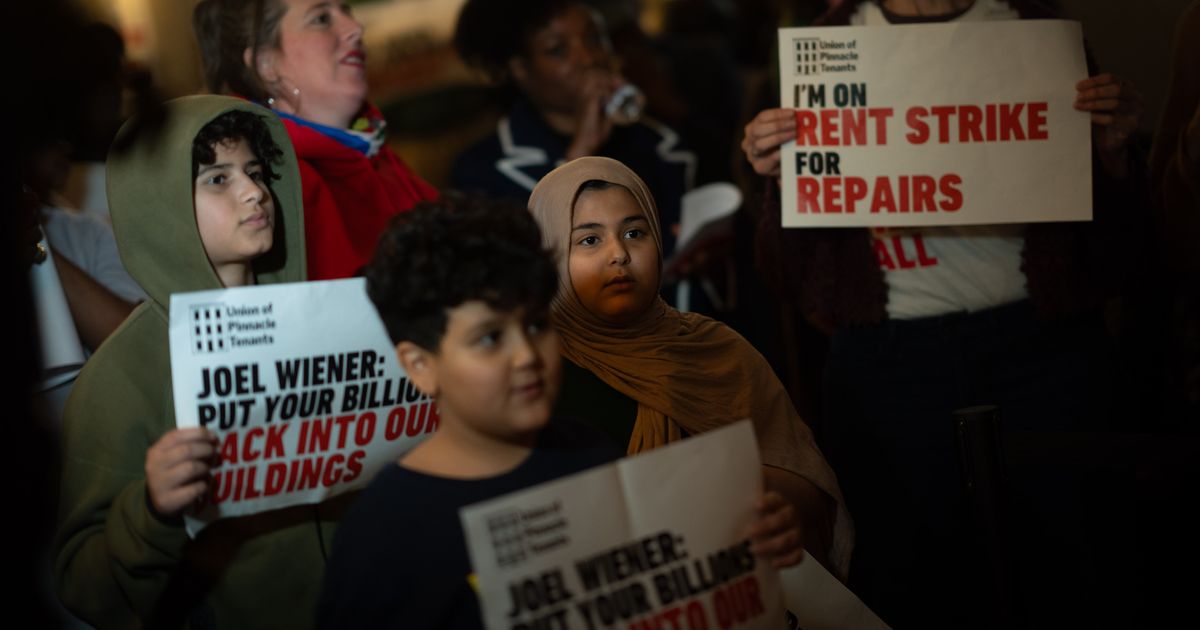
As you can imagine, tenants are unhappy. They say Pinnacle let their homes fall into disrepair and that Summit will just be more of the same. They want a say in who gets to buy their buildings. “The 93 buildings subject to Pinnacle’s bankruptcy are tenants’ homes and tenants have been organizing to get a say in a process that is effectively built to exclude them,” Tracy Rosenthal, an organizer with the Union of Pinnacle Tenants, said. Jackie Waddy, who has lived at Pinnacle-owned 546 West 50th Street for almost 50 years, says that the building’s roof leaks and they have issues with mold: “The whole place needs to be renovated.” But if the judge does approve the sale to Summit at a Thursday hearing, Waddy says the tenants will “put pressure on them to make them responsible” for the repairs.
The city submitted its objection to the sale in early January, requesting a 30-day extension to “evaluate sufficiently the proposed sale to Summit, to explore any potential alternatives, and to discuss with the interested parties a path forward that will benefit all constituencies.” The filing argued that the city should have a say given that it’s a “substantial creditor,” since Pinnacle owes $12.7 million in fines and violations.
The judge denied the delay and the auction proceeded as planned. “We are assessing all of our options as the case moves forward — both in the bankruptcy proceedings and through other city tools — but our goals have not changed,” Leila Bozorg, Mamdani’s deputy mayor for housing, said in a statement afterward. If the sale does go through, the administration can still use its enforcement powers to make sure any new owner corrects open violations and adheres to rent-stabilization laws.
On January 12, the attorney general’s office sent in an objection to the courts, writing that “Summit’s track record in its current portfolio indicates that it has no capacity to adequately oversee a management company and a sale will result in these properties falling into disrepair.” The AG’s office argues that the city should be given the opportunity to come up with a more suitable buyer and if not, then the courts should “require Summit to provide a much more detailed explanation about how it intends to reverse its history of purchasing buildings that accrue high levels of violations.”
For a few reasons: Pinnacle is one of the largest rent-stabilized landlords in the city. Pinnacle tenants, who have formed one of the city’s largest cross-borough tenant unions, have also been trying to make the fate of their buildings a front-page story. The mayor, for his part, signaled the issue’s importance to him by making it a day-one priority. Whatever direction it goes, the outcome of this fight might be a bellwether for similar foreclosures. Other cases are certainly coming down the line — as Jay Martin, executive vice-president of the New York Apartment Association, a group representing rent-stabilized landlords, put it in October, “There are thousands of loans that were underwritten under the premise that certain units in the buildings would be deregulated at certain rent thresholds, and therefore they’d be able to pay back these loans under those terms, and now they’re no longer able to do that.”
How this all works out is a significant test for Mamdani: A rent freeze can go only so far, since the wider rent-stabilized system in the city is under stress — the buildings are old, and investment has been uneven, with some properties in serious, sometimes quite intentional disrepair. Mamdani’s administration needs an answer to the question of how to keep rents affordable while also maintaining and — in many cases — vastly improving the conditions inside the buildings themselves. Landlords claim this is like trying to get blood from a stone, but we actually know very little about most of their portfolios and overall finances. (And that’s on purpose.) Mamdani’s head of the Mayor’s Office to Protect Tenants, Cea Weaver, has written that “the crux of the problem” was the frenzy of private investment that led to a “fever-dream of real estate speculation that fueled the rent-stabilized market from 1994 to 2019.” If Summit ultimately takes over the Pinnacle portfolio, how will the Mamdani administration enforce its thousands of open housing violations? If a judge somehow stops the sale, what would an alternative buyer or ownership model even look like?
“It’s not going to be that the city politically decides, Hey, we should socialize housing,” Sam Stein of the Community Service Society said. “It’s going to be that the landlord can’t do it anymore and instead of giving a different landlord a chance to do an even worse job, the city is going to have to push it in a different direction.” That could look like a lot of things — the city could funnel the buildings through Neighborhood Restore, a nonprofit HDFC, or the NYCHA preservation trust, or even through some form of tenant ownership, strategies that have been utilized at a smaller scale. But it’s all pretty unclear at this point.
There is a confirmation hearing on Thursday, during which the judge will approve or deny the sale to Summit. The mayor’s office, Pinnacle tenants, and landlords across the city will certainly be watching.
Sign Up for the Curbed Newsletter
A daily mix of stories about cities, city life, and our always evolving neighborhoods and skylines.
Vox Media, LLC Terms and Privacy Notice
Related