
New York is my escape. I come here each January to see in the new year. Over time it has become a ritual. I vanish here. I escape myself as much as anything else. This is New York’s gift: loneliness.
It is an indulgence, I know. I am fortunate that I am able to afford to disappear. The world keeps turning, but for a while I like to imagine I can step off. We all need to sometimes, wherever we may find that.
This year it feels harder. The world tracks me down. Last year has accelerated into this one. I’m not optimistic for what it holds.
I am in an America that some time ago stopped being a functional democracy. It is easy to blame it on Donald Trump, yet the Democrats have also been captured by big money and sectional interests and long ago abandoned poor Americans.
Trump is more shameless about it. He believes power makes its own rules.
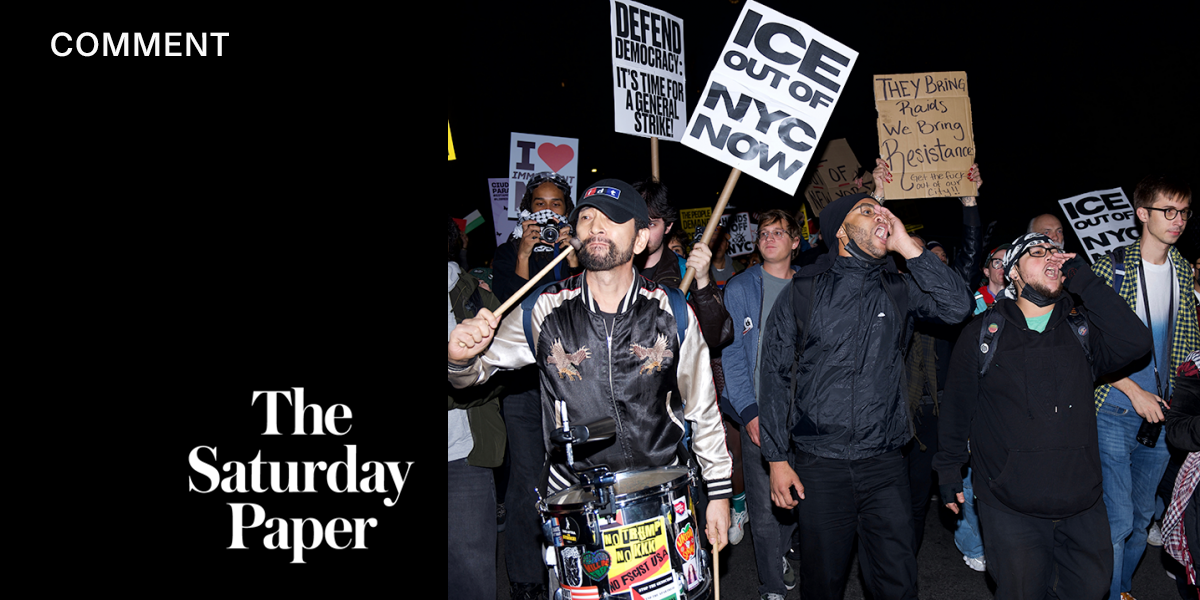
So what if he invades Venezuela and captures the president? So what if Immigration and Customs Enforcement officials shoot dead a woman? So what if he takes Greenland?
That’s how Trump sees it and who will stop him? Media pundits like to quote international law, but there is no international law that will restrain him. Who will enforce it?
America has always had a respect for lawlessness and gangsters. Its battle has been between the vicious and better angels of its nature.
America helms a world where there is no rules-based order. It is a power-based order. That’s what it has always been. Trump is showing Vladimir Putin and Xi Jinping what they already know: you keep what you can defend.
I have watched from afar as Anthony Albanese bowed to pressure and announced a royal commission into anti-Semitism.
Within days, Adelaide Writers’ Week was cancelled after many writers withdrew from the event following the Palestinian–Australian writer Randa Abdel-Fattah having her invitation to speak rescinded by the festival’s board.
In Iran people are dying on the streets protesting against the theocratic regime. Some are praising Trump and calling for him to intervene.
Lost in the New York crowd, I take joy in the small things. We are small people; we live small lives. We cannot determine what big power will do and we cannot defend ourselves against madmen intent on mayhem.
War continues in Ukraine. Gazans still die each day. Sudan has passed a thousand days of war: more than 150,000 people are dead and another 13 million have been displaced. The United Nations calls it the world’s biggest humanitarian crisis.
I have not heard one word about it on American television news. There has been little coverage in Australia.
Depending on the source and the definition, there are dozens of wars or major conflicts in our world today.
As for my own poor, suffering people, Indigenous Australians start the year looking at very bad numbers. According to the Australian Institute of Health and Welfare, First Nations people suffer disease at twice the rate of non-Indigenous Australians. They die younger – eight years younger on average; 12 years in remote areas. Two thirds of cases of fatal disease are avoidable. Per 1000 people, 400 years of life are lost due to the disease burden on Indigenous Australians as opposed to 177 years for the rest of the population.
Between the ages of 30 and 64, Indigenous death rates are seven times higher than for non-Indigenous people in the same age bracket.
The same study tells us that suicide is the second-leading cause of death for Aboriginal boys and men. It is the leading cause of death for all Indigenous people under the age of 24. One in five kill themselves, four times the rate of non-Indigenous Australians.
Nearly 60 per cent of First Nations deaths are from potentially avoidable causes. That’s three times higher than for the rest of the Australian population.
If we dare mention racism we are as likely howled down by those who tell us to get over it. All of this in the “lucky country”.
We have had our apologies. We have had our royal commission. Still there is the hard grind.
We are a powerless people in a world that bows to power alone.
There are many things I could say about the state of our world, but I am out of words. I start 2026 and words seem superfluous and self-serving.
I have made my living in words. I have been a journalist for 40 years. I have reported from at least 70 countries. I have covered major wars and natural disasters. I have interviewed despots and presidents. Sometimes they are one and the same.
I have a PhD in theology. I have written a feature documentary film and this year I will publish my ninth book. Add that to countless news articles and columns and essays and I have published millions of words.
I wonder if my words have amounted to anything. In a world where everyone speaks all the damn time and with such shrill certainty, I would rather start the year saying nothing.
Right now, I just feel like a squeaky hinge on history’s gate.
So, what does a columnist do if they have nothing left to say?
I have pondered that. Maybe it is time to say nothing at all. Or maybe there is a better way of saying it.
I would hope there are kinder words. I would hope that our words are more considered. I would hope that we might be more generous.
There is a word that means something, a word from a language that was nearly extinct. The word is yindyamarra. It is a Wiradjuri word and it means to listen before speaking. It means to show respect. It is a word of this soil. It is a word that has saved us.
Yindyamarra winhanganha teaches us that we must consider the wisdom of respectfully knowing how to live well in a world worth living in.
So, in honour of a language that my people have fought to save, let me tell you about the loneliness of New York.
For two weeks, strangers have smiled at me. I have been wished a good morning. I have been served in shops with gratitude and enthusiasm.
I had a wonderful conversation with a young woman working in a bookstore who loves what she does. We talked for five minutes about old books, about the beauty of words, about the joy of holding in our hands something of timeworn beauty.
Lost in the New York crowd, I take joy in the small things. We are small people; we live small lives. We cannot determine what big power will do and we cannot defend ourselves against madmen intent on mayhem.
Yes, there is unbearable suffering on these New York streets. There are people whom the world has cast aside. I can’t deny that, but nor can I deny the modern world is a remarkable achievement. We are thrown together with all of our difference and we are overwhelmingly peaceful, safe and respectful.
New York streets have rarely been safer. Data shows murder rates have declined by a third since 2021. Shootings have more than halved in the same period. Subway crime is trending down.
Australia is safer. Homicide and violent crime have been falling for decades. Of course, after Bondi, to speak of safety sounds facile. Yet it is true.
Terrorism is thankfully rare in countries such as ours. The 2025 Global Terrorism Index shows that most attacks are conducted by lone-wolf actors, not organised groups.
Nearly 90 per cent of terrorism-related deaths occur in 10 countries. All but 2 per cent of those deaths occur in nations already in conflict.
That does not mean we should not be vigilant, but we should guard against fear and hate.
I am not a Pollyanna. I have seen more of the worst of the world than most people could imagine.
Rising power rivalry could so quickly tip us into another world war. Tyrants hold vast swathes of the world’s population in terror. Democracy is collapsing. We are more censorious. In the West, there is greater alienation, wealth disparity and mental illness.
In Australia, the anti-Semitic massacre at Bondi has reminded us that the worst of the world can descend on us.
The 21st century has enormous challenges and globally there are few leaders equipped with the imagination, intellect or courage to meet those perils.
As always, though, it is the small people who make the world what it is – you and me.
We are not as hateful, divided and violent as the media would tell us. We should not fear our neighbours, as populist politicians would have us believe. The great many of us navigate our world with a smile and good manners.
Here I am in one of my favourite places in the world, sharing space with people of all races, cultures and religions, and I want to savour that.
I will start 2026 with a prayer for those in grief, afraid or struggling to be free, and I will give a prayer of gratitude that hate must not be the measure of our world.
This article was first published in the print edition of The Saturday Paper on
January 17, 2026 as “A squeaky hinge in NYC”.
For almost a decade, The Saturday Paper has published Australia’s leading writers and thinkers.
We have pursued stories that are ignored elsewhere, covering them with sensitivity and depth.
We have done this on refugee policy, on government integrity, on robo-debt, on aged care,
on climate change, on the pandemic.
All our journalism is fiercely independent. It relies on the support of readers.
By subscribing to The Saturday Paper, you are ensuring that we can continue to produce essential,
issue-defining coverage, to dig out stories that take time, to doggedly hold to account
politicians and the political class.
There are very few titles that have the freedom and the space to produce journalism like this.
In a country with a concentration of media ownership unlike anything else in the world,
it is vitally important. Your subscription helps make it possible.
Send this article to a friend for free.
Share this subscriber exclusive article with a friend or family member using share credits.

Used 1 of … credits
use share credits to share this article with friend or family.
You’ve shared all of your credits for this month. They will refresh on February 1. If you would like to share more, you can buy a gift subscription for a friend.
SHARE WITH A FRIEND
? CREDITS REMAIN
SHARE WITH A SUBSCRIBER
UNLIMITED
Loading…