
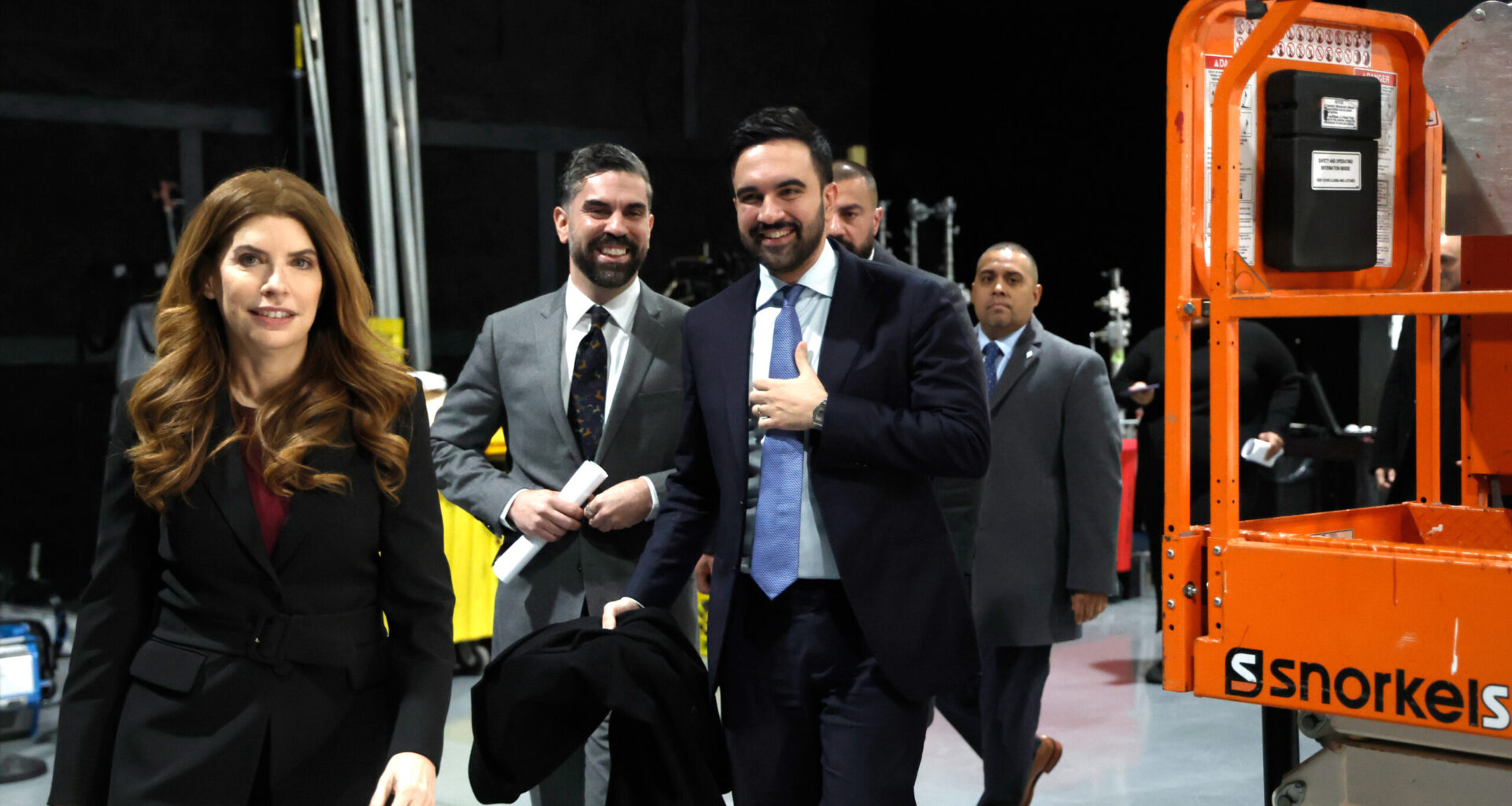
Julie Menin, the recently elected speaker of the New York City Council, announced a comprehensive plan to confront rising antisemitism on Friday, unveiling several initiatives that notably include an emerging legislative proposal to establish buffer zones around houses of worship to keep protesters from harassing congregants.
The measure, which echoes legislation introduced last month by state legislators, comes in response to a recent series of anti-Israel demonstrations outside synagogues in New York City, including a protest in Queens last week where participants voiced support for Hamas — raising fears in the Jewish community amid a broader rise in antisemitic activity across the five boroughs.
But it could place Menin, the Council’s first Jewish speaker and a vocal defender of Israel, at odds with Mayor Zohran Mamdani, underscoring a tension in their new relationship on areas in which anti-Israel activism crosses a line into antisemitic behavior. In his statement addressing the Queens protesters, for example, Mamdani, a fierce critic of Israel who has long identified as an outspoken anti-Zionist, chose not to accuse them of antisemitism as several of his top allies on the far left had done, even as he made sure to call Hamas a terrorist group and denounce the slogans chanted by demonstrators as “wrong.”
While Menin has yet to confirm the exact distance of the barrier she hopes to impose around houses of worship, she has floated a possible perimeter of 100 feet, far surpassing a 25-foot zone proposed by Gov. Kathy Hochul in her State of the State address this week. Mamdani, who was in attendance during the governor’s speech in Albany, did not applaud when she mentioned buffer, stirring speculation over his support for implementing such restrictions.
Some critics have raised concerns that the efforts could run afoul of free speech protections, though one state legislator who introduced a bill to create buffer zones last month told Jewish Insider that the legislation had balanced those considerations with a need to safeguard congregants from intimidation in seeking to freely practice their religion.
“We’re not trying to stifle peaceful protests,” Menin said on Friday during a press conference held at the Museum of Jewish Heritage in Manhattan. “What we are trying to do is protect congregants for any house of worship, of freely being able to enter and exit without fear of intimidation or harassment.”
Jack Lobel, a spokesperson for Menin, told JI that the legislation “establishing a safe perimeter around schools and houses of worship is being drafted, and we will have more to share in the future.”
Mamdani, meanwhile, has voiced interest in exploring the establishment of buffer zones that some Jewish leaders have urged him to consider. The mayor signed an executive order on his first day in office to instruct the police commissioner and the Law Department to assess “proposals for regulation of protest activity” outside houses of worship, citing a possible buffer “of at least 15 feet and up to 60 feet from the entrance.”
In a statement shared with JI, Dora Pekec, a spokesperson for Mamdani, said the mayor “is committed to fighting antisemitism, and ensuring that New Yorkers continue to be able to worship freely as well as exercise their First Amendment rights.”
“On the first day of his administration, the mayor directed the NYPD and Law Department to review the legality of a range of proposals, including those like Speaker Menin’s buffer zones proposal, and he will wait for the outcome of that review,” she added.
Jewish leaders who spoke with JI provided mixed predictions about how Mamdani would respond to the legislation, which came in addition to a range of proposals Menin announced on Friday — including $1.25 million in funding for the Museum of Jewish Heritage and a new hotline to help report incidents of antisemitism that would be overseen by the New York City Commission on Human Rights.
With the exception of Menin’s safety zones bill, one Jewish leader argued that there was “not much for” the mayor “to push back on,” calling the other new proposals “mostly monetary.”
The establishment of legally proscribed perimeters around houses of worship is “the only” issue where there is ongoing uncertainty, the Jewish leader told JI on condition of anonymity to address a sensitive topic. “But we don’t have her proposal yet,” he said of Menin’s effort, which marked the first legislative push of her new tenure.
Still, Josh Mehlman, the chairman of the Flatbush Jewish Community Coalition, an Orthodox group in Brooklyn, said he was optimistic that the legislation would pass, noting his conversations with Menin as well as other supportive Council members indicated Mamdani would ultimately be amenable to the final version of the bill.
“It’s not something they feel that the mayor would not be happy with,” he told JI.