
According to Spotrac, the New York Jets have 24 impending free agents entering the 2026 offseason.
How should the Jets handle each of them?
S Andre Cisco (UFA)
Cisco had an abysmal 2025 season that saw him allow a 152.6 passer rating on throws into his coverage. Moving on is the easy call.
Verdict: Dump
QB Tyrod Taylor (UFA)
In 2025, Taylor was not quite the reliable backup that he used to be; his 72.9 passer rating was the second-lowest of his career among the eight seasons in which he started at least one game. Now 36 years old, Taylor probably isn’t the Jets’ best option for the veteran backup/stopgap role.
Verdict: Dump
G John Simpson (UFA)
Simpson is a high-character presence in the locker room with plenty of NFL starting experience. He has also accumulated extensive chemistry with the Jets’ starting offensive line throughout the past two seasons.
However, Simpson’s production declined in 2025. He projects as a low-end starter/high-end backup moving forward.
Simpson is worth retaining for the right price to compete for a starting spot, but the Jets should be cautious not to overpay for him. There is room to improve at the guard position.
Verdict: Keep as a backup/placeholder starter
LB Quincy Williams (UFA)
The Jets signaled their long-term intentions for Quincy Williams when they extended Jamien Sherwood and chose not to do the same for Williams. A major production decline in 2025 sealed the deal for the former All-Pro.
Verdict: Dump
G Alijah Vera-Tucker (UFA)
Vera-Tucker’s ceiling is undeniable, but he has suffered season-ending injuries before the end of October in three of his five NFL seasons.
Still, Vera-Tucker is talented enough to be worth bringing back on a cheap, low-guarantees deal if the Jets can make it happen. The Jets should not commit to Vera-Tucker as a starter, though.
Verdict: Keep as a backup
S Tony Adams (UFA)
Adams did not seize his chance to prove himself as a long-term starter for the Jets, but he is worth keeping around as a backup and special teamer if he can be had on the cheap.
Verdict: Keep as a backup
WR Josh Reynolds (UFA)
Reynolds is 30 years old and has struggled with durability over the last two seasons, while making a minimal impact when healthy. Perhaps he is worth having around for his veteran experience, familiarity with Tanner Engstrand’s scheme, and his blocking, but any type of guaranteed money would be too much.
Verdict: Keep on non-guaranteed camp tryout
S Isaiah Oliver (UFA)
Oliver was a massive liability for the Jets’ defense in 2025, frequently showing up as a culprit for missed tackles and busted coverages. Moving on would signal their intention to leave the horrors of 2025 in the past.
Verdict: Dump
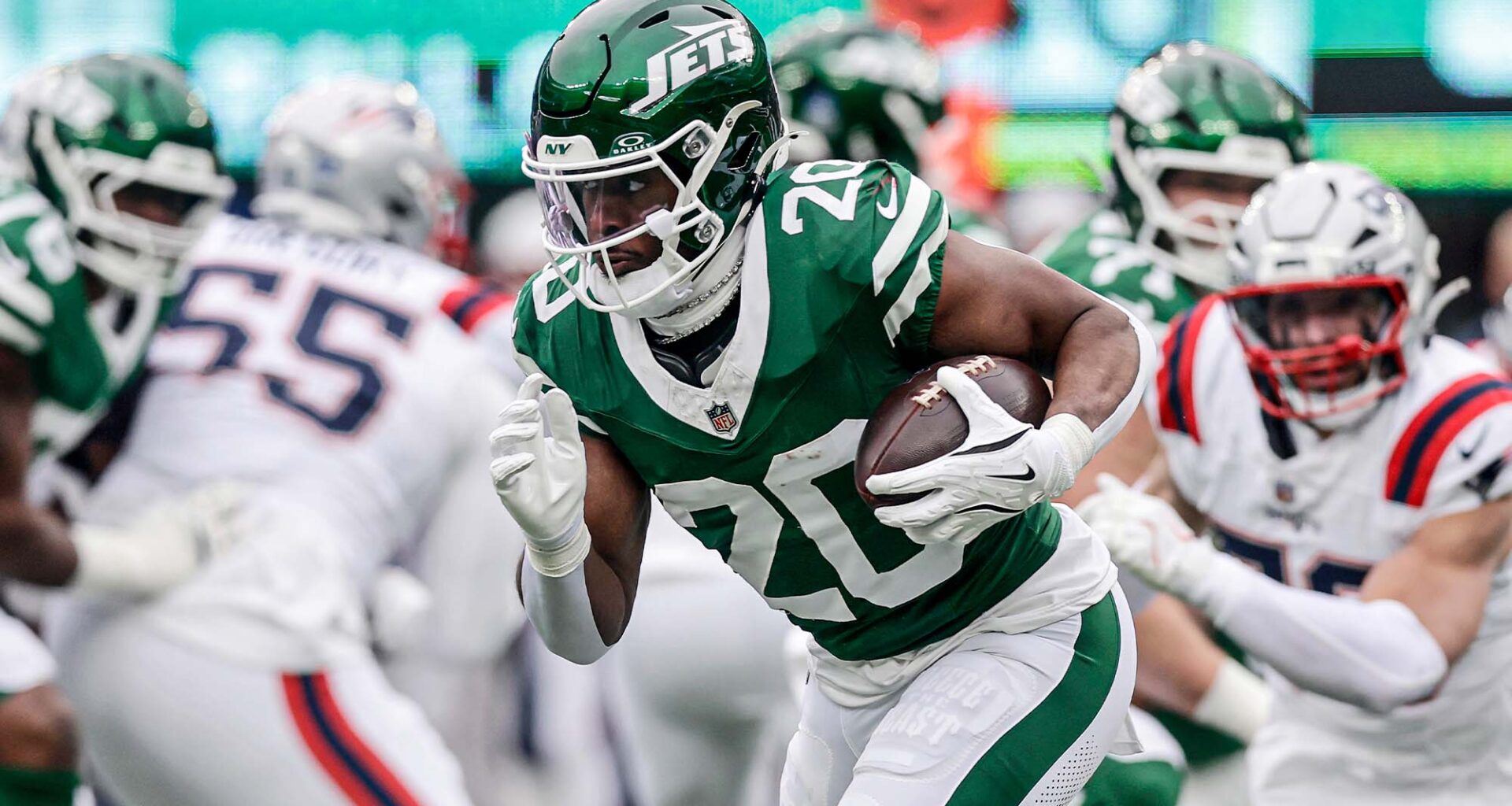
RB Breece Hall (UFA)
The Jets’ Breece Hall situation demands its own examination that cannot be summarized in a couple of short paragraphs. It will be one of the team’s most difficult decisions of the offseason.
In 2025, Hall proved himself as a rock-solid starting running back, rebounding from a 2024 season in which he looked replaceable. However, he has not been a game-wrecking star since his rookie year.
That leaves the Jets in an awkward spot. Do they view Hall as special enough to justify a lucrative long-term extension at a non-premium position? Or would they rather take the chance that a low-cost replacement would offer better value on the dollar?
Then, you have the variable of whether Hall even wants to return to the Jets. He’s sent mixed signals over the years.
With plenty of cap space, the Jets’ best move with Hall is probably to apply the franchise tag and take it from there. The franchise tag for running backs is projected to be worth $14.2 million in 2026; it’s a hefty number, but for just one year, the Jets can handle it.
Tagging Hall gives the Jets flexibility with his future. If he doesn’t want to play for the Jets, they can trade him. If he is willing to return, the Jets can get another year to evaluate him before committing long-term.
Verdict: Franchise tag
WR John Metchie (RFA)
As a restricted free agent, the cheapest tender the Jets can use to retain Metchie is the right of first refusal tender, projected to be worth $3.5 million.
While RFA tenders are non-guaranteed, that number is too hefty for Metchie based on his drop-prone stint with the Jets in 2025. New York can decide not to apply a tender, allowing him to become an unrestricted free agent, and then try to retain him at a lower cost on the open market.
Verdict: Allow to become UFA, try to retain for cheaper
CB Kris Boyd (UFA)
Boyd, a longtime special teams ace for the Vikings, Cardinals, and Texans, was going to be a core member of the Jets’ special teams until he suffered a season-ending shoulder injury in the summer.
The Jets clearly prioritize their special teams unit, and they will have their work cut out for them as they try to replicate their dominant special teams production from the 2025 season. So, it would make sense to bring Boyd back to at least compete for a role, assuming he is ready to play, as he suffered a shooting wound in November.
Verdict: Keep as camp competition
RB/KR Kene Nwangwu (UFA)
No-brainer here. Kene Nwangwu was one of the Jets’ best players in 2025, consistently dominating on kick returns to the point where teams became scared to kick to him. He is arguably the most proven kick returner in the NFL, leading active players with five career kick return touchdowns.
Verdict: Keep
TE Stone Smartt (UFA)
Smartt was a sneaky good piece of the Jets’ special teams unit in 2025. Although he only had three tackles, his main contribution came on the kick return unit, which is where he played 56% of his special teams snaps. Smartt threw some key blocks to help spring big returns for Kene Nwangwu and Isaiah Williams.
If the Jets want their special teams to be equally dominant in 2026, they should keep the supporting characters who comprised the unit’s backbone.
Verdict: Keep as camp competition
TE Jelani Woods (UFA)
Woods could not get onto the field for the Jets until Week 16 after being claimed off waivers in August. However, he is a former third-round pick who started his career on a high note until injuries knocked him off track.
The Jets’ tight end unit lacks receiving threats beyond Mason Taylor, so Woods is worth keeping around as a camp flier.
Verdict: Keep as camp competition
OT Chukwuma Okorafor
Luckily, the Jets never had to use Okorafor on offense throughout the entire 2025 season. He was healthy and appeared on special teams, but was never required to fill in for the offensive line.
Even if only for the experience that he gained in Engstrand’s scheme, Okorafor is worth keeping around to compete for a backup role.
Verdict: Keep as camp competition
FB Andrew Beck
Who had Andrew Beck tying for second on the Jets in receiving touchdowns?
Beck was a solid player in his role for the Jets. In 17 games, he played 112 offensive snaps, doing a nice job as a run blocker while catching six of his nine targets for 45 yards and four first downs (including two touchdowns).
He was also a core part of the Jets’ special teams unit, arguably being its MVP outside of the returners and specialists. Beck made eight tackles and threw plenty of crucial blocks for the return team. His 315 special teams snaps led the team, while his 84.1 special teams grade from PFF was first among the Jets’ top 16 players in special teams snaps.
This is the “dominate in his role” type of player that makes up the outer skeleton of championship-caliber teams. Keeping Beck in Florham Park is an easy choice.
Verdict: Keep
DT Jay Tufele
There isn’t anything to build off of with Tufele, who has struggled in all five of his NFL seasons. The Jets can use this roster spot on a player with more potential.
Verdict: Dump
OT Max Mitchell
Like Okorafor, we barely saw Mitchell play his natural position in 2025 due to the health of the Jets’ starting tackles; Mitchell played only seven snaps at tackle. However, the Jets occasionally deployed him as a sixth lineman, giving him 66 snaps in that role, and he was decently successful as a run blocker.
Mitchell has struggled at tackle throughout his career. However, because of his value as an extra blocker, he is worth keeping around to compete.
Verdict: Keep as camp competition
EDGE Micheal Clemons
Clemons did little in 2025 to justify the coaching staff’s faith in him; he had one sack on 578 defensive snaps, was routinely out-leveraged on the edge, and had the second-highest missed tackle rate (26.9%) on a Jets defense loaded with bad tacklers.
Already set to turn 29 years old before the coming season, there isn’t enough potential left with Clemons for him to be worth a roster spot.
Verdict: Dump
G Xavier Newman-Johnson
Newman offers guard-center versatility and has shown promise in the preseason, although he has yet to play much in the regular season. He is worth keeping around.
Verdict: Keep as camp competition
LB Marcelino McCrary-Ball
McCrary-Ball is best known for the flag he drew during a bizarre celebration. His play leaves a lot to be desired.
Verdict: Dump
LB Cam Jones (RFA)
Jones is an accomplished special teams player whom the Jets could explore bringing back after allowing him to become an unrestricted free agent.
Verdict: Allow to become a free agent, try to retain for cheaper
DT Jowon Briggs (ERFA)
The Jets can keep Briggs on an exclusive rights free agent tender, which is a non-guaranteed one-year contract for the league minimum salary. That would be a massive steal for the elite-level pass-rushing production that Briggs offered in his 2025 breakout season.
However, the Jets should go ahead and sign Briggs to a long-term extension for his efforts. He is the lone Jets defender who displayed top-tier upside in 2025, and at 24 years old, he can be a core building block for the long haul. The Jets don’t have nearly enough talent to justify not extending Briggs.
It would be in the Jets’ best interest to extend Briggs now. He remains somewhat of a hidden gem around the NFL, as he is a former seventh-round pick whose excellence was buried underneath the stench of a historically bad defense. Briggs also spent the first half of the season as a backup, limiting his season-long box-score production. In 2026, Briggs will likely start for the entire season, allowing him to boost his cumulative numbers and increase his value.
Extending Briggs early is the type of proactive decision-making that can help the Jets’ new regime inspire faith that they should be trusted to rebuild the franchise.
Verdict: Sign to long-term extension