
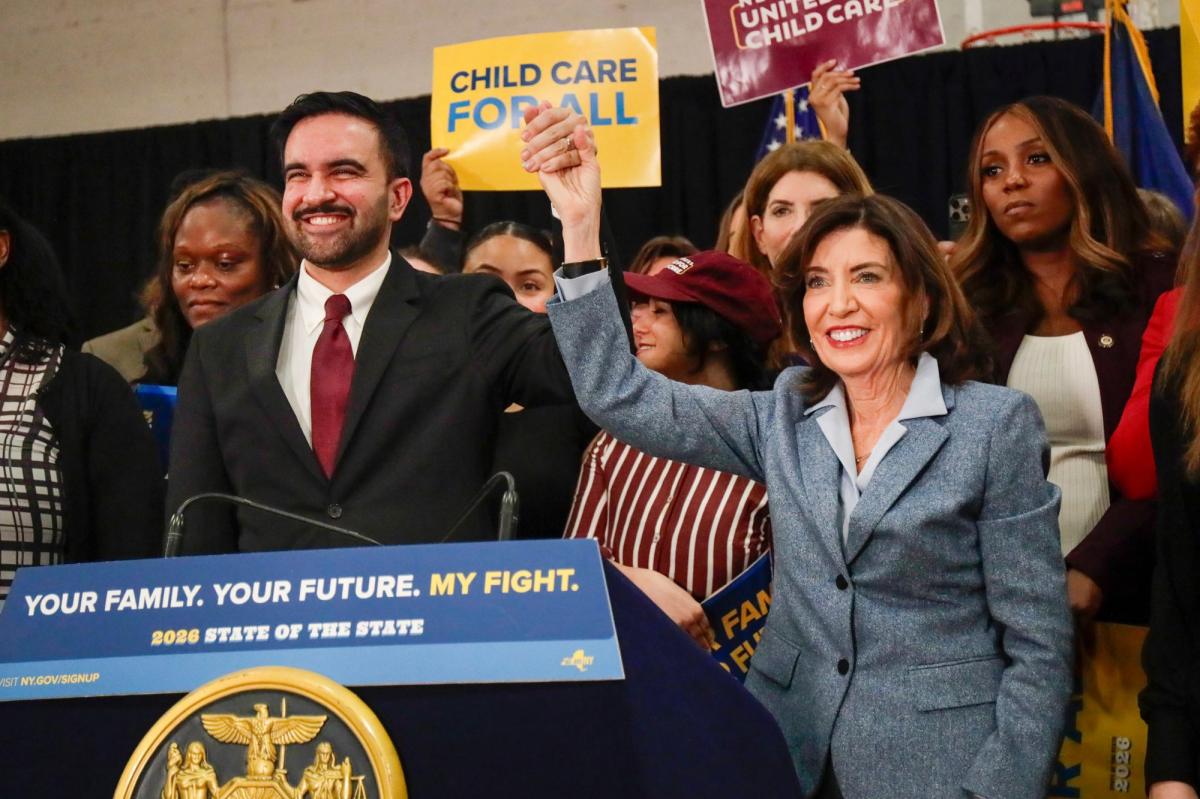
New York’s child-care debate is being sold as a budget question.
It’s not: It’s a child-outcomes question.
Credit to Mayor Zohran Mamdani for putting this issue front and center. My party — the family-values party — has been slow at advancing solutions.
Child care sits at the intersection of affordability and workforce growth. But the question now is whether Albany will help families, or build another government system that replaces them.
First off, let’s stop calling it “universal.” Gov. Kathy Hochul and the media are selling it as a statewide policy. But this is NYC day care with upstate crumbs, even though there are 8 million New Yorkers in the city and 11 million upstate.
Pre-K isn’t even universal yet.
But geography isn’t the biggest problem. The real issue is what kind of system Albany is building: family care or state care.
When government becomes the default caregiver for toddlers, kids’ development is at stake.
If the system is high-quality, safe and properly staffed, children can thrive.
But if Albany promises big, scales fast and improvises later, kids will suffer.
Look no further than the state’s botched legal-marijuana rollout: big talk, sloppy execution, disastrous results. The stakes here are infinitely higher.
Here’s what’s been left out: There’s serious evidence that rushed “universal” child care can backfire.
A long-run study of Quebec’s universal rollout found negative impacts on children’s behavioral outcomes when expansion outpaced safeguards.
One author of that study was Jonathan Gruber, the MIT economist associated with Obamacare — not exactly a conservative academic.
That should terrify anyone treating “universal care” like a panacea.
Two-year-olds don’t make good subjects for a pilot project. They’re not a socialist testing ground. They’re our kids.
In 1965, Sen. Daniel Patrick Moynihan warned that welfare could unintentionally weaken families — by penalizing marriage and discouraging the involvement of fathers. He proved right.
And that warning applies here: If Albany builds a care system that replaces families rather than strengthens them, it will create problems it can’t spend its way out of.
Before creating a massive new entitlement, lawmakers should ask: Are we building a program that supports families — or a system that quietly displaces them?
The practical problems suggest the latter. Start with staffing.
Per state Comptroller Tom DiNapoli, New York has about 2,000 fewer child-care providers now than in 2015.
And Albany wants universal access for the youngest children, who require the most staffing.
The city’s “2-Care” program alone needs roughly 11,000 new workers — and no one’s saying where they’ll come from.
In September, New Mexico admitted it needs 5,000 additional professionals for its universal child-care program. New York won’t publish its estimate.
Get opinions and commentary from our columnists
Subscribe to our daily Post Opinion newsletter!
Thanks for signing up!
Then there are facilities. Two-year-olds require licensed space, bathrooms, safety upgrades — real infrastructure.
The tab could run into the billions, with carrying costs of $150 million to $300 million per year, even before hiring workers.
The plan also has no dedicated long-term revenue stream and doesn’t require means testing, which means an East Side billionaire gets the same benefit as Flatbush single mother. That’s political malpractice.
Announce the program now, fight about funding later. When “later” arrives, raise taxes, raid budgets or quietly ration with waitlists while pretending it’s “universal.”
Nor does child care exist in a vacuum: New York has a caregiver crisis across elder care, disability care and home health care.
Meanwhile, Albany is destabilizing the Consumer Directed Personal Assistance Program, which lets families care for their own elderly and disabled relatives.
The state will bid against itself for workers, driving costs higher while weakening every service.
Finally, let’s be honest about the politics driving this: A “universal” system is a pipeline to tens of thousands of new dues-paying members for unions like 1199 SEIU, DC 37, and the United Federation of Teachers. Once built, it’s nearly impossible to reform.
What’s the alternative?
How about caregiver credits — money families can use for care that works best for them, whether it’s for child care, helping a spouse stay home, supporting a grandparent or caring for a disabled relative.
This wouldn’t eliminate the need to expand child-care supply. But a family-first credit recognizes reality: More parents work from home part-time, and families can cobble together care if Albany gives them room to breathe.
That strengthens families and expands options — unlike a massive state-run system where Albany controls everything.
What New York needs isn’t another one-size-fits-all “answer.” It’s freedom of choice for families — and relief that meets families where they actually live.
New Yorkers should want reform that’s honest about keeping children safe and supported — not another Albany program that looks beautiful on paper but breaks down in real life.
If you think NYC public schools and public housing are models of competent government, sure: Sign up for this, too.
But if we get this wrong, it won’t just waste money; it’ll undermine families.
And the price will be paid by the very children Albany hopes to help.
David Catalfamo, president of Capital Public Strategies, was the political director of Gov. George Pataki’s 1994 campaign.