
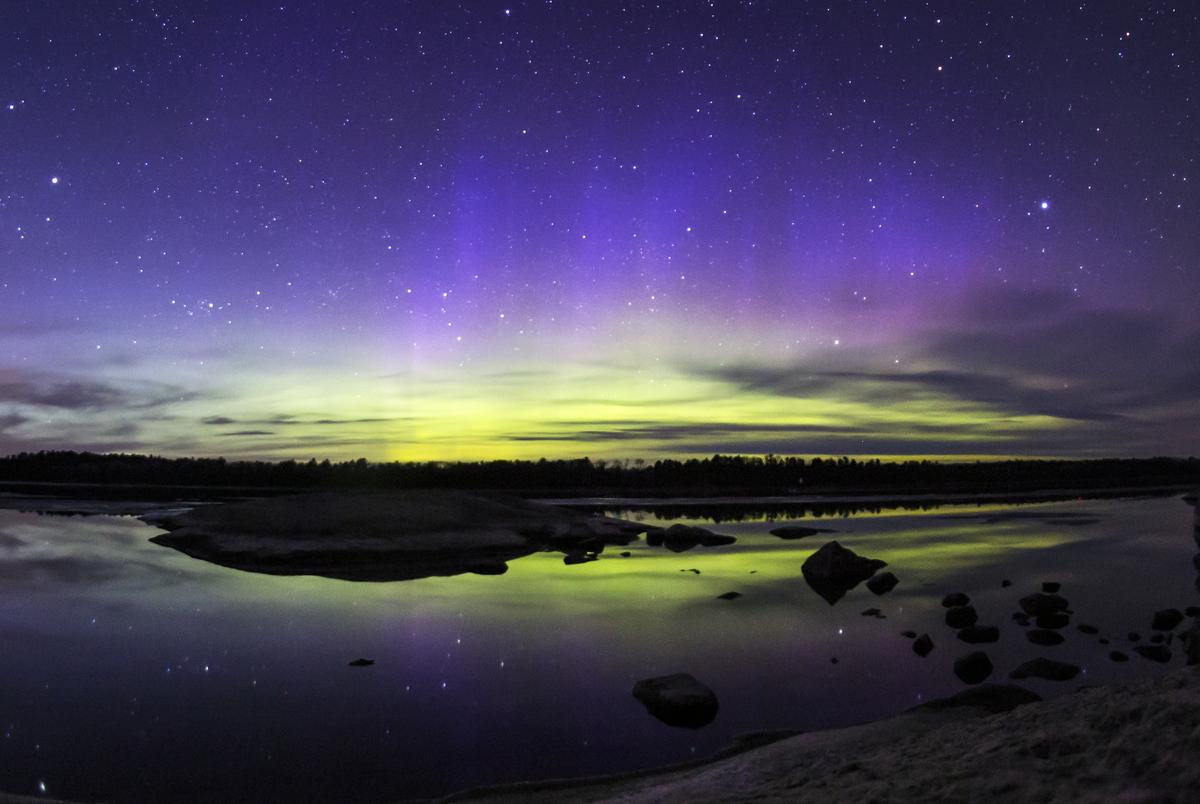
Meteorologists report that NOAA has issued a G4 Geomagnetic Storm Watch for Monday night into early Tuesday. This comes in response to a large solar flare that emanated from the Sun late Sunday, and will reach Earth by Monday.
This could very well bring the Aurora Borealis as far south as New York by late night. One issue though could be cloud cover, as winter into early spring tends to be quite cloudy across the Northeastern U.S. Another factor is the timing.
Northern Lights Could Be Seen in Parts of New York State If Weather Cooperates
NOAA Administration’s Space Weather Prediction Center says that a G4 Geomagnetic Storm Watch has been issued for Monday night into early Tuesday. This could mean that the Aurora would be seen as far south as states like New York.
However, the timing and intensity of the event might keep any sightings closer to the horizon, rather than directly overhead. The very active period of solar storms continues , as the Aurora Borealis has already shown as far south as New York over the past year.
The reason for the increased displays is that our Sun is still near its peak in its 11-year annual cycle for solar activity.
One major issue cold be weather, as The Weather Channel is calling for mostly cloudy skies for Monday evening. However, skies should clear as the night goes on, according to forecasts.
15 New York State Observatories To View Space Like The James Webb
NASA and the James Webb Space Telescope have gotten the world excited about space once again. With breathtaking photos from space, it’s safe to assume that we’ve all got a little bit of “Space Fever.” Where can you look at stars across New York State? Where are the top observatories and places to view space?
If you’re looking to look at the stars, these are some of the top places to sit back and relax from Earth to see them. We did the research for you, and we know these are open to the public. Here’s a list of 15 observatories to check out:
Gallery Credit: Dave Wheeler
What Are the Northern Lights?
The Sun’s solar winds send particles through space and towards the Earth at millions of miles per hour. The Earth’s magnetic field deflects the solar wind, stretching the field until it sort of snaps these charged particles back down toward the planet.
Once these particles collide with the gases in our atmosphere, they begin to glow in a variety of ghostly displays and colors, according to the Canadian Space Agency.