
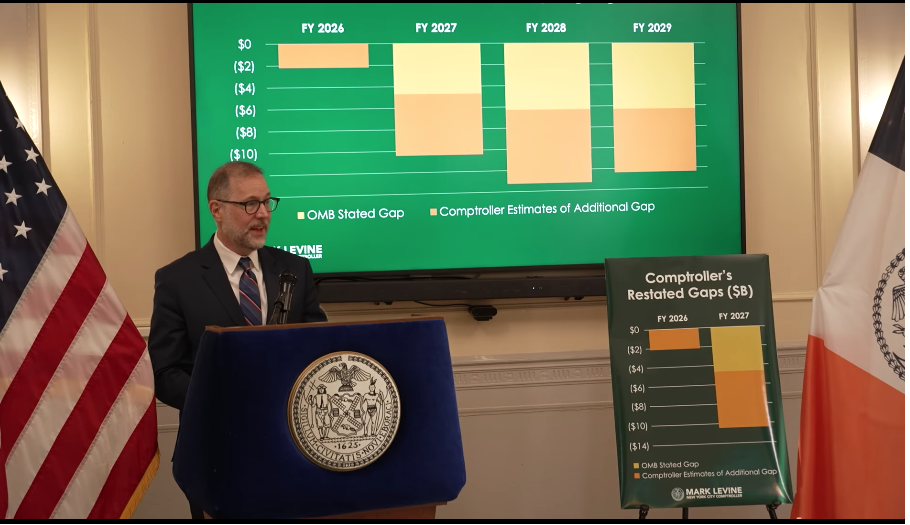
City Comptroller Mark Levine last Friday said the city is facing budget deficits that are unprecedented since at least the recession of 2008.
He blamed the administration of Mayor Eric Adams for practices using one-shot revenue sources for recurring expenses and understating the cost of things like overtime in the budgeting process.
“We want to call your attention today to a looming budget gap that we believe has big implications for our budget, and we want to talk about how we got into this mess,” Levine said in a video of his press Jan. 16 press conference. “… The issue is the previous budget practices of the previous administration.”
The Adams-era City Council, however, frequently said he wanted budget cuts when there was no need, because revenue was higher than projected, and subsequently raised spending by millions of dollars.
Levine said there is a $2.2 billion gap to close before June 30, as the City Charter does not allow the city to close out a fiscal year with red ink on the books.
He also said the fiscal year 2027 budget that kicks in on July 1 is presently underfunded by $10.4 billion; and that is before Mayor Mamdani moves to fulfill campaign promises for things like free bus service, city-run grocery stores and universal child care, which his campaign estimate to cost another $10 billion.
Mamdani must present a balanced preliminary budget by Feb. 1. The Mayor’s Office, in an email on Monday, said the findings match those of his own team.
“New York City is facing a stark fiscal challenge, due to Mayor Adams’ deep fiscal mismanagement, former Governor Cuomo’s decade-long exploitation of our city, and the resulting imbalance between how much New Yorkers give to the State, and how much we receive in return,” the mayor said. “ … As I said on Tuesday, we believe raising taxes on the wealthiest New Yorkers and corporations will be necessary.”
Cuomo spokesman Rich Azzopardi last week was quoted in multiple publications as calling Mamdani’s assertions, “As usual, untethered from the facts,” saying among other things that aid to city schools rose 68 percent under Cuomo, with the state taking over billions in Medicaid costs.
“If Mamdani thinks the system is unfair, he’s had five years in office to do something about it — except, with the worst attendance record in the Assembly, he couldn’t even be bothered to show up for work,” Azzopardi said.
Levine said anyone who follows the city’s budgeting process knows January usually brings projections of surpluses, which then are augmented when tax revenue from year-end bonuses on Wall Street and in the financial sector comes flowing in.
But he said this year is different.
“A mid-year gap of the scale we are facing now is actually extremely unusual,’ Levine said. “Normally this time of year we are facing budget surpluses … What we are seeing here is remarkable; unique, I believe, since the 2008 financial crisis.”
Outyear deficits also are forecast every January.
“But again, the scale is beyond what we have seen in recent years at over $10 billion,” Levine added.
He said one-shot financing and understating expenses “has been going on a while in New York City, unfortunately, for years. But it has gotten out of hand.”
Levine reiterated that the city cannot blame a lagging economy, office rentals, tourism, Broadway and other revenue streams performing well — just not keeping up with projected spending.
He said Mamdani’s budget team faces a difficult task in the coming days.
“There are trade-offs in just about any policy solution,” he said, unless the city’s economy can grow more rapidly.
Andrew Rein, president of the Citizens Budget Commission, said in a press release the report presents problems but also opportunities for the city.
“New York City has a significant budget problem,” Rein said. “Our estimate that the City’s fiscal year 2027 budget gap may approach $8 billion is smaller than Comptroller Levine’s, but this problem will not disappear on its own under any scenario.”
Rein said Mamdani’s first task should be to comb through city programs to identify and protect those that deliver significant, positive impact and shrink those that do not.
“For years, the City has layered new programs on top of others without eliminating lower-priority or lower-impact spending,” he said. “The result is spending growth twice the rate of inflation. City spending would be $14.5 billion lower today if it had tracked inflation. He said the city should also leverage technology, modernize outdated operations and work with labor to boost productivity.
Rein added that Mamdani should lobby with the state to repeal the class-size reduction mandate, which he said restricts the mayor’s flexibility and drives higher spending that widens the budget gap.
“It is important that New York deliver high-quality cost-effective services,” Rein said. “That requires making smart but tough choices — prioritizing what works and shrinking what doesn’t — before turning to the easier option of raising taxes.”