
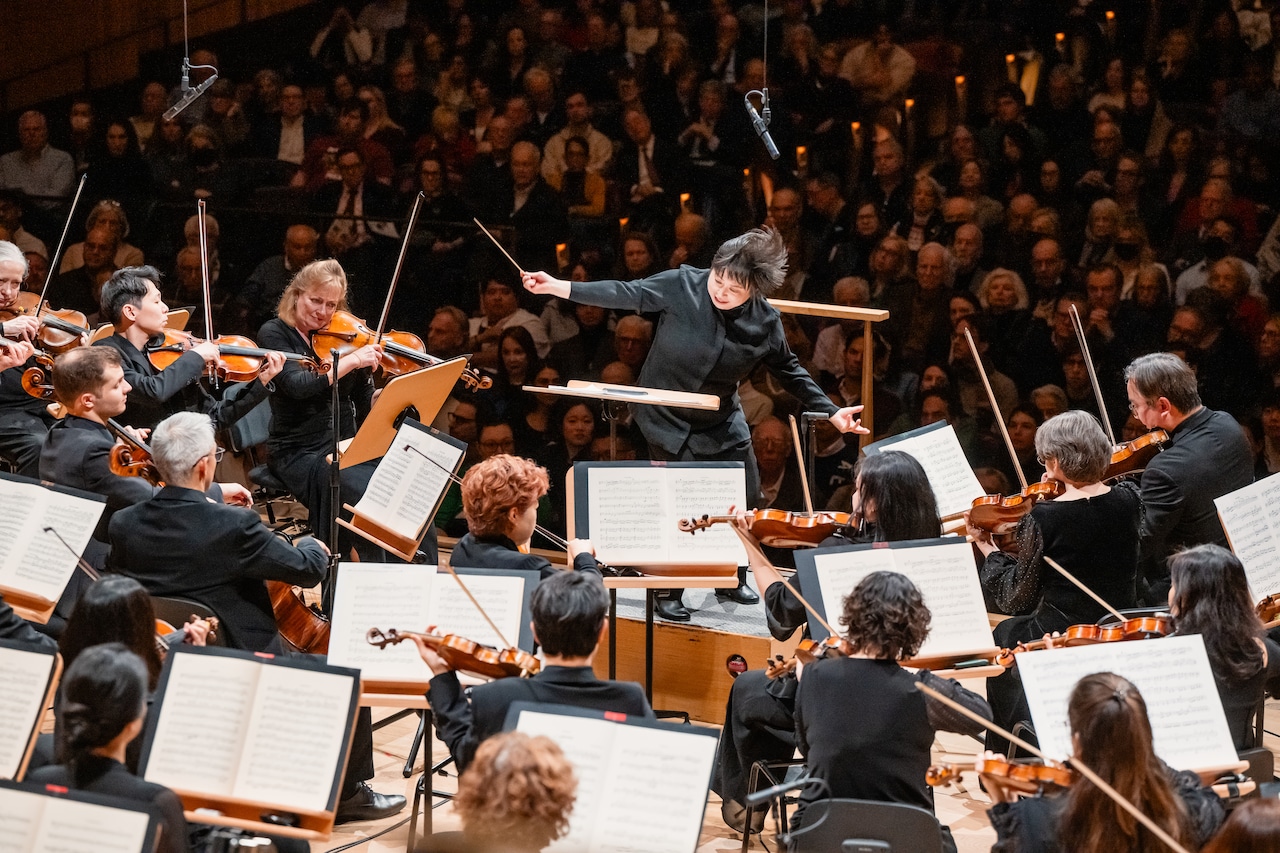
The New Jersey Symphony regularly plays the same program at different venues across the state. But this past week, New Jersey Symphony music director Xian Zhang conducted the same piece of music on opposite sides of the Hudson River.
This quirk of scheduling threatened to stir up feelings between the two states that go back to the 18th-century Line War (or at least the last Devils-Rangers game) as it invited the question: Does New York or New Jersey have the better symphony orchestra?
We’ll get to that, but first — this weekend’s concert series with Zhang leading the New York Philharmonic was a homecoming. Prior to her getting the New Jersey job, Zhang became the first female music director of a symphony in Italy. But before that, in the early 2000s, Zhang was an assistant (and then associate) conductor at the New York Philharmonic. Until this weekend, she had not led the orchestra since 2009 — a year before she conducted her first concert with the then-NJSO.
So, for this return to New York — and her first time conducting at the newly renovated Geffen Hall — Zhang brought along a trusted collaborator, soloist Yefim Bronfman. He was the star pianist Zhang brought for the NJPAC concert series that kicked off the Jersey Band’s 100th season back in 2022. Back then, they played Rachmaninoff. Here in New York this weekend it was Robert Schumann. His sole Piano Concerto is a work of subtle invention, and Zhang conducted it with care. The NY Phil is known for their big, blaring sound. But under Zhang’s baton the work had a hushed, gentle clarity. This meshed well with Bronfman’s meaty, precise playing of the romantic score. The crowd gave a mighty cheer at the end, and Zhang and Bronfman exchanged looks at the curtain call that indicated they were quite pleased with what they had just pulled off.
The concert began with Chen Yi’s “Landscape Impression,” a short orchestral work that was commissioned by the New Jersey Symphony. Zhang premiered it at NJPAC in 2023 and clearly believes in the piece, as she conducted again with the Boston Symphony last year. Here at Geffen Hall, Zhang let the NY Phil unleash its louder side, giving this 8-minute work a more refined, epic cast. When it premiered, Yi’s piece suggested a clash of old and new tunes. After performing it a few times, Zhang interprets the work slightly differently. Here with the NY Philharmonic, Zhang made Yi’s score feel more like a dance between ancient Chinese folk music and modern rhythms and sounds.
After intermission, it was time for Tchaikovsky’s Second Symphony. Last week when she played this 1873 work with her orchestra in New Jersey, the opening movement sounded as if Tchaikovsky was looking backward, trying to sound like “The Big Five” composers that defined Russian music in the mid-19th century. Here in New York this movement sounded very different. You could hear bits of his opera “Eugene Onegin” in the score, the opera that (along with his ballets) helped Tchaikovsky break away from tradition and find his own unique musical voice.
How can the same movement sound so different only one week (and one river) apart? The NY Philharmonic is famous for its majestic sound and a reputation for playing how they feel the music should be played. So, it’s perhaps not surprising that the music steered towards a later, more traditional, grand Tchaikovsky interpretation. The New Jersey Symphony has a more fluid, flexible sound and style. Therefore, it makes sense that the music felt slower and sounded more rustic (and arguably more rooted in the music’s history).
But despite these different sounds early on in the symphony, for the explosive final movement Zhang brought the same bold tempi and energy to both. So, listening to these passages, it was harder to hear a difference between the two orchestras at all. All you heard in both concerts was the gleaming Russian glow of Tchaikovsky’s grand finale. Zhang’s ability to collaborate and create contrasting — but still captivating — sounds with different collaborators is why she’s made the New Jersey Symphony so exciting. And also, why she’s in such demand on major podiums today.