
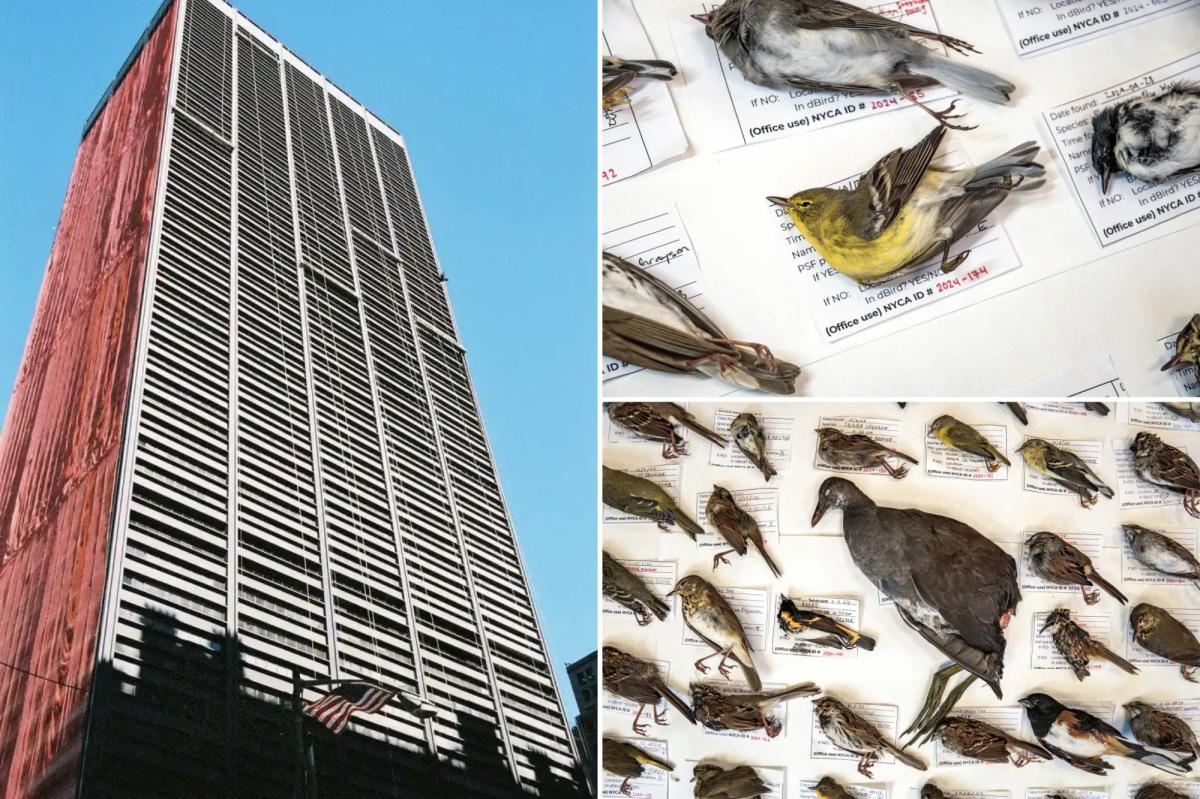
For the second year in a row, a record number of migrating birds were killed by flying headfirst into the Big Apple’s glassy and nearly invisible skyline.
At least 1,250 warblers, flickers and more were lured into their deaths during their annual fall pilgrimage, smashing last year’s record that logged the bloodiest year yet, The Post has learned.
But the true death toll is likely much higher, after an unusually heavy migration season sent thousands more birds through the five boroughs than in years past.
More than 1,250 birds were killed during this year’s migration season after flying into buildings. NYC Bird Alliance
“Bird collisions increased by 7% in fall 2025, with NYC Bird Alliance documenting more than 1,250 collisions at the buildings that we surveyed,” Dr. Dustin Partridge, director of conservation and science at NYC Bird Alliance, said.
“Because we monitor only a tiny fraction of the city’s buildings and conduct surveys just once each morning, the birds we document represent just a small slice of the true toll. Even modest increases signal a much larger, ongoing citywide problem.”
The historic death toll comes in conjunction with a record-breaking migration season.
More than 1.25 billion birds were recorded soaring through the Big Apple in a single night back in October — making for the biggest night of migration recorded in the past decade.
This year’s death toll marks a historic high since the data has been collected. NYC Bird Alliance
That number also broke a record that was set just a month earlier, when 1.2 billion birds were recorded in a single night, according to BirdCast, a migration tracking tool run by the Cornell Lab of Ornithology.
More birds in the sky means higher chances of collisions, explained Partridge.
“At the same time, New York City is getting brighter, with more illuminated buildings: artificial light at night
attracts and disorients birds and pulls them toward dangerous glass,” the bird expert said.
Birds cannot perceive glass as a barrier, and because it seemingly blends into the sky, the tiny critters smash right through and often break their necks.
At least 1,000 were killed in building strikes last year. NYC Bird Alliance
Collisions are the leading cause of death for the wild animals, with NYC Bird Alliance speculating that more than a quarter million are killed in New York City every year.
NYC Bird Alliance relies on more than 150 volunteers who comb the sidewalks around more than 80 strike hot spots to collect stunned birds — unfortunately, many of which don’t survive their debilitating injuries.
But the volunteers can only cover so much ground, and so many of the birds are scooped up by cleaning crews without documentation, while others are gobbled up by large predators like rats.
The group’s focus on some of the worst kill zones — which are often times the Big Apple’s iconic, glassy skyscrapers.
At least 28 dead birds were recorded outside One Liberty Plaza this year. Lois Weiss
One World Trade Center killed at least 13 birds and injured another seven last year, while the neighboring Perelman Performing Arts Center was responsible for another five deaths, according to dBird, a self-reporting tool.
Another 28 birds were scattered across the street outside One Liberty Plaza.
Circa Central Park, a circular and reflective building in the Upper West Side, was yet again a bird killer, with 34 struck birds recorded on its surrounding sidewalk.
The rapidly-growing Long Island City waterfront also had its fair share of bird deaths, with about 30 birds found dead or injured along a stretch of the developing Hunter’s Point nabe.
Bird advocates for years have been raising concerns that bird deaths will only continue to rise as new developments continue without safeguards for the flying creatures.
Several pieces of proposed legislation would require commercial and industrial buildings to turn off non-essential lights during migration periods, as well as require new construction to implement bird-friendly designs that make the glass less reflective.
“There are easy solutions to reducing bird collisions with buildings, and all New Yorkers can help. Turn off
non-essential lights at night in your apartment or office building, especially during spring and fall
migration, and make your windows safe for birds by using patterns or decals that break up reflections,” said Partridge.