
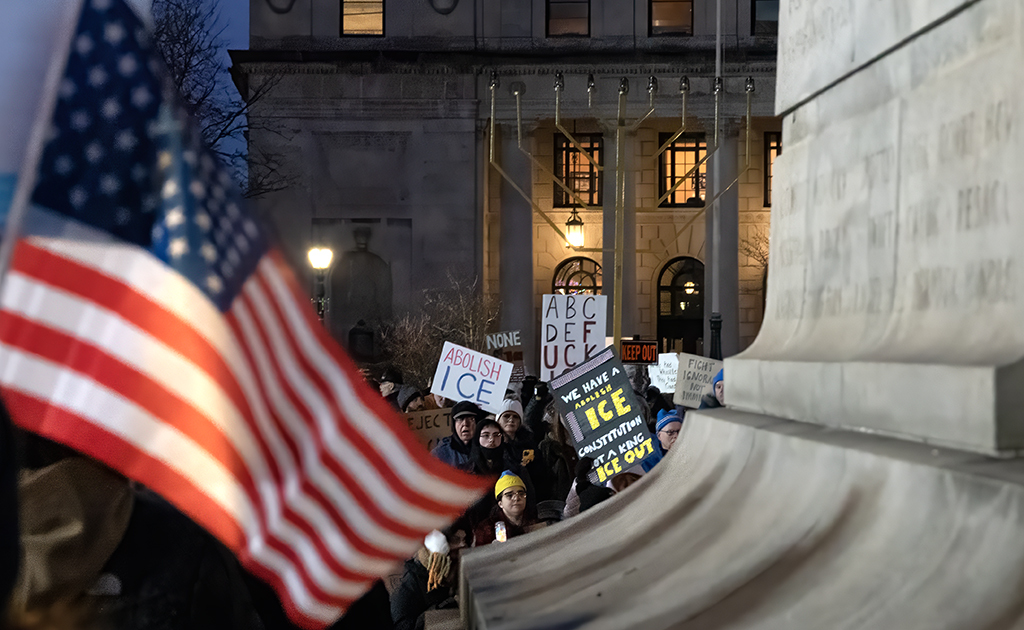
Local lawmakers are looking for ways to limit the reach of the federal government’s immigration crackdown in Syracuse. One city councilor is pushing Albany to help.
Syracuse Common Councilor Chol Majok on Wednesday asked his colleagues to sign onto a resolution calling on New York state lawmakers to enact the New York For All Act, which seeks to limit President Donald Trump’s deportation operations.
Sponsors of the bill, which was first drafted in 2020 but has since languished in the state legislature, say passing the legislation is more urgent now than ever before to protect immigrants from the federal government.
Federal government officials — who say they are targeting the “worst of the worst” of illegal immigrants — have swept up over a million legal residents and even American citizens in a detention and deportation dragnet of unprecedented scale, often without due process.
After Wednesday’s council session, Majok told Central Current that he believes the New York For All Act is a necessary protection not just for immigrants, but for all state residents. The resolution would not change any laws or policies, but instead advocate for the passage of New York For All.
Majok’s colleagues indicated they would support the measure in the council’s Monday voting session.
“We are brutally harassing New Yorkers, and that’s unacceptable,” Majok said. “People have said, ‘Oh, well, it’s quote, unquote, illegal immigrants.’ … it’s coming for all New Yorkers, even non-immigrants.”
The bill’s supporters began the year with hope as they convened the state legislature that Gov. Kathy Hochul might support the legislation. A week later, Hochul refrained from naming the New York For All Act at all in her State of the State address.
State Senator Andrew Gounardes, a sponsor of the bill, said in a statement to Central Current that communities across the state are looking at the federal government’s crackdown in Minnesota saying, “we want no part of that chaos.”
“New York for All builds trust between immigrant communities and institutions — like the police, schools, public hospitals,” Gounardes wrote. “That kind of trust leads to the strong relationships and open communication that are the real keys to public safety. Having masked agents roaming the streets and tearing apart families doesn’t accomplish any of that.”
The New York For All Act would prohibit local and state agencies from supporting federal agencies like U.S. Immigration and Customs Enforcement, preventing them from furnishing sensitive data or other collaboration.
The legislation would also limit federal immigration agents from accessing non-public state and local property absent a signed judicial warrant.
New York For All would dissolve over a dozen active 287(g) agreements in the state, which allow local law enforcement personnel to enforce elements of federal immigration law. ICE boasts over a thousand agreements with local law enforcement agencies around the country.
According to a tally on ICE’s website at the time of publication, 14 local law enforcement agencies across New York have inked pacts to collaborate with ICE. The most recent of those agreements, in the Village of Wayland Police Department in Steuben County, was signed on Jan. 7, the same day the state legislature kicked off this year’s session.
Himself an immigrant who fled war in South Sudan and found a home in Central New York, Majok explained why he believes the resolution — which wouldn’t change any law or policy in Syracuse — is still a relevant measure for the Syracuse city council to pass.
“This protection is not just for immigrants, it’s for everybody,” Majok said. “Stopping all this madness, where the federal government is just going after everybody.”
Majok worries that the federal government’s expanding operations are targeting legal immigrants, naturalized citizens, legal residents, and even born Americans who support those groups.
If immigrants and other community members are too fearful to report criminal acts or tips to local law enforcement, Majok said, it hinders the ability of police officers and sheriff’s deputies to solve crimes and keep the peace.
It is unclear when legislators will bring New York For All to the floor. Even if the bill clears both chambers of the state legislature, Hochul’s stance on the legislation remains opaque.
“We will not allow masked federal ICE agents to storm into our schools, daycares, hospitals, and houses of worship for civil immigration raids,” Hochul said, “unless they have a judicial warrant, meaning signed by a judge.”
Regardless of the governor’s position on federal immigration operations, State Senate Majority Leader Andrea Stewart-Cousins said she remains committed to pushing the New York For All Act through that chamber this session.
“The Senate Majority Leader made it clear in her opening day speech that standing up for our immigrant brothers and sisters including advancing New York for All is a top priority for the Senate this session,” a spokesperson for Stewart-Cousins’ office said in a statement to Central Current.
A spokesperson for Assembly Speaker Carl Heastie did not immediately respond to a request for comment at the time of publication.
Some local advocates lauded the news of Majok’s motion — but encouraged the councilor and his colleagues to go further.
“While it is commendable that the Council appears to support New York for All, which prohibits state and local public resources from being used for immigration enforcement, those protections must be extended beyond public agencies to the private companies contracted by the city,” Genevieve Garcia Kendrick, said in a statement to Central Current.
Garcia Kendrick, a member of the local chapter of the Democratic Socialists of America, had hoped to see a separate resolution, also seeking to distance the city from the federal immigration agenda, appear on Wednesday’s agenda.
DSA and other organizations, sent Common Council President Rita Paniagua on Jan. 5 a resolution proposal that, if passed, would prevent the city from renewing or entering new contracts with companies found to facilitate or profit from Trump’s deportation agenda.
The activists, to no avail, asked for the council to add the resolution to its agenda by Wednesday.
Majok, though, said that didn’t mean the council wasn’t considering the resolution.
Compared to the New York For All Act resolution, Majok thinks DSA’s resolution proposal could potentially become actionable legislation — but that may require more negotiation with his colleagues.
“I don’t want us to just pass a resolution to pass a resolution, when we have the ability to maybe give it some teeth,” Majok said. “That’s what I’m looking at. Give it some teeth so it can bite.”