
STATEN ISLAND, N.Y. — Political opposites could soon find themselves in a court-ordered attraction.
A New York Supreme Court judge in Manhattan ruled Wednesday that Staten Island’s congressional district is illegal, ordering a state redistricting commission back to the drawing board over the next few weeks.
Justice Jeffrey Pearlman did not order specifics on how the district should be redrawn, but plaintiffs in the case, the Washington, D.C.-based Elias Law Group, sought a reconfiguration of New York’s 11th congressional district, which Staten Island currently shares with South Brooklyn, into lower Manhattan.
Under the ruling, the New York Independent Redistricting Commission will have until Feb. 6 to finalize new lines for the district represented by Rep. Nicole Malliotakis, a Republican.
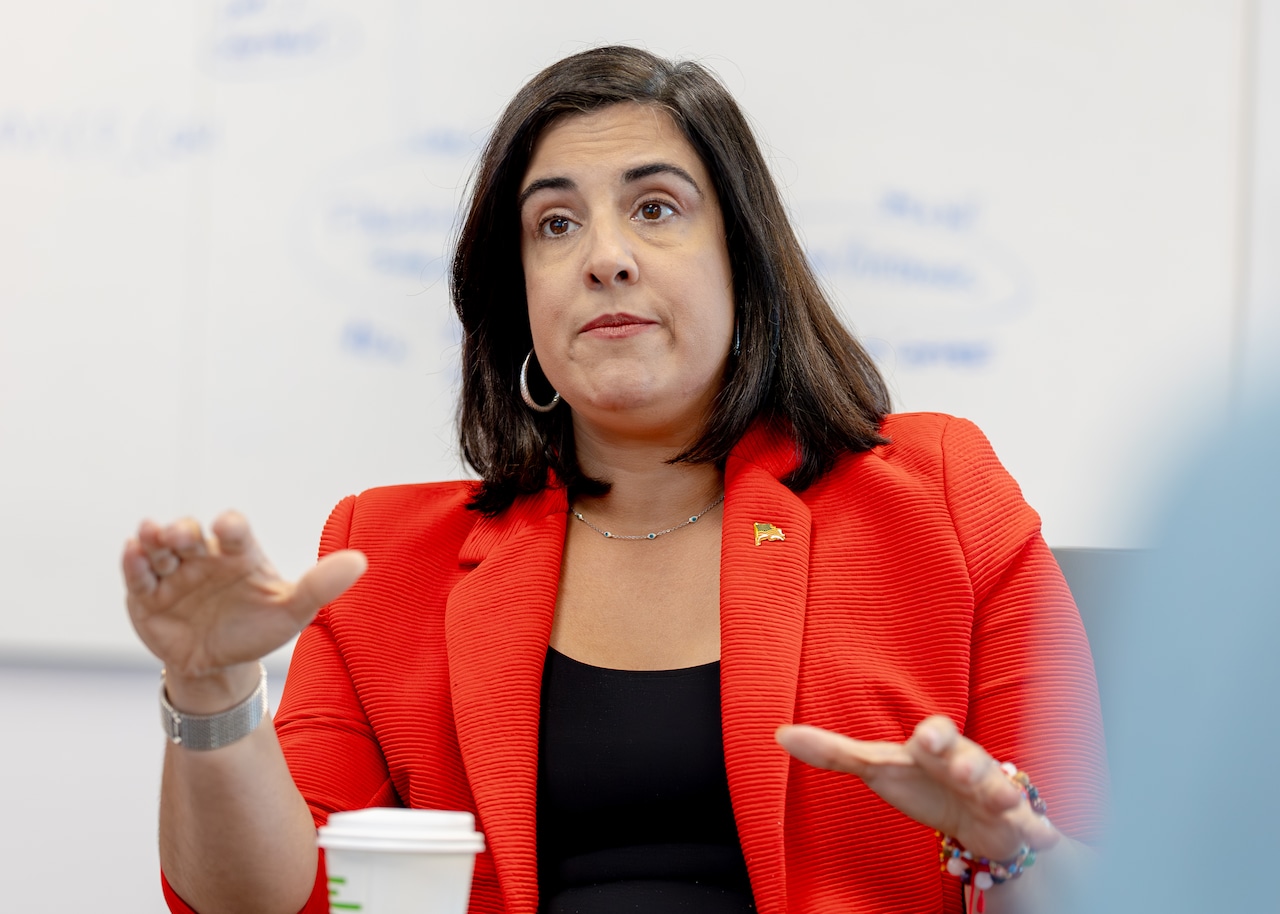
“We are reviewing the judge’s decision and our options to protect the voices of the people of Staten Island and Brooklyn,” Malliotakis said. “Nothing changes the fact that this is a frivolous attempt by Washington Democrats to steal this congressional seat from the people and we are very confident that we will prevail at the end of the day.”
An impending challenge from Malliotakis could see the case reach the U.S. Supreme Court over various pieces of language in New York law meant to protect minority voting rights.
The Feb. 6 deadline comes from testimony in the case submitted by the New York Board of Elections, which said the date is the latest they could be ready for this year’s congressional elections with new maps.
If the Redistricting Commission moves the district into lower Manhattan, it would pair the most conservative part of the five boroughs with a liberal bastion.
Staten Island has been one of New York’s most conservative locales for a decade with almost 64% of the borough voting for President Donald Trump in 2024.
While voters in both district-mate options — lower Manhattan and South Brooklyn — went for former Vice President Kamala Harris in the last presidential election, those in lower Manhattan did so more overwhelmingly, according to an analysis from The City news outlet.
That advantage could help Democrats take the only Republican-held congressional district in the five boroughs, which Malliotakis first won in 2020 when she defeated former Democratic Rep. Max Rose.
Staten Island Republican party head Assemblymember Michael Tannousis, a state representative for the East Shore and part of South Brooklyn, slammed the judge’s decision, pointing out his political background, including work for Gov. Kathy Hochul.
“This redistricting decision is a complete sham,’’ Tannousis said. ”They are trying to fracture our community because they don’t like how we vote. We have a judge who was previously Special Counsel to the governor directing the show, with an ‘Independent Redistricting Commission’ that previously found the current congressional lines to be perfectly fine but is now charged with redrawing our congressional district. It’s rigged. It’s transparently partisan, and it’s wrong.”
Hochul, whose office did not respond to a request for comment by the time of publication, is a defendant in the case, as are Sen. Majority Leader Andrea Stewart-Cousins, Assembly Speaker Carl Heastie and Attorney General Letitia James, all Democrats.
Amid an August push from Republicans for more advantageous Texas congressional districts, Hochul said she intended to “fight fire with fire.” Staten Island’s congressional seat seems to be her party’s primary target in New York.
James’ office responded to a prior request for comment with reference to a letter they filed in the case on behalf of all four politicians.
The letter takes no position on the claim of racially-biased maps, and goes as far as preemptively arguing against Malliotakis’ attorneys, who had to intervene in the case to defend the maps Democrats passed in 2024.
New York’s current congressional district maps replaced those created in 2022 by a court-appointed special master, who took over the process after a controversial and chaotic state effort failed to deliver legally-acceptable maps.
Typically, states redraw their congressional district lines after each decennial U.S. Census giving political parties in control of a state government, Democrats in the case of New York, an opportunity to redraw advantageous lines and take more control over the federal government.
However, New York voters approved an Independent Redistricting Commission in 2014 that was meant to remove politics from the redistricting process.
The State Legislature did retain an approval requirement for the maps, so if the Independent Redistricting Commission doesn’t draw maps to New York Democrats’ liking, those maps won’t be approved.
That’s what happened in 2022, leading to the appointment of the special master, and in 2024 the State Legislature wound up drawing its own maps, leaving what the special master drew largely in place, particularly in the 11th Congressional District.
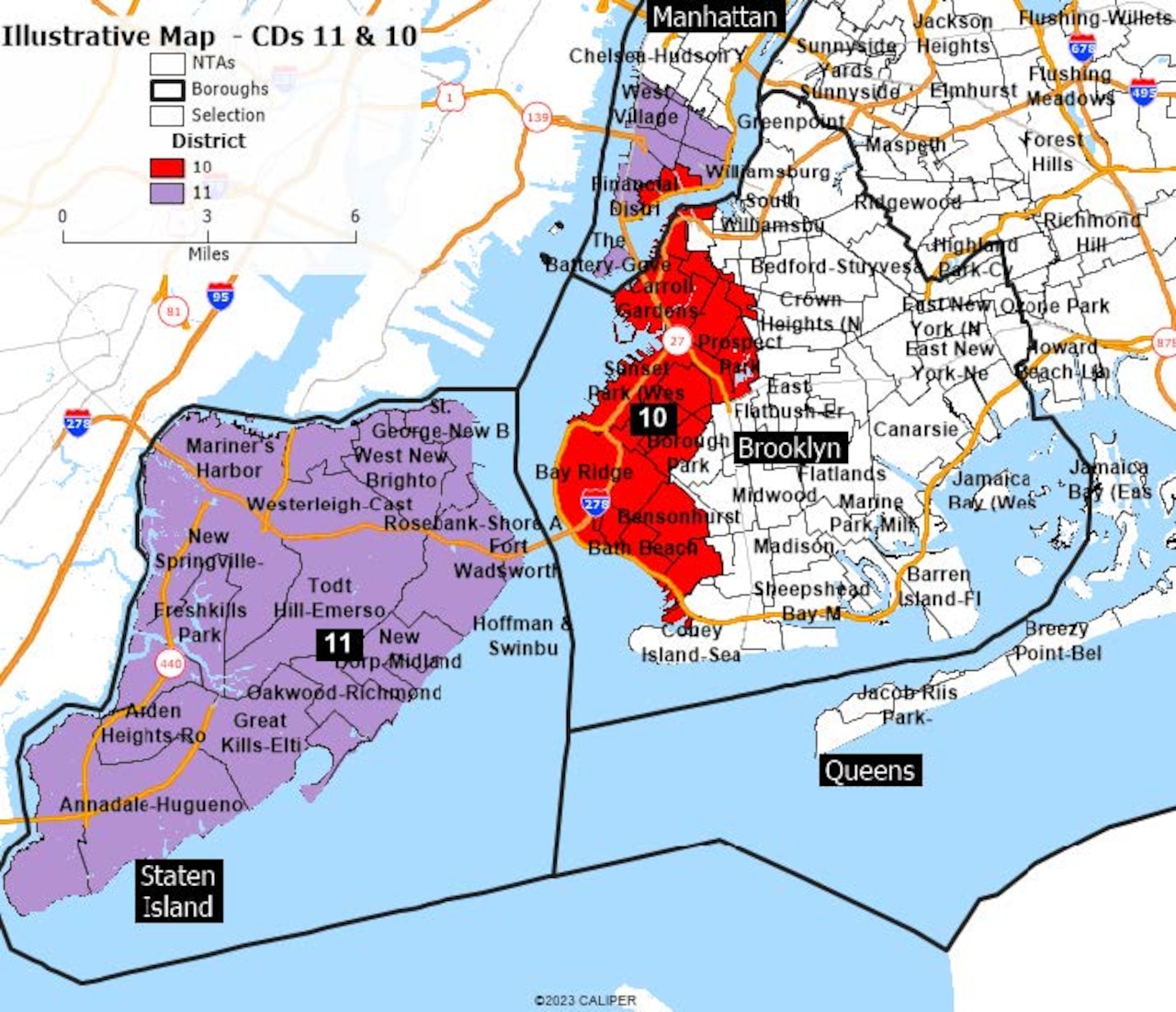 An illustrative map shows what Staten Island’s congressional map could look like (in purple) if a Democrat-backed court case in Manhattan prevails.(New York Supreme Court)
The most relevant example of what a new Staten Island district could look like comes from William Cooper, a redistricting expert who submitted an illustrative map for the plaintiffs in the case, showing what a possible new district with Manhattan would look like.
Cooper’s plan effectively trades 11th Congressional District’s South Brooklyn geography with most of the 10th Congressional District’s share of Manhattan outside Chinatown.
Rep. Dan Goldman, a Democrat currently representing District 10, is facing a tough primary challenge from former Comptroller Brad Lander, but would be redistricted into the Staten Island seat should Cooper’s map come to fruition. Goldman resides in Battery Park City.
Staten Island doesn’t have a large enough population for a congressional district entirely of its own, and the shift into Lower Manhattan would give Democrats an advantage over Malliotakis heading into the November elections.
The move isn’t entirely unprecedented. Assembly District 64, represented by Democratic Assemblymember Charles Fall, touches part of the west Brooklyn waterfront and makes its way into lower Manhattan. Staten Island’s congressional district following the 1970 Census also encompassed parts of lower Manhattan.