
Real journalists wrote and edited this (not AI)—independent, community-driven journalism survives because you back it. Donate to sustain Prism’s mission and the humans behind it.
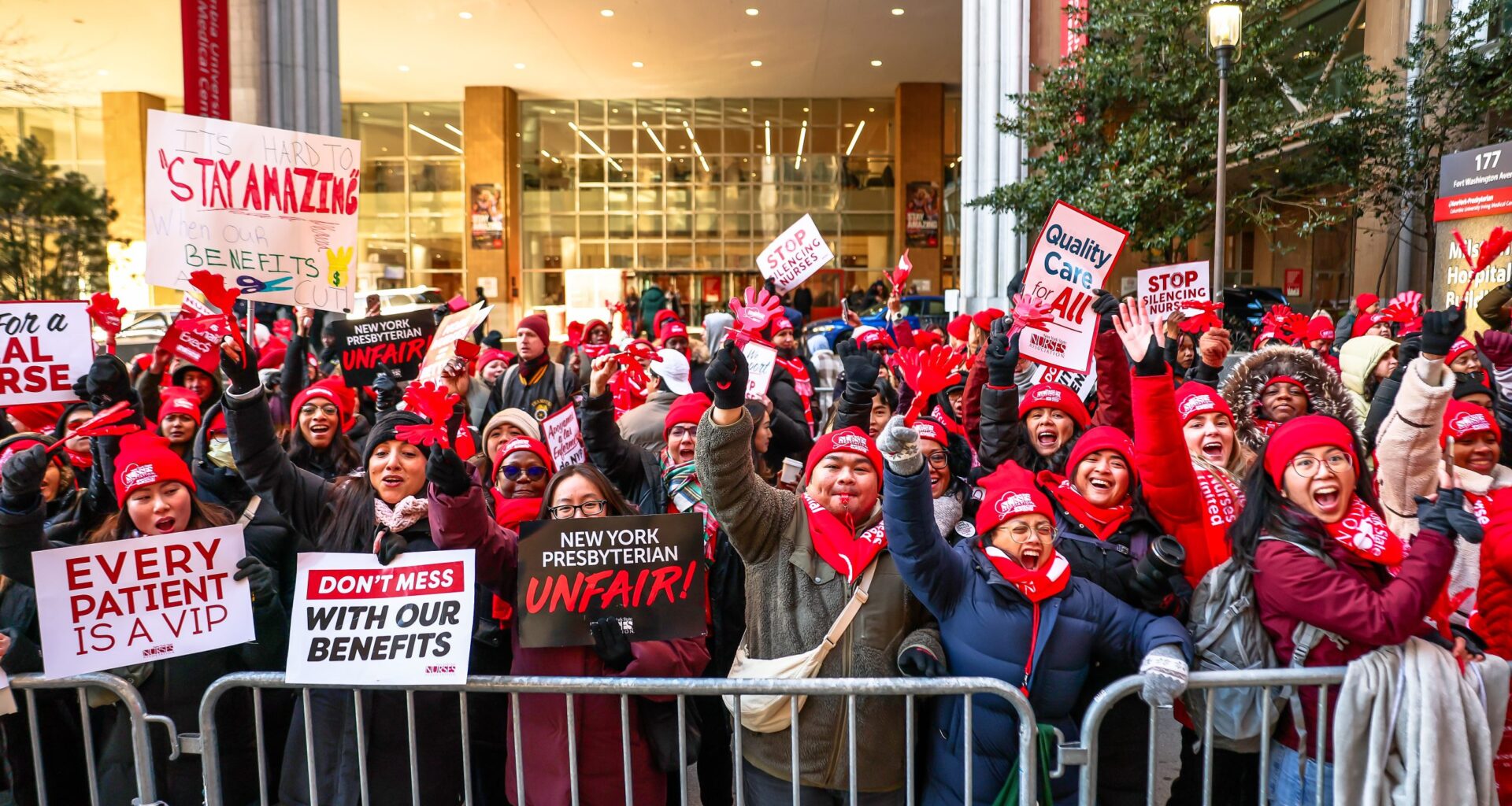
Almost 15,000 nurses are powering through a second week of the largest nurses’ strike in New York City history, hoping to secure fair health care benefits, sensible and safe staffing numbers, and better workplace safety protections at the city’s biggest hospitals.
Unionized nurses, represented by the New York State Nurses Association (NYSNA), walked off of the job in protest on Jan. 12. They delivered notices in early January to several hospitals, including those under the Mount Sinai, Montefiore Medical Center, and NewYork-Presbyterian/Columbia University Irving Medical Center systems—some of the wealthiest hospitals in the country.
The nurses say hospitals have either refused to bargain in good faith or stalled negotiations on key issues like reasonable health care benefits, staffing plans that keep patients and workers safe, and workplace safety measures that could help de-escalate violent situations.
NYSNA nurses’ contract expired at the end of 2025, and nurses say both sides are far apart on most matters. They also say that the bargaining sessions that have occurred before the strike began, and since then, have been tense and have not yielded gains for nurses.
“It takes two to negotiate. NYSNA nurses respect the mediators and are ready and willing to come to the bargaining table when they call,” NYSNA President Nancy Hagans said in a press release. “We urge hospital executives to do the same. Hospitals are willing to keep frontline nurses out in the cold instead of at the bedsides of our patients where we want to be.”
So far, NYSNA nurses from NewYork-Presbyterian and three Mount Sinai hospitals met on Jan. 15 and 16 with management and a mediator to negotiate for the first time since the start of the strike. The session, which drew a crowd of 70 nurses as spectators, went on past midnight. Union officials said in a press release that those conversations resulted in little progress toward a fair contract.
Nurses then met at the bargaining table with Montefiore’s team and a mediator on Jan. 18. Both sides traded proposals on safety measures to prevent and address workplace violence, and agreed on the role of AI in the workplace. No major progress was made on other issues, union officials report.
“As a health care worker, we’re giving our all,” said Elesha Van Zee, a radiology nurse at Mount Sinai West. “We’re caring for people. We constantly are giving our love out to the community.”
Prism reached out to public relations officials from Montefiore, Mount Sinai, and NewYork-Presbyterian. Only a Montefiore spokesperson responded to questions about the allegations made by NYSNA regarding bargaining and the three major demands made by nurses.
A Mount Sinai representative did not respond to Prism’s questions but emailed a message from its CEO, Dr. Brendan Carr, from Jan. 19, updating stakeholders on the strike.
“Our negotiating teams met with NYSNA’s negotiating teams on Friday (Jan. 16),” Carr wrote in his update. “After little progress was made at either table, the mediators told the parties to break. As of now, no additional meetings are scheduled, and we will continue to follow the direction of the mediators on when to meet again.”
What are the nurses’ demands?
Almost 44,000 people who receive benefits through NYSNA’s health fund—including striking nurses and their families at Mount Sinai, Mount Sinai Morningside and West, and NewYork-Presbyterian—could see those benefits cut, NYSNA officials said.
Montefiore is the only one of the three systems where nurses are striking that has vowed to keep health care benefits the same as part of any upcoming contract, a spokesperson for the hospital told Prism. The spokesperson noted that Montefiore provides free health insurance with no premiums.
Van Zee said health care has been a sticking point in negotiations. “Mount Sinai has held our health care hostage,” Van Zee said. “They refuse to go any further until we agree to pay for our health care.”
NYSNA officials said in a press release that wealthy hospitals are raising the cost of care while refusing to provide health care benefits that measure up to said increases.
In the release, NYSNA officials pointed to increases of more than 54% to CEO total compensation at NewYork-Presbyterian, Montefiore, and Mount Sinai from 2020 to 2023, citing 990 tax filings.
NYSNA officials said executives make astronomically more than registered nurses at those three hospital systems. At Montefiore, for instance, tax filings show that last year, the CEO, Dr. Philip Ozuah, received approximately $16.3 million in reportable compensation.
The average Montefiore registered nurse earns approximately $134,488 in yearly pay, according to Indeed.
“Our leadership states they can’t afford nurses’ health care coverage, even though they’re the ones driving up the cost of premiums, even though their executive leadership are making millions of dollars a year,” Van Zee said. “They are definitely not putting patients first.”
Nurses said they are also fighting to establish safe staffing standards, mandating specific registered nurses-to-patients ratios based on patient acuity. Some states like California have codified these standards into law.
KA Hogan, an emergency department nurse at Mount Sinai Hospital, said that when they started their tenure at the hospital in 2023, there were 16 patients per nurse in Hogan’s department.
“It was just untenable,” Hogan said. “You can’t see patients every hour if you have 15 patients. That is really dangerous.”
Nurses went on strike that same year, aiming to reduce that ratio. In Hogan’s department, they said, there are now eight to 10 patients for every nurse.
“Certainly better, but it’s not as safe as it should be in there,” Hogan said, noting that they would like to see New York pass a law instituting better standards.
A new contract would create ideal staffing ratios and improve the grid’s system, Hogan said. Staffing grids in hospitals map out the number of patients to the required staff for every unit in the hospital. Grids factor in acuity, shift, and skillsets.
“Mount Sinai doesn’t want to agree to the grids at all, and wants to remove arbitration from the contract,” Hogan said. “So that’s also going back on what … folks had won last time.”
In response to the union’s allegations of a lack of safe staffing ratios, a spokesperson for Montefiore said their nurse turnover rate is outperforming the 90th percentile national benchmark and represents a 51% improvement since 2021.
But a spokesperson from the nurses union said that while the hospital is touting its turnover ratio, that response does not address the safe staffing ratios nurses want to bargain for.
Another major sticking point nurses would like to see addressed in a new contract is the implementation of better workplace safety measures.
Hogan said they would like for departments to have behavioral response teams. These often include a psychiatric nurse and a social worker who can help de-escalate tensions or help individuals who are experiencing a mental health crisis.
“People get frustrated. People have mental health issues and physical issues; they’re not thinking or acting in the way that they normally would,” Hogan said. “We all know what it’s like to feel sick, and it can feel bewildering and depressing.”
For Hogan, the tools Mount Sinai currently provides for nurses to deal with such a crisis are not appropriate.
“What Mount Sinai is providing right now is basically someone who will come and provide restraints and medication, and that’s not helpful,” Hogan noted. “That just creates more panic.”
At Montefiore, the spokesperson said the hospital system has widespread deployment of weapons detection capabilities and pays for NYPD officers and internal security personnel. Montefiore also provides wearable panic buttons for nurses, the spokesperson added.
The cost of striking
Hospital representatives told Bloomberg News that they have spent more than $100 million in preparation for the strike, in part paying more than $9,000 per week to travel nurses willing to cross the picket line.
NYSNA officials estimate that, based on an average nurse workload, Mount Sinai is spending at least $10 million a week to pay the 1,400 travel nurses they reportedly hired before the strike began.
NewYork-Presbyterian, meanwhile, spent $60 million to hire temporary nurses in preparation for the strike, the hospital told Bloomberg.
On the other side of the strike line, nurses are experiencing a heavy financial burden; the economic reality of forfeiting their pay and health care benefits to seek better conditions.
As the grueling New York winter continues, bringing in an arctic blast that has lowered temperatures at times below freezing, NYSNA nurses are keeping the faith.
On Martin Luther King Jr. Day, nurses even received a visit from civil rights leader Rev. Al Sharpton.
“I believe [King] would like those of us who come in his tradition to be standing with nurses and standing with those who should be getting wages for saving lives, and caring for people that the private hospitals seem not to care about,” Sharpton said, addressing nurses at the strike line at Mount Sinai Morningside.
For some nurses, giving up salaries and health care benefits epitomizes just how much of a last resort measure striking is.
“They’ve forced this to happen,” Hogan said, referring to the prolonged bargaining conversations nurses have had with management dating back to last September. “It has been definitely challenging for folks who have ongoing health issues, who have children and elders that they take care of.”
Van Zee is leading one of those struggling households. Her husband Ivan Larios relies on Van Zee’s health care plan to treat a severe infection on his leg that stemmed from a series of grave fractures suffered in 2020.
“He’s been in constant pain, and now, more than a year later, he still cannot walk, and we can’t even continue to progress with his care,” Van Zee said. “They’re putting their profits over his care.”
Through pain and desperation, nurses said they will carry on with the strike.
“People are struggling,” Hogan said. “But we know that the longer-term gain of keeping our patients safe and making our workplace better, safer, more welcoming, and a place where we can actually thrive and be able to come to work and be proud of what we do is so important.”
Editorial Team:
Sahar Fatima, Lead Editor
Carolyn Copeland, Top Editor
Stephanie Harris, Copy Editor
Related