
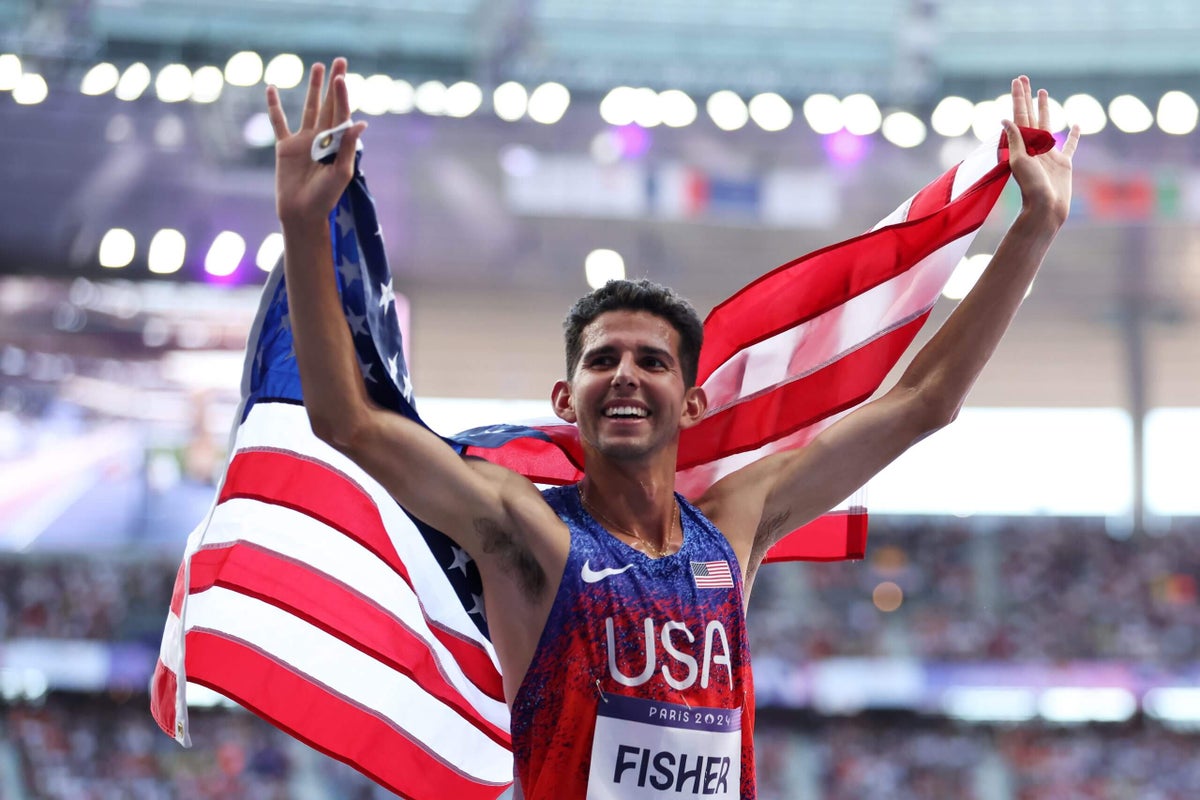
Grant Fisher calls it “uncharted territory”, his step into the unknown to make Olympic dreams a reality.
The 28-year-old American, a double Olympic bronze medalist over 5,000m and 10,000m two years ago in Paris, will make his 13.1-mile debut at the New York City half-marathon on March 15, the long-term goal being the full marathon on home soil at the Los Angeles-hosted Olympics in 2028.
In an exclusive interview before his participation in New York is announced later today (Thursday), Fisher tells The Athletic: “I’ve been thinking about it (half marathon) for a while, thinking about the L.A. Olympics and which events I want to target. Always in the back of my mind is the full marathon. To potentially do that at LA, I need to do a half marathon this year, so that I could do a full marathon next year, and get into it by 2028.”
He first spoke with New York Road Runners, the event’s organizers, in November.
We might have seen Fisher on the roads last year but for the World Championships being held in Tokyo, Japan, in the middle of September, where he doubled-up on the track in the 5,000m and 10,000m, finishing eighth in both finals.
“It’s a lot of unknown, especially in an off-year (with no global championships). At this point in my career, it’s fun to shake things up,” he said during a 30-minute video call from the high-altitude of Flagstaff, Arizona, a change of scenery having been “snowed out” of Park City, Utah, where he lives and usually trains in the surrounding mountains.
Fisher picked the New York race because of the sense of occasion, but the mid-March date also means he can run a full indoor season and have time to prepare for the biggest half marathon in the United States, which follows part of the city’s full marathon course.
“I want to have the feel of a major in this first try. I want it to be a real attempt,” he says. “There’s pressure in being the new guy, but also a lightness, a freedom where, if it goes great, awesome; if it goes poorly, I still have several years of being competitive on the track.”
By those next Olympics, the Canadian-born, Michigan-raised Fisher will be 31 years old.
“In the past, pro careers were seen to be structured; that either you go to the roads immediately, or you stay on the track for as long as you can, and then go to the roads and just fade into the sunset. I don’t really want to do that,” he says, adding that athletes today are no longer pigeonholed as solely track or road runners because there is “more crossover”.
Take fellow men’s mid- and long-distance runners Josh Kerr, Marco Arop, Jimmy Gressier, Andreas Almgren and Jakob Ingebrigtsen. All are primarily track athletes who, to use Fisher’s words, “dance up to the half marathon and see how it goes”. Likewise, he has respect for Conner Mantz, the U.S. record holder for both the marathon and half marathon, for how he “dips his toe” into track races and “keeps that speed up”.
“The footwear allows for that transition a little easier now than in the past,” Fisher adds, in reference to super shoes (and super spikes), the technological advancements in shoe foams and the addition of carbon plates which have revolutionized athletics.
The Stanford University graduate, where he was a 12-time All-American, had immense cross-country success in NCAA competition between 2015 and 2019, winning a national title over 5,000m as a sophomore, having run in his first Olympic trials while a freshman in 2016. In the decade since, he has been incredibly consistent, making two World Championships and two Olympic teams, doubling-up every time in the 5,000m and 10,000m and never finishing lower than ninth.
Eventually, the records and medals came.
His distance-double bronze medals at the Games in Paris were the first time an American has finished on the podium in the two events at the same Olympics.
Last February, he set indoor world records over 3,000m and 5,000m within the space of a week.
When Fisher then clocked 3:48.29s in July at the Bowerman Mile, the blue ribbon event at the Eugene, Oregon, Diamond League meet, he became only the second man, after Ethiopia’s Yomif Kejelcha, to break 3:50 for the mile, 13 minutes for 5,000m, and 27 minutes for 10,000m.
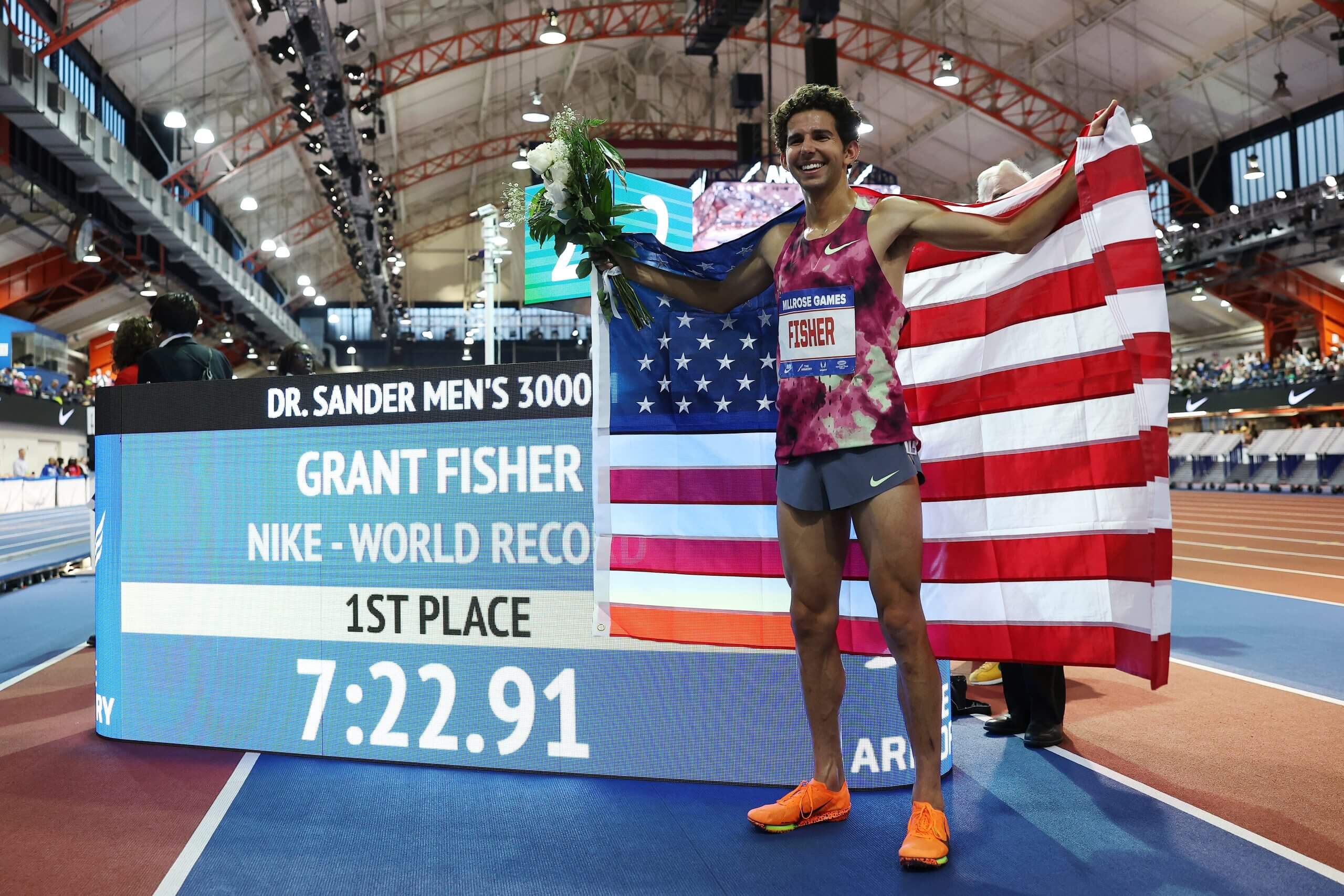
The American set a new world indoor record in the men’s 3,000m last February. (Sarah Stier / Getty Images)
The rankings speak for themselves. Fisher is the No.1 U.S. man over 3,000m, two miles, 5,000m and 10,000m, putting him in the top 10 globally for all those distances bar the 5,000m, where he’s 11th.
“The past few years have been fantastic, much, much more than I ever anticipated when I first started running professionally,” he says. “The 2024 season was a huge, huge success. The Olympics are the biggest thing, so coming home with medals is as good as it gets.” He quickly interjects to correct himself: “Almost as good as it gets, I guess.”
That 10,000m men’s Olympic final was the quickest in history — 13 runners went under the previous Games record as Joshua Cheptegei won in an Olympic record 26:43.14s, edging Berihu Aregawi to silver and Fisher to bronze, the American finishing just three-tenths of a second behind the champion.
Running that final at the “packed and loud” Stade de France was, Fisher says, an “out-of-body experience”.
“I had built up so much into that race. That was about a year after I switched coaches and training environments,” he explains, having gone back to Mike Scannell, his high school coach, after four years with Nike’s Bowerman Track Club, based in Portland, Oregon.
“I knew going into that race I had a shot to do something special … Getting your flag after and doing the podium lap, that’s stuff you never forget. So much goes into a medal. Right after that race, it all came flashing in front of my eyes — all the people, all that hard work. A moment of joy, tons of relief, because there I had put a lot of pressure on myself.”
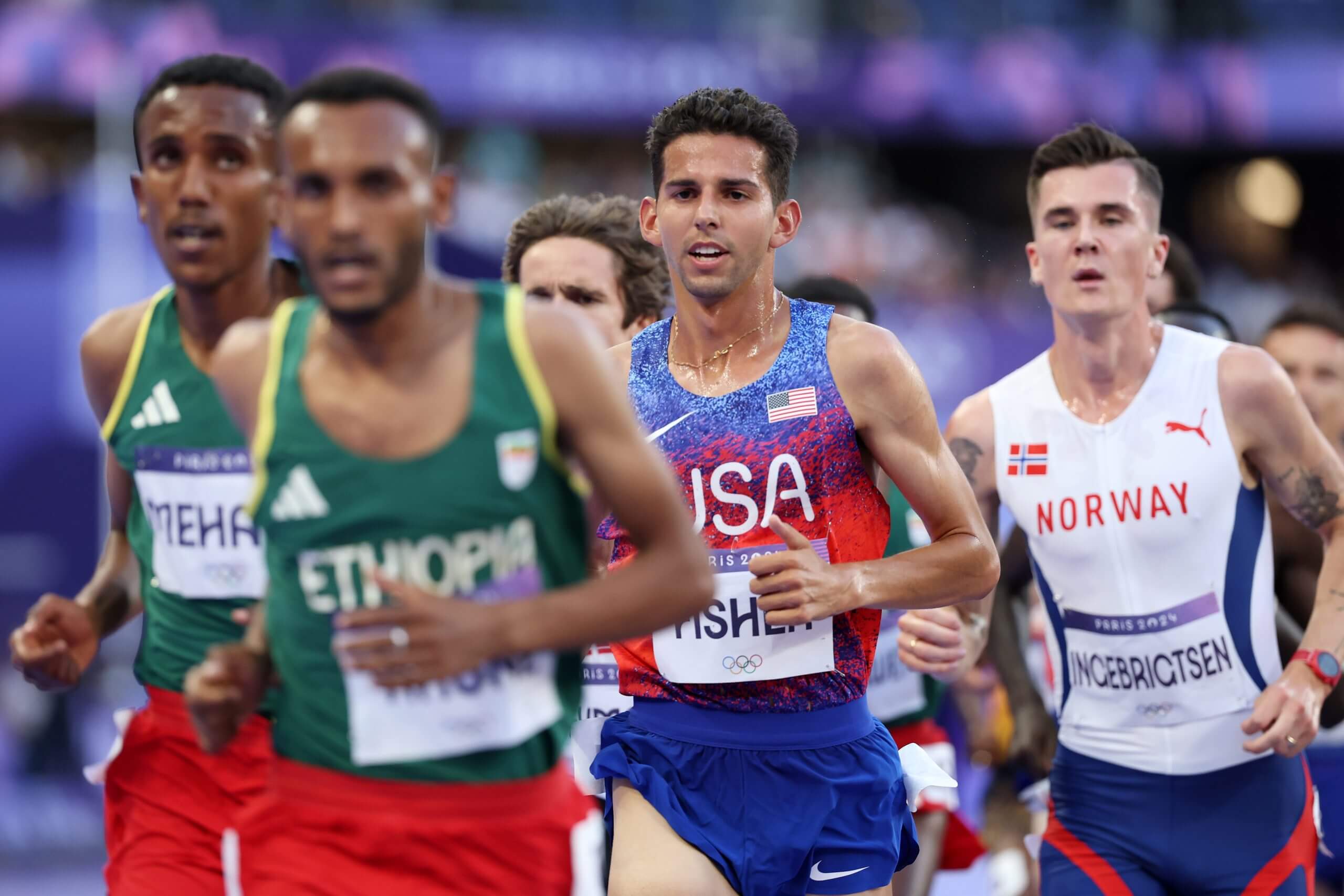
Fisher running the men’s 5,000m final at the Olympics in Paris in August 2024. (Patrick Smith / Getty Images)
Winning medals “raises your expectations,” says Fisher, so, comparatively, the 2025 outdoor season proved to be one of ‘nearlies’ — especially when set against his indoor successes earlier in the year.
He came second in the 5,000m and 10,000m finals at the U.S. national championships in late July and early August, meaning that while he qualified for the World Championships, he did not retain the titles he’d won the year prior. Over 3,000m at the Diamond League final in Zurich a few weeks later, he was out-kicked by Frenchman Jimmy Gressier and again had to settle for being the runner-up. Those eighth-placed finishes in the 5,000m and 10,000m in Tokyo meant the year did not end in glory.
“I was running really fast at the beginning of the year, I got some really cool records and had fun. By the end of the year, I just ran out of steam and was a little fried. It was a long year and I over-committed the training a bit early,” he says.
In many ways, Fisher could not have picked a worse time to start road racing.
He references the Houston half marathon earlier this month, where Americans Alex Maier (59:23), Casey Clinger (59:34), Ryan Ford (59:48) and Isai Rodriguez (59:57) all cracked one hour, and Rory Linkletter came away with a new Canadian record (59:49).
“The U.S. men’s group has really levelled up across basically every event,” he says. “We used to always be competitive in sprints and throws and jumps, but now middle and long distance are up there. The level has changed. You go back a few years ago, and if an American were trying to break 60 minutes (for the half marathon), that was groundbreaking.
“On the track, I think, 800m through 10,000m, the U.S. is pretty competitive internationally. The marathon is starting to come into that fold. We have really strong marathoners who can get on a major podium and are thinking about medalling at a World Championships or an Olympics.”
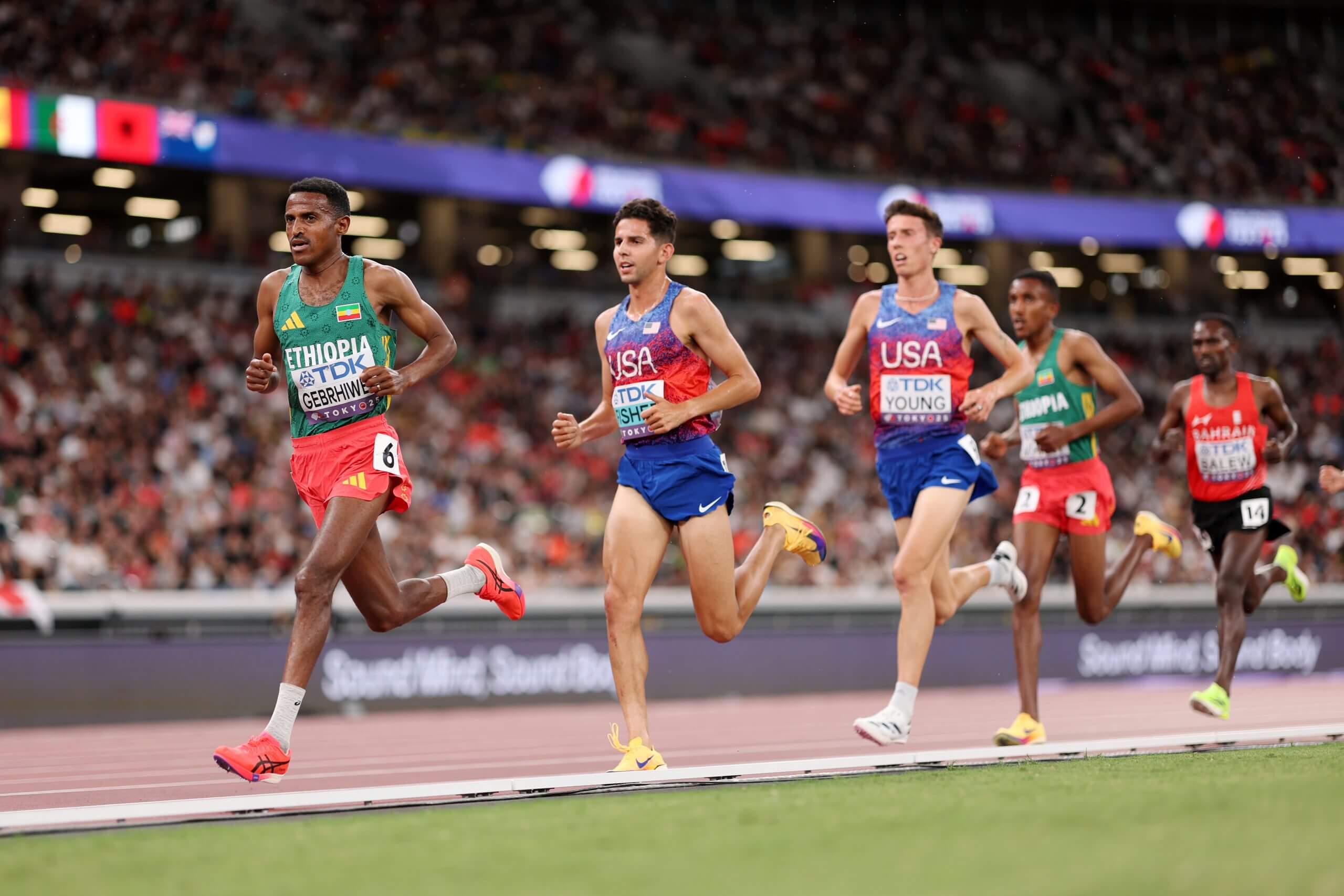
America’s Fisher finished eighth in the men’s 5,000m final at the 2025 World Championships. (Cameron Spencer / Getty Images)
Fisher says he occasionally runs with Clayton Young, ninth-fastest on the U.S. men’s marathon all-time list, and Mantz. “I started asking Conner about the half marathon maybe a year ago, picking his brain about it and how different it is than the track,” he says.
He has a “blank slate” in terms of a target time on a “pretty tough” New York course, but there is another reason not to have a targeted finish time.
“Because I haven’t done the targeted half marathon training yet, I don’t know how the fitness translates,” he explains. “Once this indoor season wraps up and I’m able to hit a few half marathon-specific workouts, I should get a better idea. I’m kind of going in blind.”
Tactically, Fisher realises he will need a “slightly different mindset shift” from the track, where he attacks based on distance rather than landmarks.
There are risks, he concedes, to trying to balance both sides of his sport.
“It’s hard to fit in a road race when you’re focused on the track all the time, focused on your speed and trying to be strong in championship races. It’s a different skill set to what you usually need on the roads,” Fisher says. “You risk a little bit, but I think I can learn much quicker in that environment (New York) than if I were to just time-trial by myself somewhere. I hope it’s a good transition.
“The older I’ve gotten in the sport, I’ve realised opportunities aren’t infinite. You only have so many attempts out there.”