
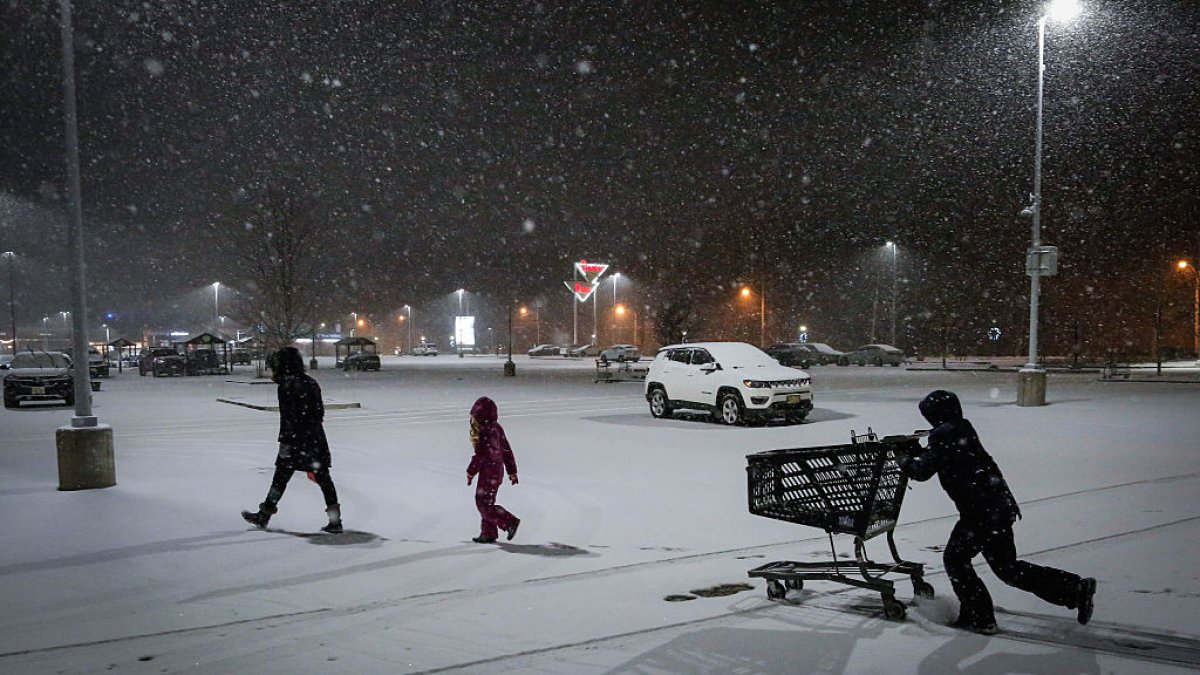
Your governor issued a State of Emergency ahead of the anticipated winter storm heading our way, but what does this mean for you?
New York Gov. Kathy Hochul announced a State of Emergency during her press conference Friday on the state’s preparation ahead of the winter storm that is expected to pummel the tri-state region this weekend into Monday.
New Jersey Gov. Mikie Sherrill and Connecticut Gov. Ned Lamont have scheduled press conferences on Friday afternoon, at which time they could also declare a State of Emergency for their states, which is expected considering the forecasted snowfall. However, as of Friday morning, both these states have not announced a State of Emergency.
Here’s a breakdown of a how a State of Emergency declaration impacts residents of a state.
WHAT IS A STATE OF EMERGENCY?
A State of Emergency can be declared when a governor believes a disaster has occurred or may occur.
A State of Emergency is a declaration issued by a governor saying that — in this instance — weather may end up being severe enough that the state sees it necessary for state-level coordination and resources to support local governments responding to the severe weather conditions or its aftermath, according to the New Jersey Office of Emergency Management.
This declaration, according to the NJOEM, allows the governor to make resources “immediately available to rescue, evacuate, shelter, provide essential commodities.”
DOES A STATE OF EMERGENCY AFFECT YOU?
Because declaring a State of Emergency gives the governor the power to send out resources more quickly, things like emergency response centers, snow plows, police and other first responders tend to be deployed more rapidly during a State of Emergency. This means streets are salted and cleared of snow as fast as possible and first responders are on alert for any emergency that may arise.
The declaration, according to the NJOEM, also lets the State seek federal assistance when the event that brought on the State of Emergency, in this case weather, becomes too much for state officials to handle because it “exceeds the State’s resources,” allowing for resource requests and easier communication with federal officials.
AM I BANNED FROM TRAVELING? DO I HAVE A CURFEW DURING A STATE OF EMERGENCY?
Not necessarily. A State of Emergency does not automatically restrict anyone from going outside or ban traveling. However, there may be travel advisories that are issued.
According to New York’s Oswego County, “travel advisories issued during a “state of emergency” do not prohibit travel but instead, they caution residents about hazardous conditions.” Such is the case with New York City. The city’s Mayor Zohran Mamdani issued a “hazardous travel advisory” for Sunday and Monday — the expected peak and immediate aftermath of the storm.
“So if you need groceries. If you need a new winter coat — anything, frankly, that you are thinking about this weekend, today is the day to make that trip,” he said during his Friday morning press conference on the city’s winter storm preparations.
The same can be said about curfews — there is no automatic curfew that is imposed during a State of Emergency.
However, the state government may decide to limit access to certain areas impacted by the emergency because of public safety concerns. If this is the case, the public will be notified.
Travel restrictions may be announced following a State of Emergency declaration that may make certain roadways off limits for safety reasons or traveling during certain times may be prohibited. Curfews could also be enforced. However, if this were to happen, this would require a specific and separate order, and state officials will announce it to the public.
DOES A STATE OF EMERGENCY SHUT DOWN STATE OFFICES? SCHOOLS?
No. A State of Emergency, on its own, does not automatically shut down government offices.
In the case of New Jersey, if the governor decides to close State offices, she will make an announcement to the Cabinet and then to the public.
Meanwhile, when it comes to schools, districts decide whether to close schools during a State of Emergency. However, for the most part they tend to do so when it comes to such events.
In the case of New York City, during his press conference Friday morning, Mamdani said the city is still deciding whether to have an in-person school day or remote day on Monday. (New York City got rid of traditional snow days for students for the first time during the 2022-2023 school year.)