
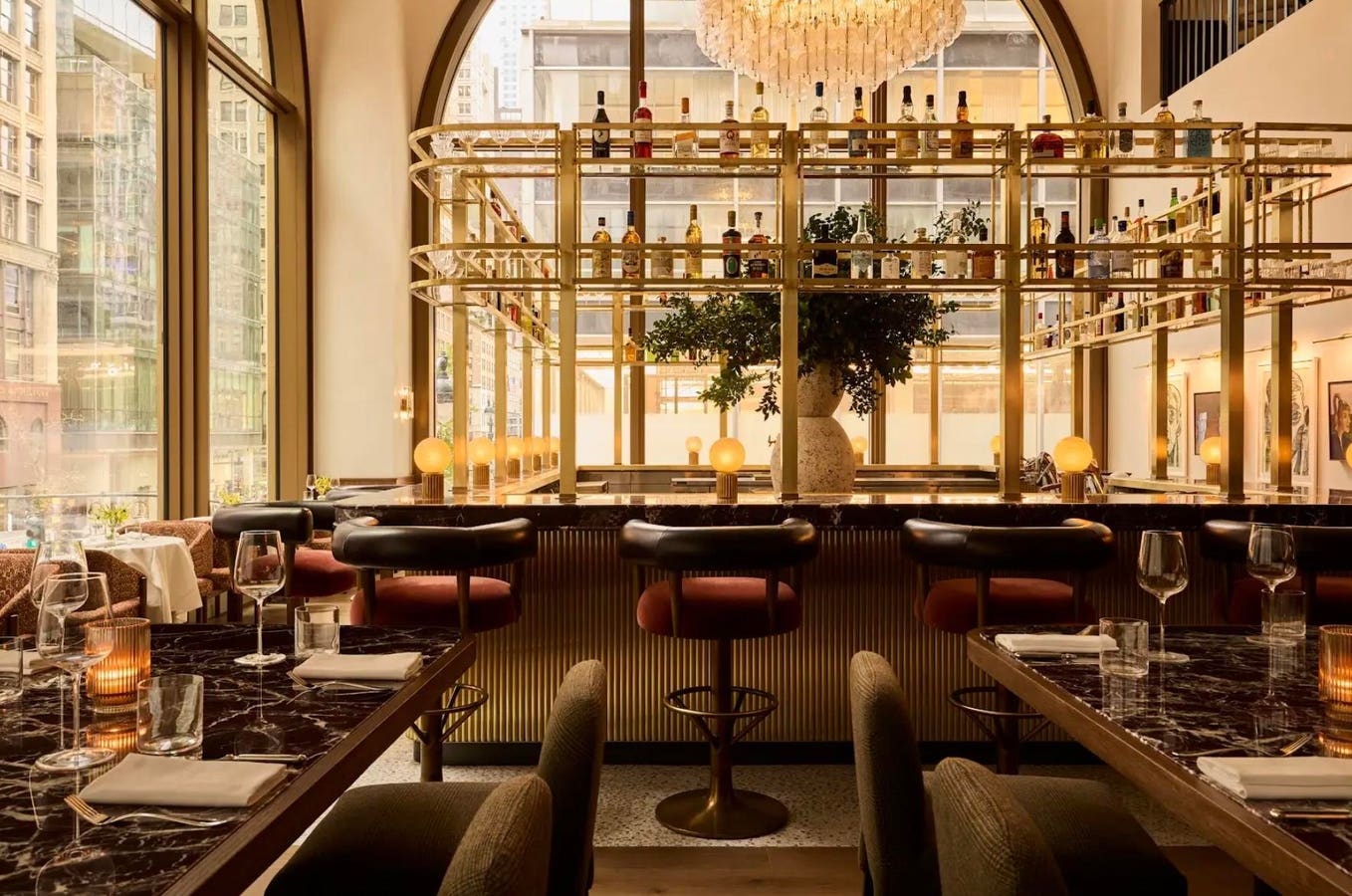
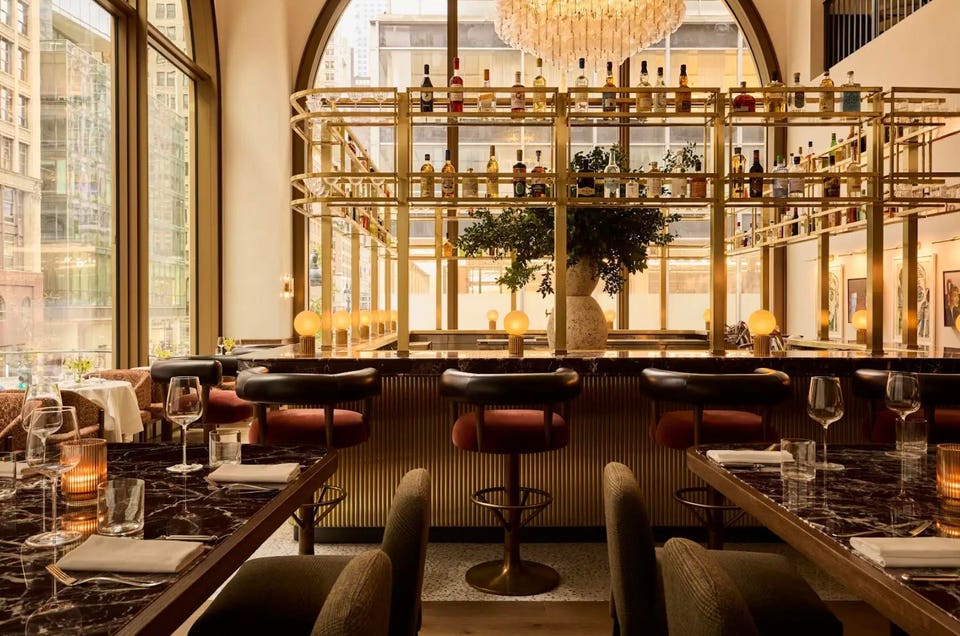
The main bar at the new Moss member’s club in midtown Manhattan
Nicole Franzen
Once a relic of a bygone era, members-only clubs have seen a surge in recent popularity. Nowhere else in the country has embraced the boom quite like Manhattan. Since the pandemic, there have been nearly a dozen high-profile openings across the city, each one offering its own carefully cultivated brand of elegance and exclusivity – accompanied by sizable initiation fees.
The latest to enter the landscape is Moss, part of a geographic shift in the trend towards Midtown. Occupying five stories–and 40,000 square feet–worth of space in 520 5th Avenue, the newcomer seeks to stand apart from the crowd with a focus on health and wellness. This includes multiple floors dedicated to aquatic fitness and athletics as well as multiple food and drink spaces featuring conscientious cuisine as conceived by chef Angela Zeng – formerly of Frenchette, an enduringly popular bistro in Tribeca. An ambitious wine program is led by Kristin Courville, formerly the lead sommelier at The Bazaar by José Andrés.
All of it unfolds across a comfortable interior that combines the sophistication of Art Deco-inspired furnishings with the effortless comfort of a SoHo loft. And it’s offered with relatively modest member fees – by Manhattan standards: initiation costs start at $1500 with monthly dues as low as $480. Taken together the brand forms a distinctive whole that its co-founders Colleen and Hailey Brooks have coined as “intelligent leisure.”
We sat down with the folks behind Moss to learn more about the concept, along with what members can expect to eat and drink while hiding away from the midtown masses.
The following interview has been edited for length and clarity.
The team behind Moss New York (from left to right): Chef Angela Zeng, Pastry Chef Taylor Kim, Co-Founder Hailey Brooks, Wine Director Kristin Courville, Co-Founder Colleen Brooks
Will Pippin
Let’s start off with the basics. How do you define “intelligent leisure?”
Colleen Brooks: “Intelligent leisure is our vision of thoughtful and thought-provoking programming—an open invitation to gather friends and play with ideas. Inspired by historic creative and intellectual communities, Moss events range from art exhibitions and musical performances to interdisciplinary salons and supper clubs. They’re a chance to pull up a chair for an evening, lose oneself in the conversational flow, and think differently.”
When you began developing Moss, what role did food and beverage play in your vision of “intelligent leisure?” Was it central from day one, or did it evolve alongside the club’s wellness and cultural programming?
Hailey Brooks: “It was always an integral part of our vision for the club, and we think it touches both our intelligent leisure and physical culture ethos.
Tell us more about that physical culture ethos.
CB: “Physical culture is the art of integrating movement, balance, rest, and a bit of competition into your daily routine. It speaks to the fundamental human desire to gather together to exercise, nourish, and celebrate the body in all its forms. Our Physical Culture programming is housed at our two-level Bedrock Aquatics & Athletics, which offers 20,000 square feet for individuals and groups to pursue the physical and social sides of fitness, wellness, and athletics.”
HB: “Food embodies a similar duality to the club. A dining experience can be just as mentally stimulating as it is nourishing. It truly represents that mind-body balance we’re always talking about.”
How do you see food and drink helping foster community within the club, especially among members who may not come from the same worlds?
CB: “It’s no doubt fine-dining, but our food is always rooted in the comforts of home. You should feel like you’re in your own space with your own private chef. We want it to feel like a classic New York City dinner party amongst friends, every time.”
HB: “In general, it’s all about sharing and sparking conversation, including about the food. We think everyone will recognize something familiar and comforting on the menu while also encountering something new and interesting. This applies to our bar program, too. Every ingredient in our cocktails is meant to spark interest and connection with and between our members.”
Tell us more about that beverage program and what kind of unique cocktails are being constructed.
Kristin Courville [wine director]: “We work closely with our bar manager, Raul Zavala, to create deeply integrated menus across our dining and bar programs, using the same ingredients. Our collaborative cocktails follow the same Spanish essence as the wine program. With my rich background in Spanish wines, I love to incorporate Spanish wines and spirits like sherry, Pacharán, and cava into our cocktail offerings. Angela also uses our wines in her cooking, as does our pastry chef, Taylor Kim.”
It feels as though there’s an emphasis on drinks that can move easily between day and night; for example, beverages that feel appropriate post-workout but still work at a dinner table. Was this intentional?
KC: “We purposely chose spritz selections for lighter daytime drinking, martinis for evening, and non-alcoholic options with ingredients like coconut and green juice for hydration, with post-Bedrock recovery top of mind. At Moss, the beverage program is designed the same way our programming is designed: with intention and narrative. The drinks aren’t simply offerings at a bar; they’re part of how the club expresses its identity as a thoughtful, creative, and socially generous space. Our non-alcoholic cocktails, in particular, have become a signature of the program. They’re not stand-ins for classic drinks, and they’re not treated as a separate category. They’re original compositions built with the same care, structure, and sense of occasion as everything else on the menu. By giving non-alcoholic drinks equal footing, we remove the quiet social pressure that often exists around drinking while preserving the ritual, elegance, and pleasure of having a beautifully composed beverage in hand.”
Chef Angela, were there any ingredients, techniques, or categories you chose to prioritize because they aligned with Moss’s focus on physical culture and longevity?
Angela Zeng: “Maintaining our dedication to sustainability, where ingredients are carried throughout the different dining and beverage spaces, is very important to us. We’re always challenging ourselves and our teams to make one ingredient stretch across many items; our back-of-house learns to stretch budgets and get creative. We’re not trying to reinvent the wheel, but find practical and delicious ways to cut down on food waste, which we think is especially important in a city like New York.”
How closely do you listen to member feedback when evolving the menus, and how do you balance that with maintaining a clear point of view?
CB: “We listen very closely. Being part of a members club, it’s essential to listen to your members. All of our menus are designed to be adaptable and flexible for food sensitivities and preferences. We strike a nice balance between providing a wellness-minded menu and honoring our flavor profiles. We’re constantly fine-tuning and tailoring our offerings to what our members want and need, and we try not to be too rigid about what we offer.”
Food and drink at the new Moss New York members club
Adrianna Glaviano
FOR Moss FOUNDERS What does “thoughtful hospitality” mean to you in practice when it comes to food and drink — and how does that show up on the plate or in the glass?
Our food and beverage offerings are carefully created and curated by our amazing team. Each one of Angela’s dishes and every bottle of wine Kristin selects reflects their unique points of view. We wanted to focus on shareability and social dining. Our dishes are definitely meant to be shared, to complement, and to facilitate the socializing happening in the club.
FOR Moss FOUNDERS
FOR CHEF ANGELA In a city filled with members’ clubs and destination dining, how do you want Moss’s food and beverage experience to feel emotionally different for members?
We always wanted the food and beverage program to take on a life of its own within the club. My formal training, travel through Latin America, and culture are all reflected in our menus. We want to always make sure we are accommodating, can adjust for our members, and remain flexible while retaining our own identity.
FOR CHEF ANGELA How did you approach menu design, knowing members might move through the space multiple times a day — from morning wellness to evening social hours? Was there a guiding principle or question you returned to when deciding what to (or not to) put on the menu?
We started with very classic dishes, then got creative about how they could adapt from casual breakfast to a fine-dining experience to a small plates-and-drinks format. We want each space in the club to feel special and unique as you move through the day and different dining periods.
FOR CHEF ANGELA How does sourcing and ingredient transparency factor into your menus, especially for members who are deeply attuned to what they consume? Were there any ingredients, techniques, or categories you chose to prioritize because they aligned with Moss’s focus on physical culture and longevity?
Maintaining our dedication to sustainability, where ingredients are carried throughout the different dining and beverage spaces, is very important to us. We’re always challenging ourselves and our teams to make one ingredient stretch across many items; our back-of-house learns to stretch budgets and get creative. We’re not trying to reinvent the wheel, but find practical and delicious ways to cut down on food waste, which we think is especially important in a city like New York.We also collaborate closely with our bar manager, Raul Zavala, to incorporate ingredients from dining into our beverage program as much as possible.
FOR KRISTIN Special wines to note?
As Angela mentioned, we work closely with our Bar Manager, Raul Zavala, to create deeply integrated menus across our dining and bar programs, using the same ingredients. Our collaborative cocktails follow the same Spanish essence as the wine program. With my rich background in Spanish wines, I love to incorporate Spanish wines and spirits like sherry, Pacharán, and cava into our cocktail offerings. Angela also uses our wines in her cooking, as does our pastry chef, Taylor Kim!
FOR KRISTIN How did you think about beverage as both a social lubricant and a wellness touchpoint — particularly in an era of mindful drinking and moderation?
Wine, to me, is relaxing and a sensory experience that keeps you present. One of our top-selling wines, funny enough, is from Bedrock Wine Co. We chose to serve Bedrock wines by the glass as an ode to the gym and spa, and it happens to be one of our best sellers.
FOR KRISTIN Did you intentionally design drinks that could move easily between day and night — for example, beverages that feel appropriate post-workout but still work at a dinner table? How do non-alcoholic and low-ABV options factor into the club’s overall beverage identity rather than being an afterthought?
We purposely chose spritz selections for lighter daytime drinking, martinis for evening, and non-alcoholic options with ingredients like coconut and green juice for hydration, with post-Bedrock recovery top of mind.
At Moss, the beverage program is designed the same way our programming is designed — with intention and narrative. The drinks aren’t simply offerings at a bar; they’re part of how the club expresses its identity as a thoughtful, creative, and socially generous space.Our non-alcoholic cocktails, in particular, have become a signature of the program. They’re not stand-ins for classic drinks, and they’re not treated as a separate category. They’re original compositions built with the same care, structure, and sense of occasion as everything else on the menu. By giving non-alcoholic drinks equal footing, we remove the quiet social pressure that often exists around drinking while preserving the ritual, elegance, and pleasure of having a beautifully composed beverage in hand.
FOR Moss FOUNDERS How closely do you listen to member feedback when evolving the menus — and how do you balance that with maintaining a clear point of view? Looking ahead, how do you envision the food and beverage program evolving as members’ relationship with wellness, leisure, and hospitality continues to shift?
We listen very closely! Being part of a members’ club, it’s essential to listen to your members. All of our menus are designed to be adaptable and flexible for food sensitivities and preferences. We strike a nice balance between providing a wellness-minded menu and honoring our flavor profiles. We’re constantly fine-tuning and tailoring our offerings to what our members want and need, and we try not to be too rigid about what we offer.