
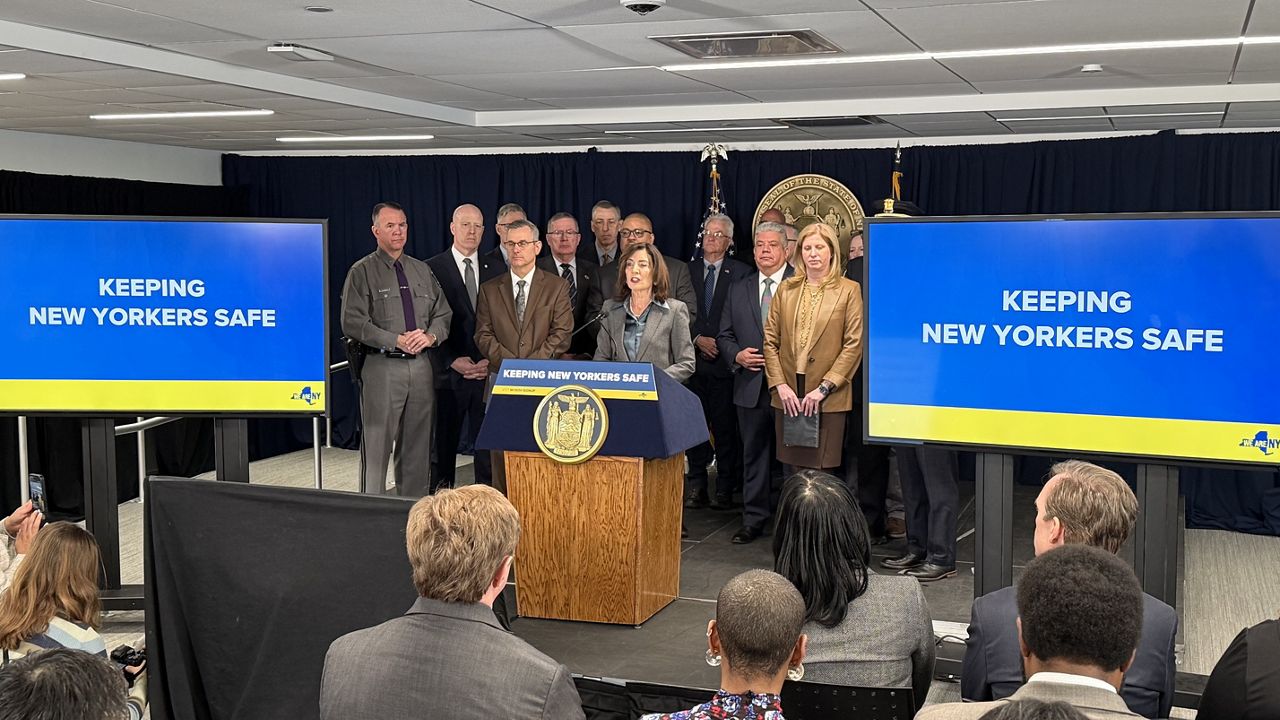
Gov. Kathy Hochul on Friday proposed a new law to restrict local police from working with federal agents on civil immigration enforcement.
The legislation would bar state municipalities from entering into agreements that allow their officers to help U.S. Immigration and Customs Enforcement carry out immigration-related arrests. It would also stop the agency from using local jails for civil operations.
What You Need To Know
Gov. Kathy Hochul on Friday proposed legislation that would bar local police from working with federal agents on civil immigration enforcement
The move comes in response to the recent ICE crackdown in Minneapolis, where two people have been shot and killed by federal agents within the past month
At a press conference, Hochul noted that police would still be allowed to assist with criminal enforcement
The move comes in response to the recent ICE crackdown in Minneapolis, where two people have been shot and killed by federal agents within the past month.
At a press conference, Hochul noted that police would still be allowed to assist with criminal enforcement.
“Police will continue to help federal agents track down violent criminals. This never has changed, it never will change,” she said. “But what I don’t want them doing, and they will no longer do, is aid armed forces who think they can occupy our streets, scare our children, round up our neighbors — neighbors separated and rounded up just because of the color of their skin.”
The governor said the proposal was personal for her.
“I’m a mom. I’m a grandma. I’ve got a 6-month-old grandbaby,” she said. “Do you know how hard people work to [keep] safe and protect their children? And you expose them like that?”
“My God, what has happened to this country? What has happened here?” she added. “We’re taking steps today, we’re standing up and saying who we are, but can we just remember, we’re America?”
To see the plan become law, Hochul would first need to secure the support of the state Legislature.
The governor is also pushing to add private homes to a list of “sensitive locations” that would be protected from civil immigration enforcement under separate legislation proposed in her State of the State address.
In Nassau County, where County Executive Bruce Blakeman is also the Republican candidate for governor, Friday’s proposal drew immediate pushback.
“Governor Hochul is the most pro-criminal governor in the United States who has a callous disregard for the safety of our communities and victims of crime,” Blakeman said in a statement. “When I am governor I will veto that legislation.”
Department of Homeland Security assistant secretary Tricia McLaughlin, meanwhile, maintained the move would “make New Yorkers less safe.”
“Our partnerships with state and local law enforcement are key to removing criminal illegal aliens including murderers, rapists, pedophiles, gang members, and terrorists from American communities,” she said in a statement. “When politicians bar local law enforcement from working with us, that is when we have to have a more visible presence so that we can find and apprehend the criminals let out of jails and back into communities.”
The Legal Aid Society, however, threw its support behind the move, calling it a “welcome step toward protecting immigrant New Yorkers from harmful federal overreach.”
“While New York City’s existing sanctuary and detainer laws already prohibit such collaboration, this measure is a significant step for the rest of the state, affirming that New York celebrates and protects immigrant communities,” the group said.
“We also support Governor Hochul adding New Yorkers’ private homes to the list of sensitive locations — alongside houses of worship, schools, and hospitals, as announced during her State of the State Address — where immigration enforcement is not permitted,” it added. “These steps strengthen existing constitutional protections that require a judicial warrant for ICE to enter these spaces.”
Hochul’s proposal is also backed by district attorneys in Manhattan, Brooklyn, Staten Island, Albany and Onondaga County, according to a release from her office.