
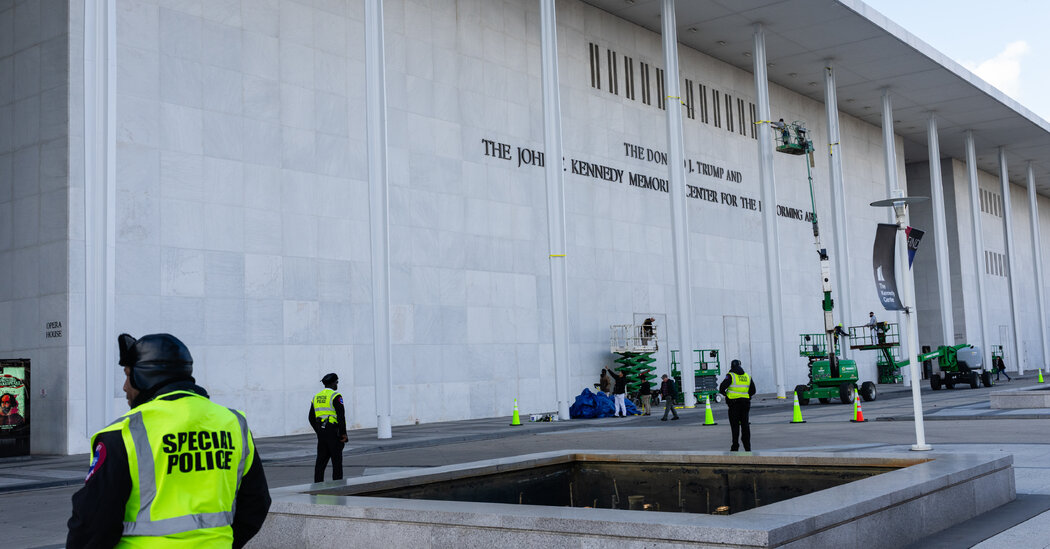
President Trump announced Sunday that he would shut down the John F. Kennedy Center for the Performing Arts, which has been battered by cancellations and boycotts, for two years starting this summer. He said that would allow his administration to transform what he called “a tired, broken, and dilapidated Center,” into “the finest Performing Arts Facility of its kind.”
Mr. Trump’s announcement came after a major backlash by performers, contributors and audience members and amounted to a sudden change in direction for what has been a high visibility initiative of his second term.
From his first weeks in office, Mr. Trump set out to remake the center, opened as a tribute to John F. Kennedy after his assassination in 1963, in his image. But in the discussions of that remaking, which included talk of renovations, there had been no public discussion of anything as drastic as a full two-year shutdown.
In recent months, Mr. Trump had attached his name to the center, installed loyalists to run it, including Richard Grenell, the center’s president, and called for changing the programming there to make it more in line with what he said was widespread American tastes and sensibilities: more “Les Miz” and less “Hamilton,” as he put it on one visit to the center.
The reaction has been harsh and unrelenting. Last week, Philip Glass, the acclaimed American composer, said he was withdrawing Symphony No. 15, which had been commissioned by the National Symphony Orchestra in tribute to Abraham Lincoln, that was to be performed there in June. A week earlier, the acclaimed soprano Renée Fleming canceled a performance.
The Washington National Opera announced last month that it was cutting its ties to the center, and the other classical music anchor there, the National Symphony Orchestra, has been playing to empty seats.
But Mr. Trump, in his social media post, made no mention of the cancellations or the patrons who are now staying home: attendance at the National Symphony Orchestra is down 50 percent over last year. Instead, he presented it as his latest effort to rebuild part of Washington — following the demolition of the East Wing of the White House and his proposal to build a towering arch across from the Washington Monument.
The Kennedy Center underwent a major renovation and expansion in 2019 under Deborah Rutter, the Kennedy Center president who left shortly after Mr. Trump took office. But Mr. Trump had earlier seemed unhappy with that expansion, which cost $250 million, saying “they built these rooms that nobody is going to use.”
The president said that funding had been found for his new project — but did not say how much it would cost or where the money was coming from. Last year, Mr. Trump secured $257 million from Congress to help with capital repairs on the building, and his allies have credited him with having “saved” the center.
He offered no details of what kind of reconstruction he had in mind, other than to say it would entail “Construction, Revitalization, and Complete Rebuilding.” Mr. Trump said the changes would have to be approved by the Kennedy Center board — which he controls — but made no mention of whether it would need approval by Congress as well.
The center will shut down on July 4, he said Sunday, coinciding with the nation’s celebration of its 250th birthday. He said that a dramatic step was necessary to safeguard one of Washington’s most treasured cultural institutions.
“In other words, if we don’t close, the quality of Construction will not be nearly as good, and the time to completion, because of interruptions with Audiences from the many Events using the Facility, will be much longer,” he wrote on Truth Social. “The temporary closure will produce a much faster and higher quality result!”
The decision was a dramatic intervention for a performing arts institution that, in recent years, has put on more than 2,000 performances and events annually.
The staff at the Kennedy Center has undergone its own transformation over the past year as dozens of employees, many with decades of experience in arts programming, have been fired or quit. On Sunday, some staff members and one Kennedy board member said they had learned the news through the president’s announcement. Shortly after, Mr. Grenell wrote in a staff-wide email that “we recognize this creates many questions as we plan to temporarily close most of our operations.”
“We will have more information about staffing and operational changes in the coming days,” the email said.
White House officials declined to address questions about when the president had reached his shutdown decision or whether he intended to seek Congressional approval for the project.
Mr. Trump’s takeover of the center has been met with objections from some Democrats in Congress who have challenged his legal right to rename the center.
On Sunday, Representative Chellie Pingree of Maine, the top Democrat on the House subcommittee that oversees funding for the Kennedy Center’s building, questioned the motivation for the planned closure in a video posted to social media, suggesting that the president was just “covering up the financial disaster he’s created there.”
“This man has destroyed the place,” she said in the video. “He’s run it into the ground financially; he’s made it a place where performers don’t want to perform, and individuals don’t want to attend performances.”
In an interview, she said her staff was seeking a legal opinion on whether the president could make a decision to shutter the venue without the involvement of Congress.
Representative Joyce Beatty, a Democrat from Ohio and an ex officio member of the Kennedy Center’s board, said Mr. Trump had “acted with total disregard for Congress,” which she said should have been consulted.
“Countless employees, artists, and others likely have existing contracts and agreements with the Center,” she said. “What happens to them? Has Trump or his handpicked Board given any consideration to their livelihoods or futures? This is exactly why congressional oversight is so important.”
In a post to X on Sunday, Mr. Grenell wrote that the center “desperately needs this renovation,” and that the closure would enable its staff to “better invest our resources, think bigger and make the historic renovations more comprehensive.”
Mr. Trump, who has described his renovation projects in Washington during his second term as a “relaxing” part of his job, has already involved himself in the minutiae of the center’s building. He ordered federal workers to paint the building’s gold columns white, and he commented on its chillers and boilers.
Renovation plans have been said to include redoing the seats in the opera house and replacing 30-year-old pieces of rigging equipment backstage, but a two-year shutdown suggests far more ambitious plans.
There was no immediate word where the National Symphony Orchestra, which has vowed to keep playing at the center in the midst of the exodus, would perform over those two years. In a typical year, the orchestra plays as many as 150 performances at the Kennedy Center.
The Washington National Opera has already begun to find other halls. “The W.N.O. is grateful to the performance venues who have committed to partnering with us in the coming seasons,” said Francesca Zambello, the artistic director of the opera. The organization has already scheduled one opera for Lisner Auditorium at George Washington University.
Mr. Trump made his announcement on what has always been a busy night for American culture and music: the Grammy Awards are taking place in Los Angeles. And it came two days after he used the center as a venue for thepremiere of a documentary about his wife, “Melania.”
Shawn McCreesh contributed reporting.