
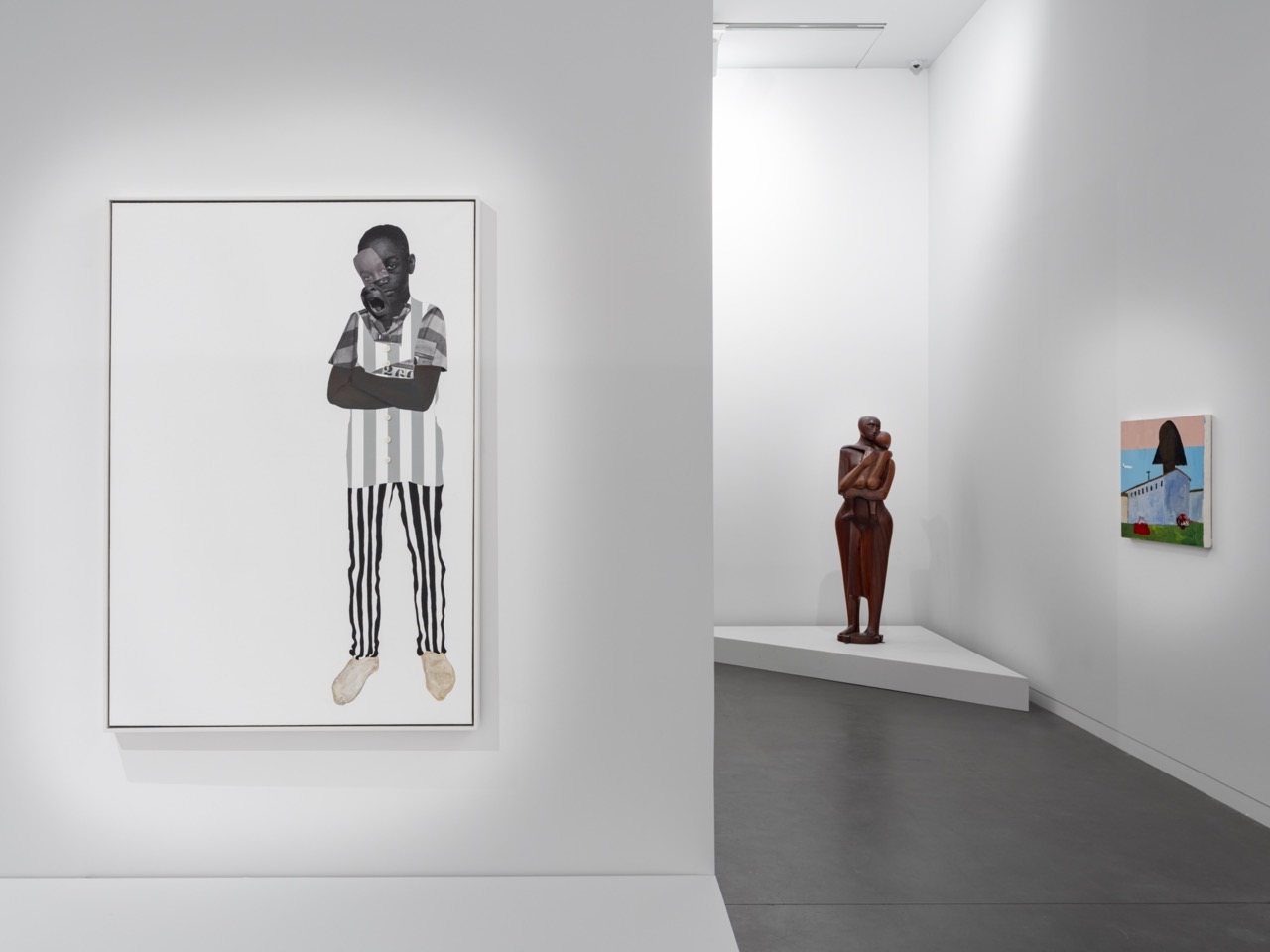
From Now: A Collection in Context
Studio Museum in Harlem
November 15, 2025–August 16, 2026
New York
In acts of war, the first mission of an invader is to destroy a peoples’ image of itself. Like a scheming lover with aims to pillage, distract, and destroy, the first task is to study, the second to seduce, and the third to siphon from the mind, body, and spirit. This mode of conquest is perhaps the most devastating and certainly the most subtle. In our time of excessive media, the barbarism that assaults the senses is discreet. Destructions that were once imposed by physical forces and crippling laws—though both seem back in style—are now mainly dispelled through narrative. The project of empire in our automated world is not only about the subjugation of the body but also the manipulation and manufacturing of the conscious mind.
From Now: A Collection in Context, the Studio Museum’s inaugural exhibition in its new building, advances like a battalion covering large swaths of land, prepared to blitz history’s stunted standards with its flank defending a border of the sacred imagination. The curators—Connie H. Choi, Jayson Overby, Kiki Teshome, Maya Davis, Simon Ghebreyesus, Taylor Ndiaye, and Maria Wilson—have assembled not a static display but an evolving, rotating call-and-response drawn from the museum’s deep holdings. The exhibition inverts the logic of panopticism: the gaze still surveils, but through an active and emancipated lens—one that reimagines the right to look, to name, to know, and to remember without Eurocentric distortions.
This mode of unveiling begins, fittingly, with David Hammons’s Pray for America (1969), a work that feels more like a concrete reminder than a critique. The male face—discernible by its white beard—protruding from a cloaked American flag is dusky, sharp, and finely boned; the hand rises in the abhaya mudra, that gesture shared across Buddhist, Hindu, Jain, and even extreme Afrocentric traditions, signifying fearlessness. The piece sets the moral temperature for what follows: an unleashed vision of art as a sacred act—as a spiritual defense—and as a mirror in communion with the truest self, seen at last without blunted eyes.
Following the Hammons is Lorraine O’Grady’s Art Is… (1983/2009), which remains an inquiry into what it means to frame joy, dignity, and the vastness of beauty. Her gilded borders capture Harlem’s African-American Day Parade through portraits that truly merit the term “still life,” heralding the highest aspirations. What O’Grady names is the truth the art world keeps begging us to forget: Black people have long generated aesthetic logics that predate, reject, and surpass Eurocentric ideals. We cannot be contained by the stereotypes colonialism created for us, or by the flattering inversions we craft in protest; our imaginations, at their purest, have always exceeded frames.
O’Grady’s original performance was a joyful incursion, undertaken with no assurance of acceptance—a Duchampian gesture meant for the people rather than the institutions that routinely ignore them. Its brilliance lay in its refusal of analytic distance. As Marimba Ani reminds us, European frameworks approach aesthetic experience through analysis—to objectify it, to verbalize it incessantly—and much of European art still remains, to quote Aziza Gibson Hunter, the “the invisible clothing of the West”: the scaffolding of a nationalist psyche. Art Is… rejected that scaffolding. O’Grady offered the parade a moment unburdened by the Western compulsion to explain itself, a space in which Black people recognized themselves as masterpieces without mediation. Which is why the installation here—a quiet grid of evenly spaced frames—feels gently at odds with the work’s original spirit. A project that once leapt out of the frame is now coaxed back toward order, its exuberant rupture softened into documentation. The images remain luminous, but the elation—the risk, the insurgent joy of crashing a party—sits slightly subdued behind glass.
Unfolding through a dizzying sequence of thematic constellations—Body, Sound, Nature—the exhibition offers answers to questions that are viciously censored. In the section devoted to Sound, there is, beneath the silence, a change in air, a thickness that permeates the room. On one wall, Glenn Ligon’s Untitled (Speech/Crowd #3) (2000) anchors the space. To its right, a Stanley Whitney grid hums softly—blocks of ochre, rust, and cobalt breathing through thin lines. Beneath it, a drawing of color and notation turns sound into pattern, while nearby a Rapunzel-esque tangle of painted cords by Jennie C. Jones, Shhh and Electric Clef (2012), stiffens mid-vibration, its shadow trembling against the wall. To the left, a cardboard boombox sits mute, stripped to its form, and farther down a dark arched painting absorbs the light like a low note.