
Jo Warren
All Mouth
Out-FRONT! Festival
Judson Memorial Church
January 8, 2026
New York
A rising glow illuminates five characters glitching through their own sitcom arcs. Propelled by a warm, synth-heavy sound score by Ryan Gamblin, Jo Warren’s All Mouth turns off the subtitles as we watch images of the archetypal suburban American family crack, distort, and rebuild.
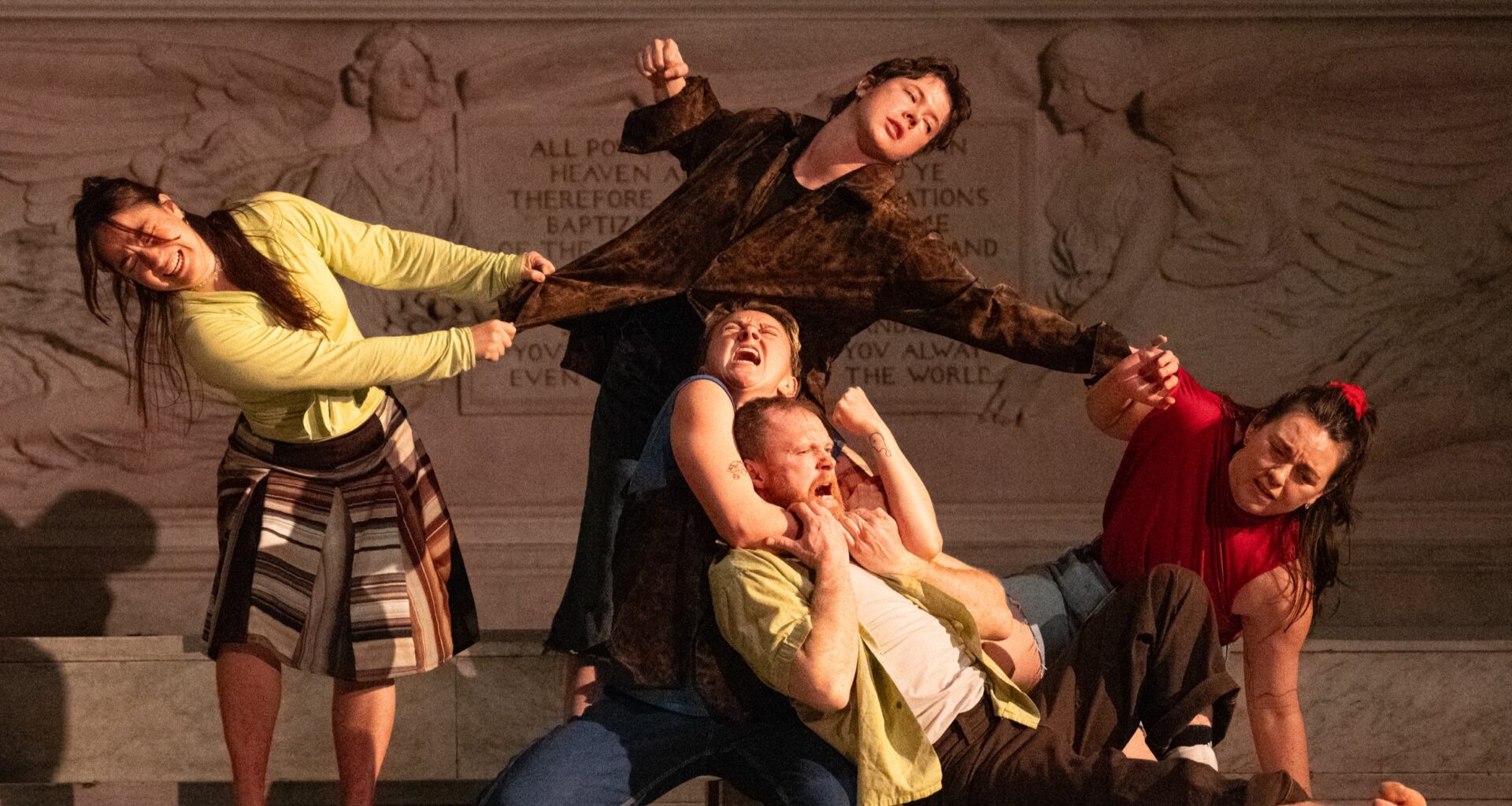
Presented as part of Out-FRONT! Festival’s 2026 programming, All Mouth centers a cast dressed in nineties-style scrunchies, stretchy skirts, and button-downs. The group repeats a sharp chorus of grimaces and grasps, traveling slowly toward a raised platform at the back of Judson Church, where they cohere into a tableau that evokes both the Pietà and a Full House cast poster. Awkward smiles and straight spines clash with torsos draped across laps and pained expressions. As they shift between cradling, choking, and silently cursing at each other, Warren’s performers seem to play out a familiar TV show or bible story, muted, in half-speed.
Their roles continue to morph. Alternately embodying mother, enemy, and lover in quick succession, the dancers pass the slippery force of power between their bodies. Who is responsible for whose hurt? Who taught us to uphold our most deeply-held morals? What does it mean to be good to each other? The drama continues to unravel with no definitive answers in sight.
Warren is not afraid of lingering, favoring repetition in their choreography as a method of revealing the weak points of our visual assumptions. They loop pedestrian waves and shoulder shrugs for minutes at a time, interjecting a few moments of somersaults and parkour-style athleticism.
As the piece progresses, Gamblin’s soundscape begins to cloud like static. Bursts of the performers’ voices pierce through, as though they are trying to escape the haze. They yell, blurt out hanging insults, and then go silent again. At times, these now-familiar characters seem lost within the storm. Meg Herzfeld paces back and forth in their solo, arms adamant and cutting as they sidestep close to the audience. They repeatedly shove away attempts from other performers to soothe and support, caught in the thrall of steps that no longer appear to be of their own accord. It can be easy to forget our own agency. Herzfeld’s isolation onstage drives home the risks of this amnesia.
Over time, we witness subtle shifts to the performers’ vocabulary. A brow unfurrows, eyes finally meet ours with recognition. These small changes add up. Just as we come to assume we understand the pattern, it breaks. The family tableau drips off the raised platform. A duet that once appeared steady fizzles and separates. Our organizing structures, Warren reminds us, are no more fixed than our emotions. The church, the family, and the countless other mythologies that structure American life are shared constructions.