
Formal Wear
American Academy of Arts and Letters
September 27, 2025–February 8, 2026
New York
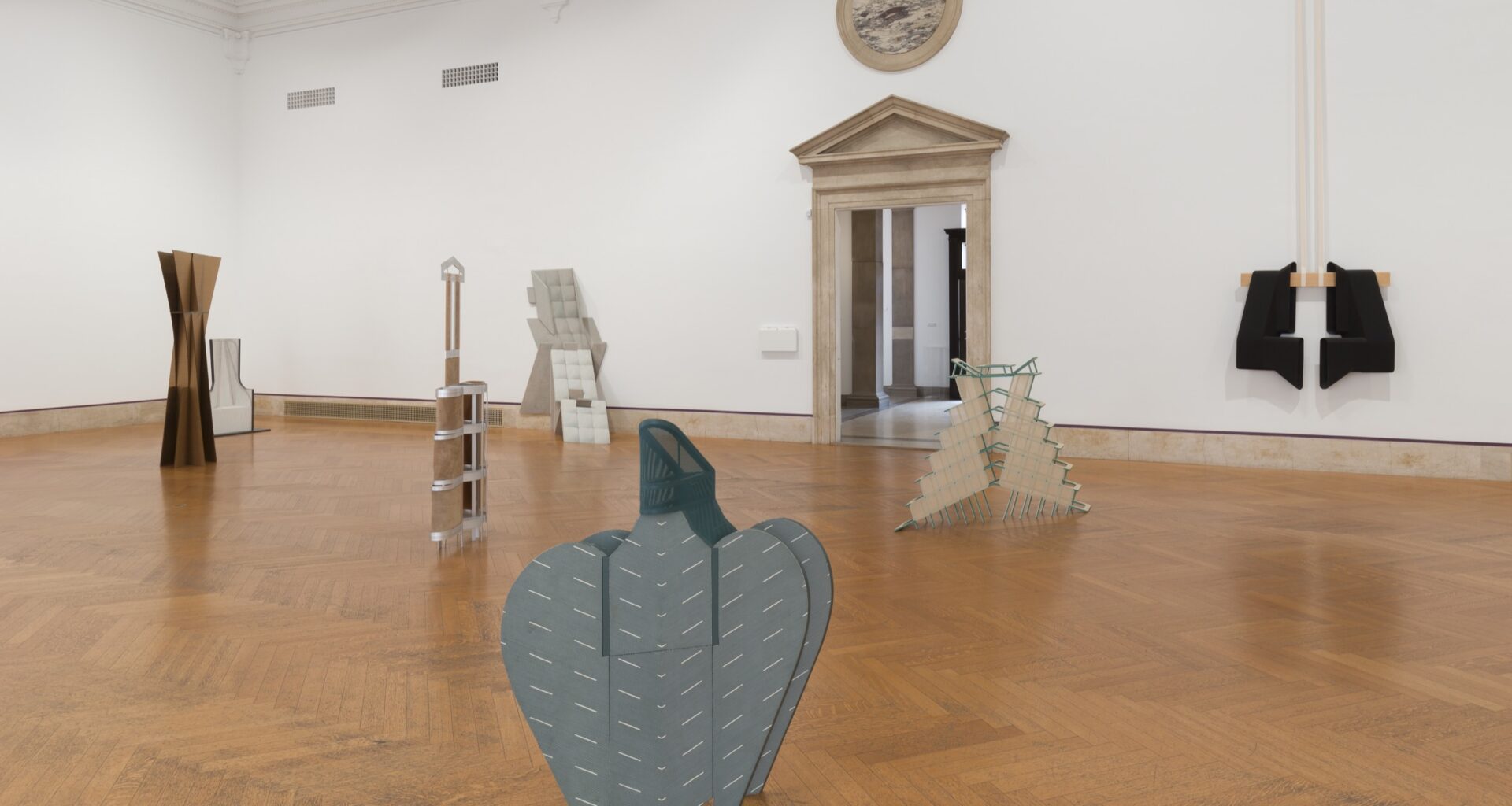
Diane Simpson has gained considerable visibility since her retrospective at the Institute of Contemporary Art, Boston in 2015–16 and her inclusion in the 2019 Whitney Biennial. Now—at the age of ninety—she is the subject of a career survey of sculptures and works on paper from the mid-1970s through 2022 at the American Academy of Arts and Letters in upper Manhattan, as well as a concurrent show of outdoor sculptures at the Art Institute of Chicago (her hometown). The American Academy of Arts and Letters exhibition in particular shows Simpson to be an artist worthy of all this recognition and more. It also reveals her as a figure who does not easily align with art historical narratives linked to the Chicago Imagists or Post-Minimalism, either of which we might imagine to undergird or explain her work.
Simpson made much of her art at home, first at the dining room table and then in the garage as she scaled up in size, all while raising her children. As Audrey Wollen wrote in an essay accompanying the American Academy of Arts and Letters show, Simpson’s light, transportable, and self-assembled works “wear her problems, the rooms in the house where she lived, and her resulting systems of ad hoc solutions, on their (literal) sleeve.” To me, this constellation of identities (artist, mother, suburban, solve-as-you-go) is particularly useful for understanding her work. For while it was once customary to assess the challenges faced by artists who are mothers as setbacks, Simpson thoroughly normalizes this position alongside a broader cohort that includes Janine Antoni, Ruth Asawa, Eve Biddle, Louise Bourgeois, Jackie Brookner, Madeline Donahue, Loie Hollowell, Mary Kelly, Hein Koh, Sally Mann, Marisa Merz, Ree Morton, Karin Schneider, Amy Sillman, and many more who mother(ed), even if they did not all bear children themselves.
The artists from this list transpose elements of domestic life or care into their practices, as Simpson does via allusions to household objects and childhood wonders: chairs, paper dolls, origami, dress up. Simpson’s chair sculptures in the American Academy of Arts and Letters exhibition—Chaise (1979), Neighbor (2021), and Winged (2022)—are all askew, as if inhabiting a dream world where their frames have been tugged out of joint by a marionette string. Likewise, Peplum IV (2015) straightens the ruffles of the eponymous sartorial flourish in four perforated aluminum panels, creating a child-sized hollow form whose eggplant enamel edges carry the work’s ornamental logic beyond the work and into the gallery architecture itself. A painted stripe of the same color runs low along the wall. Like a hinge between wall and floor, this ribbon provokes us to question the boundary between Peplum IV’s implied body and its surroundings, and, more broadly, between any body and its environment.
But there is also a more profound way that Simpson’s works engage her position as an artist, one that operates at the level of ontology rather than resemblance. In translating any given artwork from sketch to sculptural incarnation, Simpson disavows the conventional practice whereby a 45-degree angle on the page represents 90 degrees in real space. Instead, she retains that same 45-degree angle in three dimensions, yielding sculptures that seem to slant or fold in on themselves. The result of this play with distortion are sculptures that disrupt our expectations of both how things look and the very rules of spatial projection and apprehension.