
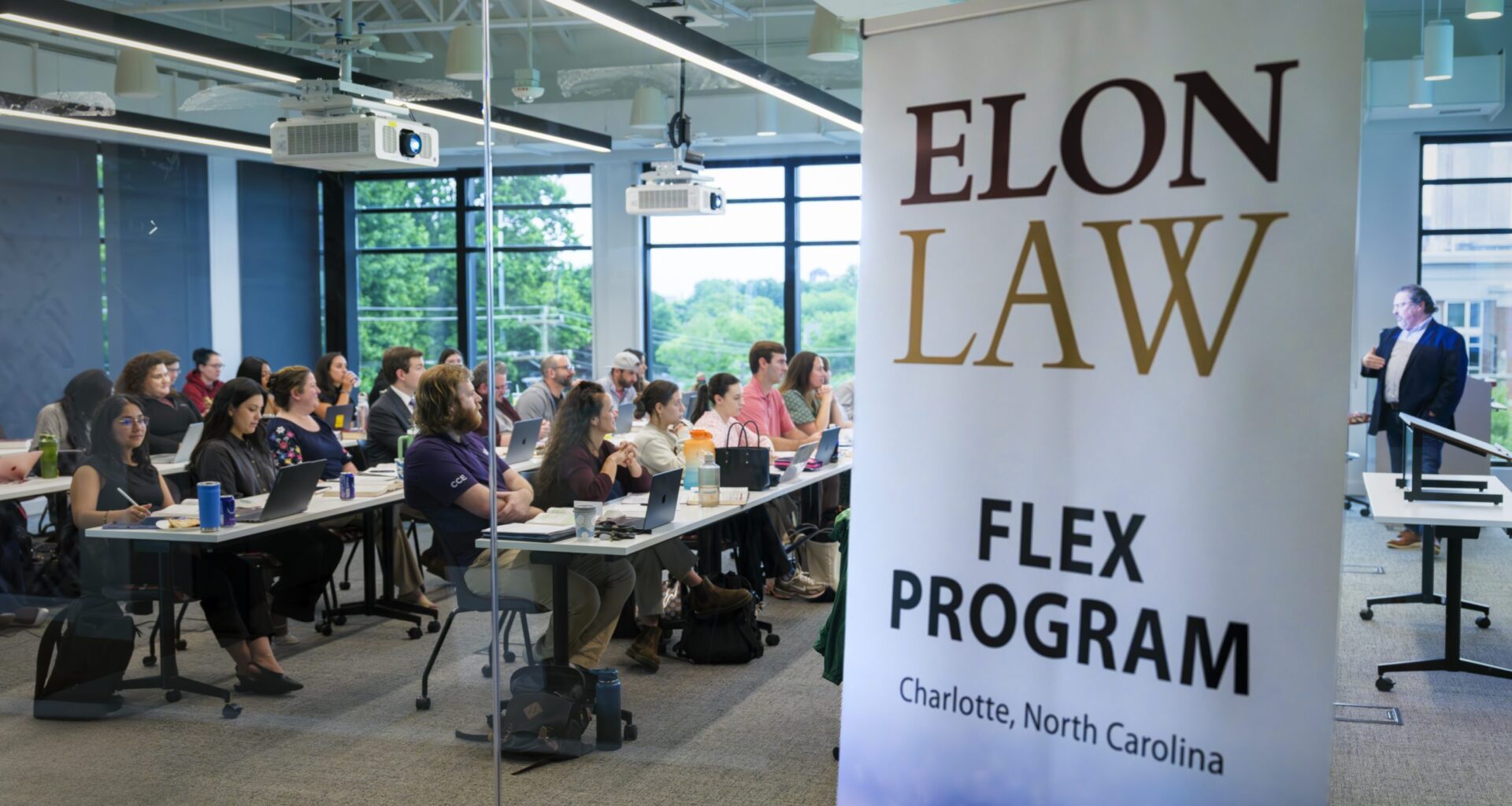
Elon University is filling a longtime gap in the Charlotte market with the announcement of its new law school program that will accept applications this fall and begin operating in the city in the fall of 2027. The part-time flex program and full-time Juris Doctor program options will both be based at the Queens University campus, shedding further light on the merger announced between the two universities in 2025.
Elon has made no secret of its desire to establish roots in Charlotte over the years. The university launched its part-time law flex program in the Queen City in 2024, recognizing the “unmet demand” in the area and offering specialized courses pertaining to Charlotte’s biggest industries like banking, health care and sports and entertainment. Then the 2025 merger with Charlotte-based Queens University sent shockwaves through higher education as Elon made its biggest swing yet toward the state’s largest city.
The new program is sure to shake up the legal education scene, seeing as all six of North Carolina law schools are currently concentrated in the closeby Triangle and Triad regions of the state.
John Lassiter, president of Carolina Legal Staffing and former president of the Mecklenburg Bar Association, said Charlotte has benefited from the North Carolina law schools as well as University of South Carolina School of Law as far as hiring new graduates. The real detriment has been to law students who might be interested in a summer internship in Charlotte but find it difficult to accomplish due to the distance.
Elon Law is a respected, nationally recognized program with an already growing footprint in Charlotte, Lassiter said. The flex model, which Elon has been running in Charlotte’s South End since 2024, has also been successful in other urban markets like Boston and Chicago in opening up opportunities for those who want to transition into law from another field.
“When people are at different life stages or different places in their career, the ability to access a legal education without having to, in the case of Elon’s Charlotte flex program, potentially, uproot from your family and from your job for up to three years to move to the Triad or the Triangle,” said President of the Mecklenburg Bar Association Sarah Motley Stone.
“It’s a tremendous way to give people access to legal education in a way that fits with where they are.”
The flex program has already seen steady growth. Even so, while the part-time, night classes are desirable for many, that’s not what every prospective law student is looking for, Elon Law dean Zak Kramer said.
The Juris Doctor path will appeal to the other sect who are looking for a full-time experience. It’s also designed to be completed in two and a half years rather than the standard three. This gets students to graduate earlier and therefore become licensed faster, Kramer said. It also lowers costs by effectively requiring one semester less of tuition.
Elon Law’s Greensboro program is intended to fully immerse its students in the local community. That’s led to a lot of success in its 20 years, so Kramer hopes to apply those lessons as they put roots down in Charlotte.
“Because of the success we’ve had and what we’ve learned in the process to really make it a special program, we think that’s a plus that we can expand and grow our network and really enjoy the relationships we’ve created in Charlotte over the years,” he said.
“Because although we’ve been in Greensboro for 20 years, we’ve always been in Charlotte in some sense because we’ve always had graduates who are going to Charlotte, we’ve had students who are doing internships in Charlotte. So we have strong relationships, and this is an opportunity to create more relationships, enjoy and strengthen the relationships we have and bring what I think is a very special form of legal education to a city that otherwise isn’t educating lawyers.”
Past law school education in Charlotte
Prior to the flex program opening in 2024, Charlotte was the largest city in the country without a law school. But Charlotte wasn’t always a law school desert. The state’s largest city once also boasted the largest law school in the Charlotte School of Law, founded in 2005 by the now defunct InfiLaw System.
Charlotte Law operated for about 10 years until the American Bar Association placed it on probation in 2016 and ordered the school to inform students of “failings of its admissions policies and curriculum.” The government subsequently revoked its access to federal student loans.
Students then filed a class action lawsuit in late 2016 against the school for misleading students and applicants when it did not abide by the ABA’s order. The school was unable to requalify for its license once it expired in 2017, leading to its immediate closure.
Lassiter recalled when InfiLaw first expressed interest in opening a law school in the city. Once the school opened, it was clear the for-profit, venture capital-backed company was going in a different direction than what was initially conveyed, Lassiter said.
“They did not stay small. They didn’t stay focused. They got kind of caught up in trying to grow as fast as they could to generate revenue and not necessarily maintain the integrity of the program,” he said.
National law school rankings are partially determined by bar passage rates and employment outcomes for graduates. While open, Charlotte Law sustained a number of low-performing stats in these areas that garnered criticism from the legal community, particularly because of its exorbitant price tag.
WFAE reported in 2016 only 45% of Charlotte Law graduates passed the bar on their first attempt, a stark difference from the state average of about 65% at the time. And in 2014, just 34% of graduates found full-time jobs that required passing the bar. Of the school’s last crew of graduates to take the bar in February 2018, zero out of 11 passed.
Restoring legal education in Mecklenburg
Bringing a law school back to the Charlotte area, especially one as established as Elon, creates opportunities to grow networks and engagement in a new place seeing as students are likely to practice in the area they attended school, Kramer said.
“It makes a huge difference to kind of do your education in the place where you’re going to be,” he said. “I think that really matters, and the law school is excited to be doing its part. I mean, more generally, Elon is eager to provide educational opportunities that will benefit Charlotte.”
Elon isn’t the only higher education institution eyeing Charlotte for graduate programs. Wake Forest University welcomed its first class of medical students to its Charlotte campus in 2025, making it the first four-year medical school in the city. UNC-Chapel Hill’s prestigious business school also began offering an MBA program based in Charlotte in 2022, the university’s first expansion beyond Chapel Hill.
Stone said Elon’s decision and the expansion of other institutions’ educational programs speaks to Charlotte’s rapid growth and identity as a young, vibrant city.
“You look at the population growth we’ve had over time, you look at the number of companies that have moved to the region and, in many cases, relocating headquarters,” she said.
“It’s a booming city. And with that comes people who are looking to further their education and have additional job opportunities. So naturally, you’re going to see an interest in MBA programs, in law programs and in medical school.”
The Mecklenburg Bar Association looks for ways to support legal aid and advocacy programs, and groups like Legal Aid of North Carolina and the Charlotte Center for Legal Advocacy are experiencing somewhat of a funding crunch at the moment, Stone said.
The local legal scene has been looking for ways to support those organizations and others geared toward increasing access to justice regardless of people’s ability to pay. Part of that is ensuring there are an abundance of well-trained attorneys available to them, so Stone views Elon’s new venture as a piece of that puzzle.
“From the vantage point I have on serving at the bar, I see adding a high-quality law school to the community is only going to make the city and county a better, stronger place, andI look forward to finding ways to collaborate with them and in doing that,” Stone said.
Related
Republish This Story

This work is licensed under a Creative Commons Attribution-NoDerivatives 4.0 International License. You may republish our stories for free, online or in print. Simply copy and paste the article contents from the box below. Note, some images and interactive features may not be included here.