
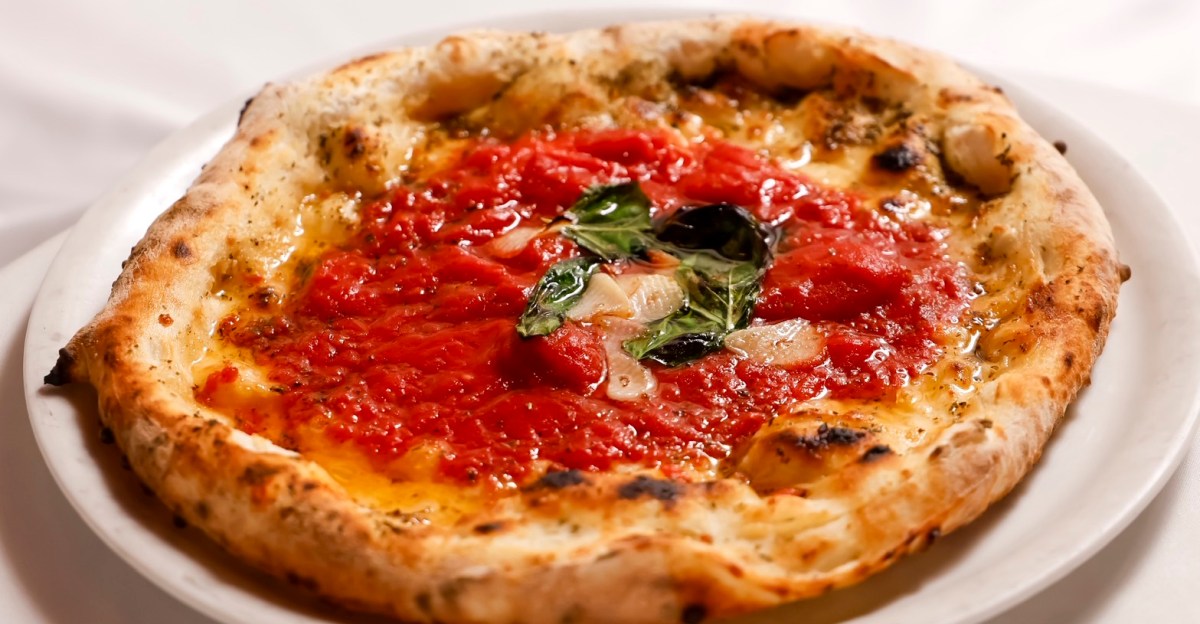
The pizzamaker widely regarded as the godfather of Japan’s Neapolitan pizza movement, Susumu Kakinuma, is heading to New York City for the first time: From Tuesday, February 24 through Saturday, February 28, Kakinuma will cook at Sake No Hana (145 Bowery, at Broome Street) on the Lower East Side, with reservations available now on OpenTable.
The news follows the recent pop-up and announcement that Pizza Studio Tamaki, from chef Tsubasa Tamaki, is moving into the Moody Tongue space in the East Village.
The collaboration is years in the making. Ralph Scamardella, one of Tao Group’s chef partners, went to Pizza Savoy in Tokyo with Jason Hall and Yoshi Kojima (both culinary VPs for Tao Group) over six years ago. “We had a great experience. We took pictures with the guys,” Scamardella says. When they returned two years ago, they learned “the guy who had started Pizza Savoy left and started his own pizzeria” named Seirinkan. They went to check it out. “There was a long line, and you couldn’t get a reservation, and in perfect New York style we went up, breaking past the front desk and pulling our way in,” Scamardella says.

Seirinkan
After that visit, Scamardella followed Kakinuma on Instagram. “He doesn’t have many followers, he doesn’t post much,” he says.
When Tao Group decided to activate the underutilized pizza oven at Sake No Hana, Scamardella contacted Kakinuma. “I just reached out to him on Instagram. And he didn’t answer; reached out again, he didn’t answer. So I had Yoshi reach out to him in Japanese,” he said — and he responded. After several conversations and an in-person meeting in Tokyo with Kojima, Kakinuma agreed to come to New York.
Hall explains that Japanese pizzaiolos “frequently toss sea salt onto the oven floor, which produces a saltier, smokier, more savory crust — distinct from the milder flavor profiles typical in the U.S.” The dough has what Hall calls a mochi-mochi texture — “springy, elastic, and chewy” — rather than airy or crisp. High heat and fragrant woods like cedar add an aromatic char.
For the Sake No Hana residency, Tao Group is importing Seirinkan’s flour from Tokyo via one of its bluefin tuna suppliers, according to Scamardella, with many Tokyo pizza masters milling their own flour to their specifications.
The menu includes three Seirinkan pizzas, including the Bianco with fresh wasabi, plus appetizers like octopus and snow beef tartare. Sake No Hana dishes like hamachi crudo and wafu carbonara will also be available.

Seirinkan
The timing puts both Kakinuma and his former student, Tamaki, in New York for pop-ups in the same month. Tamaki trained under Kakinuma at Savoy (the predecessor to Seirinkan) before opening Pizza Studio Tamaki in 2018, according to Time Out Tokyo. Both use Tokyo’s signature techniques — tossing salt onto the oven floor for extra char, plus longer fermentation times — but their approaches diverge from there.
“It was like meeting the prime minister of pizza,” Tamaki told Eater in 2017, as he remembered meeting Kakinuma. He went on to spend years studying under him. “He didn’t talk. It was like the military. He was kind and brilliant, but he didn’t say much.”
Tamaki, roughly two decades younger, is more of a tinkerer. Born in Okinawa, he initially wanted to be an architect before discovering pizza. It took him 700 attempts to perfect his flour blend, according to chef Andrea Strong, on the Strong Buzz. Whereas Kakinuma sticks to minimalism in terms of toppings, Tamaki experiments with smoked mozzarella, dramatic blistering, and cedar-scented crusts.
Before the residency begins, Tao Group plans to take Kakinuma on a Staten Island pizza tour, Scamardella says. “He’s enamored with Staten Island and Wu-Tang and all that stuff. He wants to see it like it’s the Emerald City, Wizard of Oz.”

Inside Sake No Hana. Sake No Hana