
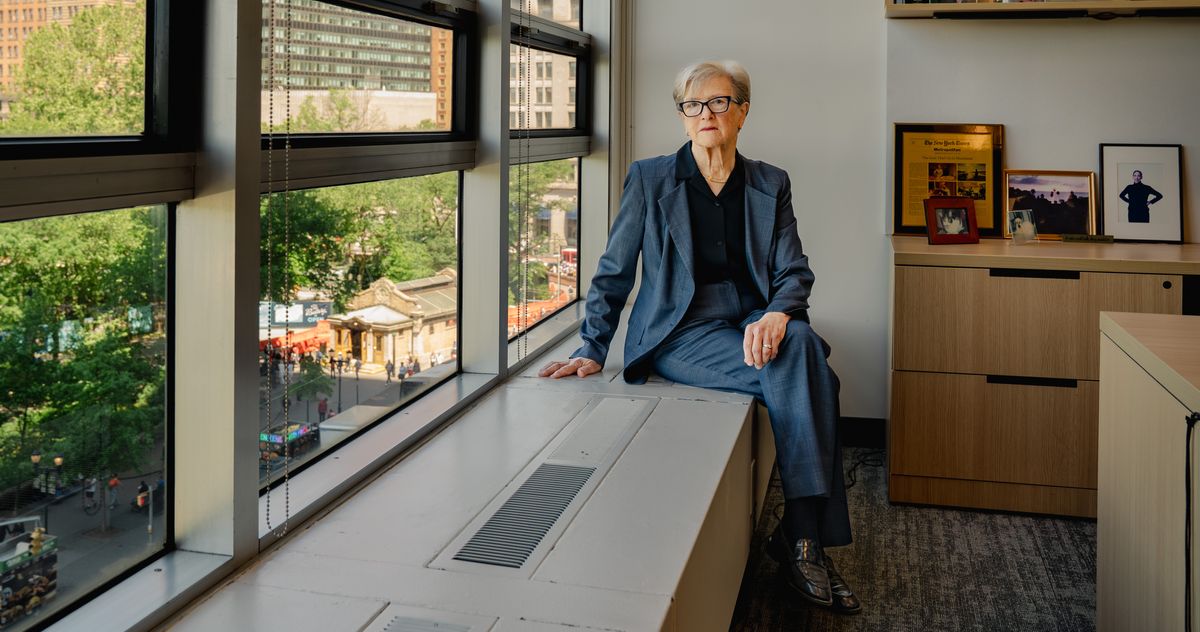
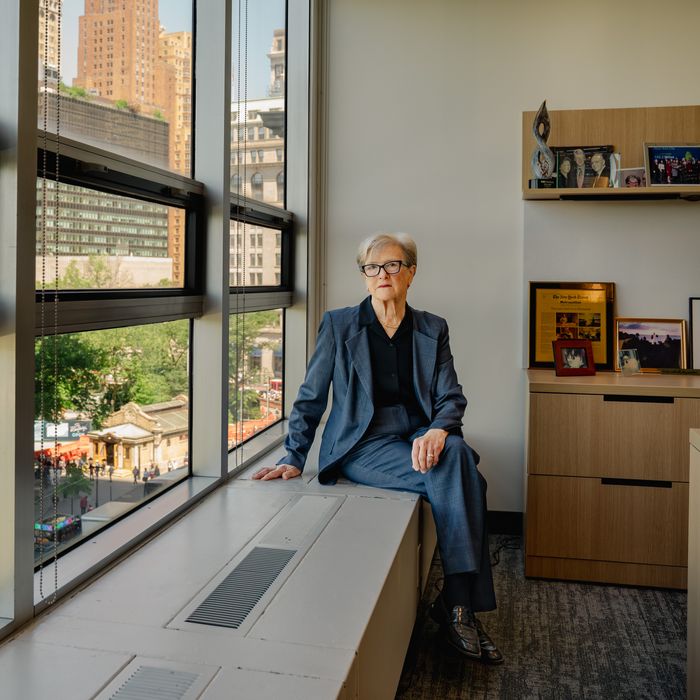
Kathy Wylde has left the Partnership for New York after a quarter-century. The group seems to be embarking on a new, more aggressive era ahead.
Photo: Shuran Huang
When Kathy Wylde stood onstage at her retirement party on a frigid Tuesday night in late January, looking out over the Rainbow Room and the glittering lights of the city below, she had a simple message for the masters of the universe who had come to see her off: Don’t panic.
“We are going to do great going forward,” she told them, trying to assuage the fears of the assembled financiers and real-estate developers who were still adjusting to life in month one of the Zohran Mamdani era in New York. For the past 25 years, Wylde has led the Partnership for New York City, a collection of 300 CEOs whose mission is to build ties between business and government. This was her swan song as she prepared to give up the reins of the group — a process that had been far from smooth or simple. She noted that David Rockefeller, the first head of the Partnership, got his start in government as an aide to Fiorello La Guardia, who she said was a democratic socialist, much like the current inhabitant of City Hall. “So not to worry.”
Wylde announced that she was stepping down last May, back when most of the bold-faced real-estate developers, billionaire financiers, and multinational corporate CEOs who make up the Partnership’s board had little reason to fear the possibility of a socialist mayor. Andrew Cuomo looked like a sure winner and had appeared at a Partnership meeting a few months prior to tell them what he thought of their little group: They were useless, punching far below their weight in city politics — which meant that New York had no countervailing force to beat back the rising tide of the left in the form of groups like the Working Families Party and the Democratic Socialists of America.
It was a bracing message, and many in the room felt that it was aimed squarely at Wylde. The two had feuded for years, despite the fact that they both hail from the moderate and pro-business wing of New York politics. So it made sense that, as Cuomo looked set to resurrect his career by reclaiming City Hall, Wylde, 79, was preparing to step aside. “What do you think I am going to do?” she told associates at the time. “Stick around for another four years and have fucking Andrew Cuomo torture me?”
That of course proved to be a miscalculation. Mamdani was still more or less unknown even to Wylde, a woman who makes it her mission to know everyone. Inside the group, his surprising win over Cuomo in the Democratic primary was seen as an extinction-level event for the city’s economy. Mamdani himself was seen as a confirmed antisemite.
Over the summer, Mamdani, eager to assuage those concerns, coordinated with Wylde to set up a series of meetings with the Partnership. By most post hoc accounts, the conversations went well, with Mamdani reassuring the business leaders that he was not the wild-eyed radical they feared. But some in the Partnership thought it went almost too well; here was an avowed socialist after all, someone who unapologetically opposed Israel, who only a few years ago was taking pictures of himself giving the finger to a statue of Christopher Columbus and tweeting about how the police were racist, anti-queer, and should be defunded, and here was Wylde, extending a hand. Or worse, putting a thumb on the scale. The Partnership is made up mostly of CEOs, but there are a few nonprofit leaders there too, and some in the room felt like Wylde was calling only on those who were more favorably inclined toward the next likely mayor to ask questions.
The day after Mamdani’s Partnership meeting, Wylde, who seemed relieved to not have Cuomo around anymore, went on CNBC’s Squawk Box and was asked what the private meeting was like. “Everyone walked away thinking he was the most impressive candidate they have seen in generations,” she told host Andrew Ross Sorkin. “He was a very compelling, charming, smart young man and gives you a sense that he is honest, means what he says, and is full of hope.”
It was jarring to Partnership members, but it was vintage Wylde, who back when Eric Adams was first elected set up weekly 7:30 a.m. Zoom calls between him and members of her board. “The Partnership is with whoever wins,” Wylde told me. She was in her bare office on her last day on the job, having just come from a lunch with Julie Menin, the newly sworn-in Speaker of the City Council, and the head of the New York Stock Exchange. That night, the Empire State Building was going to be lit up in Wylde’s honor. “Our mission is to partner with the leaders of government, labor, the nonprofit sector, to make this the best city in the world. That’s our mission, to make this a city of opportunity. This is a democracy, and we’re with whoever wins.”
As much as Wylde’s critics on the left have seen her and the Partnership as nothing more than shills for the one percent, forever pushing for lower taxes and less regulation, Wylde, who got her start as a community organizer in the arson-ravaged precincts of Sunset Park, Brooklyn, in the 1970s, has always insisted that this image of her and her group is not quite right. The Partnership is not a Chamber of Commerce or a trade association; it’s a partnership with government or labor or civic groups or whoever else wants to see New York City thrive. Over the years, the Partnership has pushed for congestion pricing, a payroll mobility tax to fund the MTA, and mayoral control of schools.
Captains of industry, as she calls them, “want the city to be successful. They want the city to be safe; they don’t want to have to worry about their kids riding the subway. It’s a misjudgment to think that these are people who can’t rise above narrow political or business interests. They can. They all do, with very few exceptions.”
But there was an increasing sense among the Partnership members, particularly the group’s co-chairs, Pfizer CEO Albert Bourla and Rob Speyer, the CEO of real-estate giant Tishman Speyer, that it was time for a different kind of leader — that this kind of above-it-all, can’t-we-all-just-get-along approach was no longer tenable. This feeling grew even stronger after Mamdani won and stronger still when Wylde, the supposed leader of their group, was not just welcoming him into their fold but going on a national cable-news program and calling him a generational talent beloved by all, including them. All this with pro-business candidates like Cuomo and Eric Adams still running, or considering it, in the general election.
“She just really stepped on it with the Zohran thing,” said one source familiar with the dynamic. “That whole CNBC interview was a ‘holy shit’ moment. People were so keyed up. There was no hedge, just her always trying to reach out to Zohran and his team. People started wondering, What are the principles of this organization? Do we fight for what we believe in, or are we just supposed to make friends at all costs?”
By this point, interviews to be Wylde’s successor were already well under way. She selected a recruitment firm and a search committee. Those who interviewed for the position told me the process was something of a mess, involving multiple Zoom interviews with individual CEOs or groups of CEOs, all of which were nearly impossible to schedule. Wylde was pushing for Adrienne Harris, the head of New York’s Department of Financial Services, but if not her, another woman, and hopefully a woman of color. There were a number of contenders besides Harris, including former federal prosecutor Tali Farhadian; Julie Samuels, the president of Tech NYC, a kind of Partnership for New York City for the digital crowd; Maria Torres Springer, a longtime government hand who served as top aide to Mayor Adams; and Daniel Garodnick, the outgoing director of the Department of City Planning.
“It was pretty clear that they were looking for someone who was much harder-hitting than Kathy,” said one person who went through the process. “There was this perception that Kathy wasn’t fighting as hard as she could, and they wanted an advocate who more directly and vociferously would advocate for their companies’ bottom-line issues.”
These feelings came to the fore last year as Albany debated rolling back some of the state’s pre-COVID criminal justice reforms. The five New York district attorneys came to a Partnership meeting and asked the group to get involved; Wylde was reluctant, fearing that it would antagonize legislative leaders. The Partnership board went forward anyway, raising $9 million among members to push for changes to involuntary commitment and discovery laws. Wylde was right, and Carl Heastie, the powerful Speaker of the State Assembly, was infuriated, but the Partnership members had a newfound taste for political combat and doubts that Wylde shared it.
“Right now the Partnership is a total disaster, and if they can’t become a political force they should not even exist, because right now they are the worst of all worlds — completely ineffective politically and yet because they exist, they deter others from acting effectively,” said Bradley Tusk, a political strategist turned venture capitalist. “It all stems from a fundamental misunderstanding of what politics is. Kathy’s view has always been you sit down with the councilmember from Staten Island and tell them what Jamie Dimon thinks — but as impressive as Jamie Dimon is, no councilmember from Staten Island cares, or cares about the white paper you just released. And so that is why the Partnership is constantly losing.”
There is talk of recruiting moderate politicians, giving them training, running ads and helping draft platforms and policy talking points that don’t focus so much on the narrow priorities of business and real estate but more on the quality-of-life and crime concerns that drive a lot of backlash to progressive politics. “As much as I disagree with the WFP and the DSA or any of those groups, they work really hard and they recruit candidates and they win races and get in big political fights that they win,” Tusk added. “But because Kathy thought that actual electioneering was beneath her, the Partnership refused to engage politically, and so it became a social club for CEOs who wanted to feel like they were doing something but they actually achieved nothing.”
But it’s a risky proposition. Anti-corporate, anti-business sentiment runs strong among Democratic primary voters in the city, and donations from real estate have become so toxic that many candidates decline to accept them. “If you go to my average partnership member, board member, head of public company, the last thing they want to do is to take on adversarial political activity,” Wylde said. “Now there are some, and clearly in the real-estate community in particular since they have suffered such political losses, they would love us as a substitute for their interests. But by and large, the last thing the heads of public companies want is to get in the middle of politics, especially locally. There is no upside.”
Partnership members supportive of Wylde say that the CEOs who want a more powerful organization misread the political moment we are in. “These guys, they all just really want to be loved, and Kathy has been managing their egos for all these years and tempering their expectations and they don’t realize how a lot of the public and the politicians perceive them,” said one. “They all have this idea that they are going to go up to Albany and everybody is going to love them, but Kathy was a master at balancing access and advocacy and sanding down a lot of their rough edges. She stopped the worst shit from happening that they don’t even know about it. They don’t realize how bad this environment is for them.”
After Mamdani won the primary, Wylde pushed to stay on beyond the end of the year; the Partnership board said no and unanimously instead picked someone whom neither Wylde, nor pretty much anyone else in New York, knew: Steve Fulop, the former mayor of Jersey City, who was just coming off a loss in the Democratic primary for governor of New Jersey.
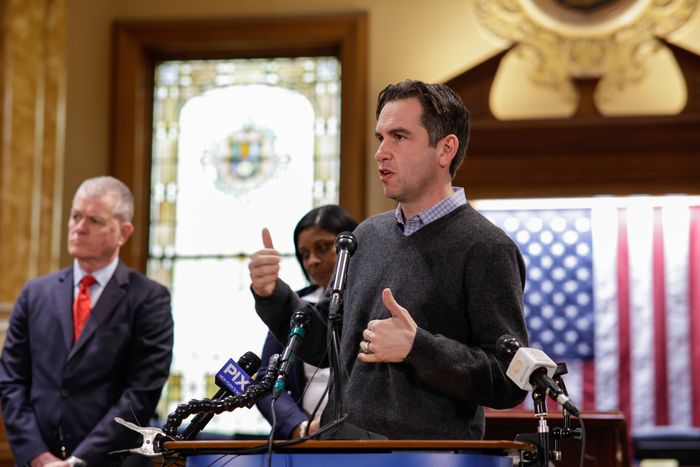
Steve Fulop, former Jersey City mayor, has taken the Partnership’s reins from Kathy Wylde.
Photo: Kena Betancur/Corbis/Getty Images
Fulop was a shocking choice, especially for allies of Wylde’s. Not only did he live across the river — and only six months ago tweeted that he didn’t want to live in New York — but he lacked any kind of relationship to the political power brokers or business leaders in the city or state. The Partnership board, though, figured that what he lacked in experience or connections he could make up for in political moxie. Since taking over, Fulop has been far more aggressive than Wylde was — for example, calling Mamdani’s proposal for a corporate tax hike “suicide for New York City.”
“Our position can’t just be, ‘Please don’t hurt us too much.’ That is not an acceptable starting place for me, and I don’t believe that is a fair starting place,” Fulop said in an interview in the same office Wylde had vacated five days before. He had just moved to the city, taking an apartment in Hell’s Kitchen, with his wife and children planning to move over after the school year.
Fulop has talked to the Partnership’s staff about “putting points on the board,” according to people briefed on the remarks, hoping to get some early policy wins right away. He has pushed for Mamdani to reverse his decision to stop clearing homeless encampments and has rallied support behind Governor Kathy Hochul’s refusal to raise taxes. Longer-term, Fulop told me he plans to push for nonpartisan elections in which the party affiliation of candidates would no longer appear on the ballot, a major priority for business leaders and moderates who believe the primary system pushes candidates too far to the left.
As Fulop sees it, his job is to advocate less for the Partnership’s CEOs and more for the 800,000 people who work for their companies. A hedge fund or a tech start-up may not strictly have an interest in homelessness or crime, but its employees might, and so the Partnership can engage politically on their behalf.
“The goal is to have one of the most respected centrist advocacy organizations within a couple of years. It takes time to build,” Fulop said, a view of Jersey City in the corner windows behind him.
Wylde is staying on as a consultant to the Partnership even as she has told friends about her disappointment with the direction of the organization she led for a quarter-century.
Meanwhile, the early days of the Mamdani administration have lived up to the fears of many Partnership members — especially Mamdani’s call for billions in new taxes and his accusation that delivery companies like DoorDash and UberEats have stolen $550 million in tips from their workers. To these critics, these actions speak to the limits of attempting a collaborative approach with the new mayor.
At Wylde’s retirement party, Bourla, the CEO of Pfizer, and Speyer of Tishman Speyer sung her praises and announced that a new scholarship had been endowed in her name at CUNY. Governor Hochul said she wished she could issue an executive order to rescind Wylde’s retirement. Wylde stood by the door, greeting and hugging well-wishers until the crowd, drinking “Wylde Cat” cocktails of bourbon and bitters with a hint of sugar and a twist of orange, began to leave. NBA commissioner Adam Silver was there, as were countless other CEOs and political power brokers, including the Speaker of the City Council, the city comptroller, the Manhattan district attorney, and the Manhattan borough president.
Zohran Mamdani was not. He had texted his regrets, but the two met the following week in Mamdani’s new City Hall office alongside Julie Su, the new deputy mayor for economic justice. Wylde had told him she wanted to be helpful, and they discussed matters of concern to the business community and the larger economic health of the city and agreed to stay in touch. The new mayor has yet to meet with Steve Fulop.