
The NHL’s Olympic roster freeze is underway, giving general managers around the league a chance to regroup until transactions are allowed to resume on Feb. 23.
For New York Rangers team president and GM Chris Drury, this time must be used constructively to plan his next moves.
He completed a couple obvious pieces of business by trading pending free agents Artemi Panarin and Carson Soucy in the days leading up to the freeze, with the Panarin deal going down right around Wednesday’s 3 p.m. buzzer. The Rangers had very little leverage due to Panarin’s no-movement clause, which limited their return to forward prospect Liam Greentree and a conditional 2026 third-round pick. That emphasizes the need to turn their remaining trade chips into substantial building blocks that will kick-start Drury’s self-proclaimed retool.
It’s a daunting task ahead, with several reasons to doubt New York’s ability to maneuver its way out of trouble and avoid a more thorough rebuild.
“It’s all to be determined,” Drury said when asked what comes next on Wednesday’s Zoom call with reporters. “We’re looking at different things every single day. I’m not going to go through player-by-player, but we’re taking a deep dive, looking at a lot of different things around the league, different trends, and looking at our own players.”
While Drury was reticent to lay out specific plans, I’ve outlined six items that should be on his to-do list ahead of the March 6 trade deadline and looking ahead to a pivotal offseason. Let’s dive in:
1. Maximize return for Trocheck
The No. 2 player on Chris Johnston’s latest Trade Board is Vincent Trocheck, who likely moves into the top spot now that Panarin has been dealt. And because he plays a premium position (center), has three years remaining on his contract at a manageable $5.625 million AAV and only holds a 12-team no-trade list, the 32-year-old should net much more in return.
It’s critical that Drury gets this one right and brings back multiple assets who can help set the foundation for the post-retool Rangers. We saw trades go both ways during New York’s previous rebuild. The return for Ryan McDonagh and J.T. Miller flopped, but essentially turning Rick Nash into Ryan Lindgren, K’Andre Miller and Ryan Strome positioned the Rangers for a successful run in the early 2020s.
Trocheck should net a first-round pick, but it’s the other pieces in the package that bear watching. Drury is targeting young roster players and prospects who are close to breaking through. They must fall closer to the Lindgren/K’Andre Miller end of the spectrum than Libor Hájek, the defenseman who New York acquired in the McDonagh/J.T. Miller trade and never panned out.
The Minnesota Wild are a team to watch here. They’re the early front-runner for Trocheck, but Drury is surely talking to multiple clubs in pursuit of the best return. The Carolina Hurricanes, Colorado Avalanche and Detroit Red Wings are among other logical landing spots.
2. Set high asking price for Schneider
After Trocheck, the name who has come up most often in my industry conversations is Braden Schneider. The Rangers don’t need to trade the 24-year-old pending RFA right now and maintain belief in the player, but they’re at least listening.
Drury views the right-handed defenseman as one of his most valuable chips and is setting a high asking price. Whether a team is willing to meet it remains to be seen, but Schneider plays another premium position and is one of the few assets New York can hope to leverage into something of note. Part of that equation is determining whether it’s better to strike now or closer to the NHL Draft in June.
3. Gauge the market for Lafrenière
There’s less confidence that the Rangers can turn Alexis Lafrenière into a big return, but now is the time to find out how the 2020 No. 1 overall pick is valued around the league.
Selling low is generally a bad practice, but if there’s concern that the 24-year-old winger’s stock will continue to dip from here, exploring a change-of-scenery swap before it’s too late could make sense.
What would New York say if offered another young forward with untapped upside in exchange for the fledgling Lafrenière? We recently detailed some potential targets.
Drury expressed confidence in both Lafrenière and Schneider, but that falls into the what-did-you-expect-him-to-say category.
“I still believe in them as players and as people,” he said. “I’m not singling them out, but I think there’s been a number of areas and different spots where we’ve underachieved this year. I know they’re continually working on their individual games, those two individual players, and trying to find ways to be more impactful. They’re still young players, even though it feels like they’ve been around for a number of years now. But we’re going to continue to work with them, and we think they both have bright futures in this league. Sully and his staff, and me and my management staff, are excited to have them here and keep trying to help them reach their potential.”
4. Explore options for depth players
Outside of Trocheck, Schneider, Lafrenière and a handful of veterans protected by no-movement clauses, the Rangers are thin on players who they can expect much back for in a trade. That doesn’t mean they shouldn’t be trying.
Veteran center Sam Carrick is an interesting one. He’s slowed down after a good start to the season, but he’s viewed as a solid fourth-line center who can kill penalties, win draws (53.9 percent this season) and always plays hard. He’s also proven that he won’t back down from anyone, often answering the bell when the NHL’s toughest customers come calling. The 33-year-old has one year remaining on a contract that pays a modest $1 million AAV, which some contenders may be willing to offer a mid-round pick for.
The price tag would be even lower for depth forward Jonny Brodzinski, but if New York doesn’t plan to re-sign the pending UFA, a fifth- or even sixth-round pick is better than nothing.
And then there’s a group of young wingers. The Rangers have walled off top prospect Gabe Perreault in previous talks, with little reason to think they’d change that stance unless they were offered a haul, but Brett Berard, Brennan Othmann, Adam Sýkora and a host of others are considered very much on the table.
My understanding is that offers on those players have been underwhelming to this point, but they’ll eventually have to take whatever they can to break up the logjam of draft picks who are stuck in developmental purgatory. That could mean tossing them in as secondary pieces in larger trades.
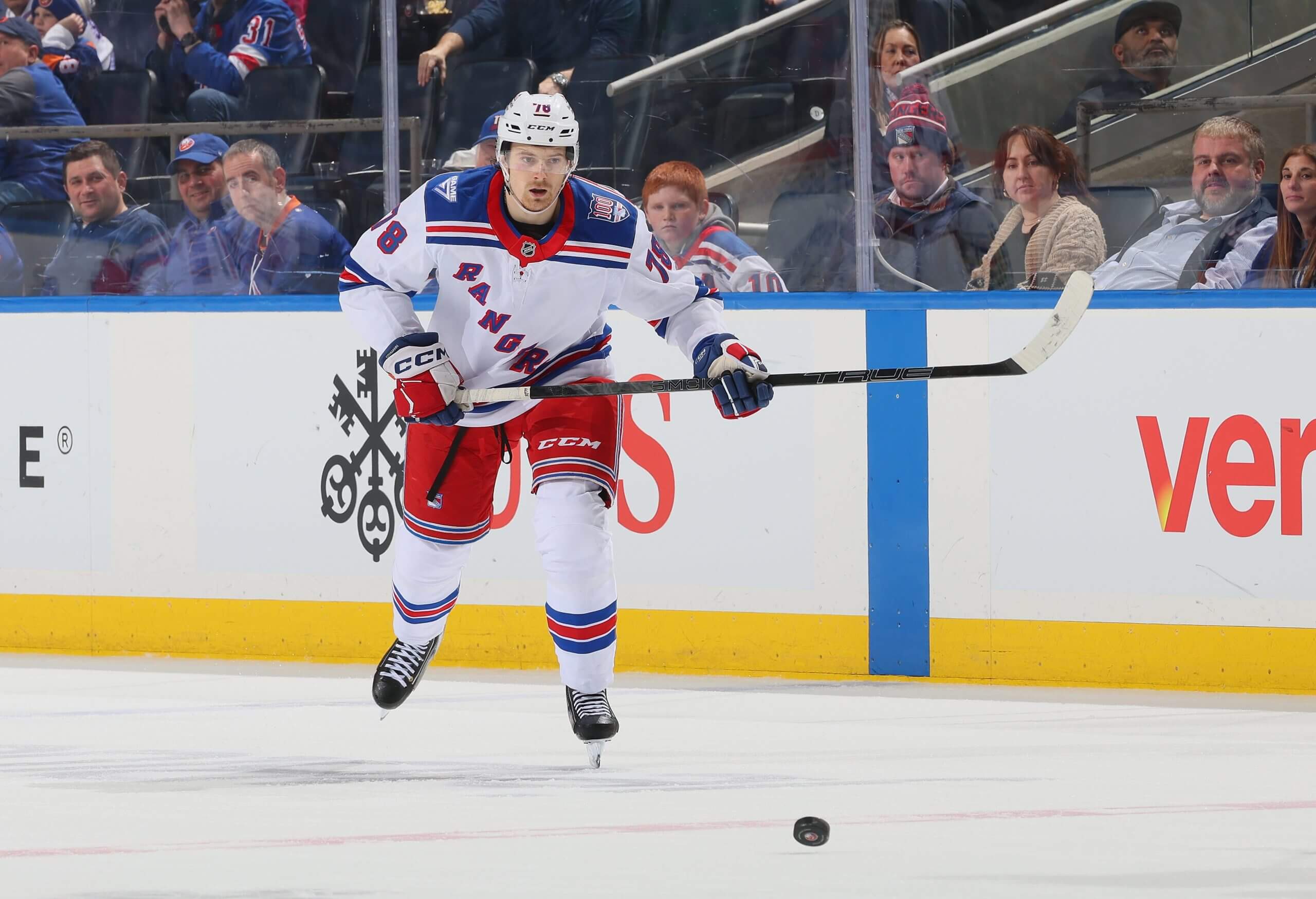
Brennan Othmann is set to be a restricted free agent after this season at 23. (Bruce Bennett / Getty Images)
5. Find out what you have in young players
For the young players who stick around, the top priority for the final 26 games of the season should be their development. There’s healthy skepticism about how many impact prospects the Rangers have in their system outside of Perreault, but Drury, coach Mike Sullivan and the rest of the organization should be working to change that narrative.
There’s no reason why they shouldn’t expand the roles of Berard, Othmann, center Noah Laba, defenseman Scott Morrow and others now that they’ve waved the white flag on the season. Maybe none of them end up factoring into the organization’s long-term plans, but this is the time to find out. Wins and losses don’t matter — some would argue in favor of the latter to improve the team’s draft lottery odds — as much as building something for the future.
Scale back on playing veterans who are either battling injuries or unlikely to be here much longer and give the young guys a chance. Some will surely sink, but it’ll be worth it if a few of them prove they can swim.
“It’s already happening out of necessity,” Sullivan said. “It gives us an opportunity to assess where people are at and what we have and how we can help them improve. … Will it continue to occur? I would envision it would, yes.”
6. Gear up for a big summer
There are so many things that have to go right for the Rangers to execute this retool strategy, starting with nailing the 2026 draft.
With two third-round picks added in deals for Panarin and Soucy (and the Panarin pick could move up to the second round if the Kings win a playoff series), they’re up to nine total selections this coming June. Their first pick should land somewhere in the top five, where it will be essential to come away with a foundational piece.
Making the right picks is a necessity, but how they’re handled once the Rangers get them into their pipeline will be equally important. It’s time to take a critical look at the developmental missteps of recent years and implement changes to improve their organizational hit rate. Drury acknowledged as much, announcing his intention to “deep dive into each department (scouting and development),” but did not elaborate on what that will entail.
Before and after the draft, New York must be proactive in procuring assets. That starts with targeting young talent to refresh the roster via trade, with Greentree the first step in that process, but also taking chances on reclamation projects like defenseman Vincent Iorio, who was snagged off waivers earlier this week.
The Rangers should also be looking for opportunities to weaponize what’s expected to be over $30 million salary cap space this summer. They shouldn’t be dishing out big contracts to free agents, but it’s smart to absorb bloated salaries other teams are looking to get rid of in exchange for picks and/or prospects. If they rehabilitate that player into an asset they can flip at a later date, even better.