
Hidden inside a historic 19th century house on East Fourth Street in Manhattan is a secret sanctuary.
Ever since the Merchant’s House Museum opened its doors to the public in 1936, visitors have lined up to get a taste of “old New York.”
What You Need To Know
Ever since the Merchant’s House Museum opened its doors to the public in 1936, visitors have lined up to get a taste of residential life in “old New York”
The Merchant’s House is the first landmarked building in Manhattan. Built by Joseph Brewster on East 4th Street, he was a noted abolitionist. This powerful architectural time capsule, dating back to the 1830s reveals its most dramatic secret: the high-stakes, dangerous work of aiding enslaved people seeking freedom
Historians call this passageway a masterwork of deliberate concealment, designed to be absolutely invisible to slave catchers or city marshals during the 19th century. It’s groundbreaking discovery, a testament to the courage of the abolitionist movement in New York City
The Merchant House Museum plans to integrate this discovery into its public narrative and allow unprecedented access to the property
The Treadwell family lived there from 1835 until 1933. Their residence is frozen in time, from a ruby-red front parlor complete with its original piano to the kitchen with its cast-iron coal-burning stove.
But when visitors head upstairs to the bedrooms on the second floor, there’s something strategically hidden within the walls of Manhattan’s first landmarked building is a link to the Underground Railroad.
“We knew it was here but didn’t really know what we were looking at,” Camille Czerkowicz, the curator for the Merchant’s House Museum, said.
Now they know that the Merchant’s House was also a “safe house” for enslaved Africans who escaped bondage in the South.
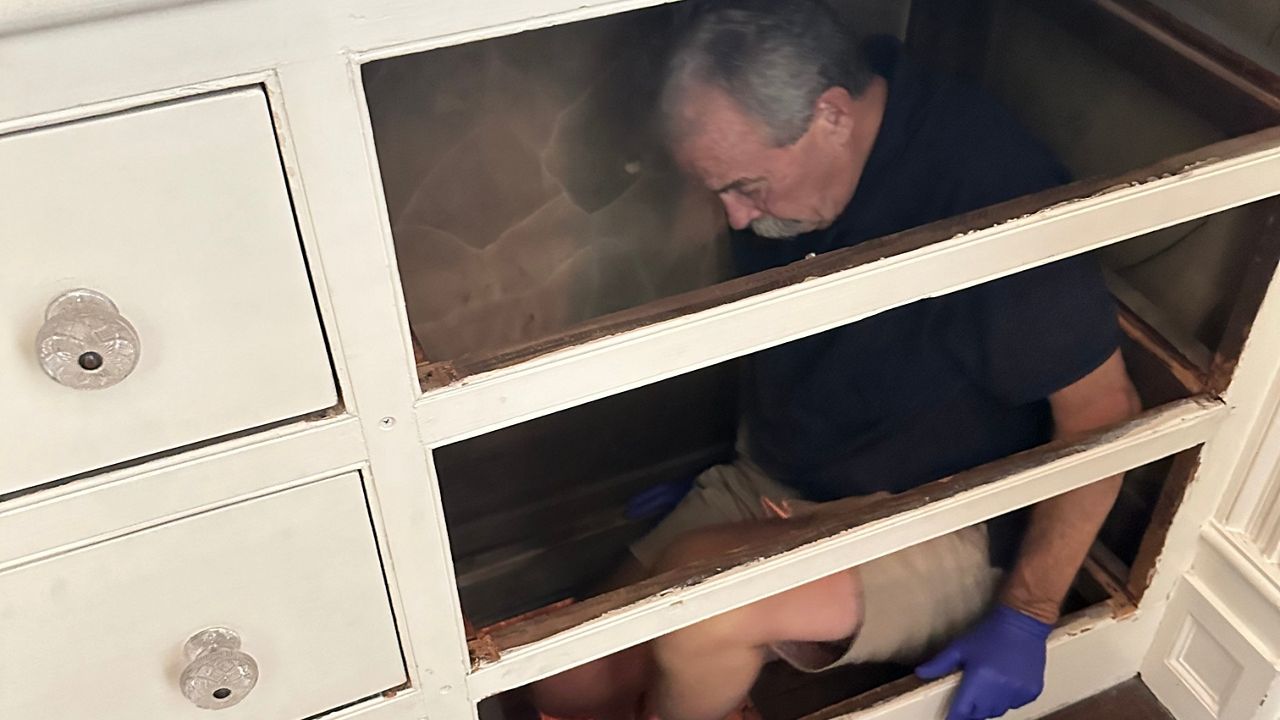
Architects and preservationists recently investigated the building’s hidden vertical passageway along the west wall and examined it for themselves.
“I’ve been practicing historical preservation law for 30 years, and this is a generational find. This is the most significant find in historic preservation in my career, and it’s very important that we preserve this,” Michael Hiller, a preservation attorney and professor at Pratt Institute, said.
Underneath those built-in drawers is the path to freedom.
When you remove the heavy bottom drawer, you can see a rectangular opening cut into the floorboards, which leads to an enclosed space about 2-by-2-feet. It then reveals a ladder that leads down to the ground floor.
“Being an abolitionist was incredibly rare among white New Yorkers, especially wealthy white New Yorkers,” Patrick Ciccone, an architectural historian, said. “[Joseph Brewster] was the builder of the house, and he was able to make these choices and design it.”
Brewster sold the building to the Treadwell family in 1835. It’s unclear if the Treadwell family used or even knew the passageway was there.
“Many New Yorkers forget that we were part of the abolitionist movement, but this is physical evidence of what happened in the South [during] the Civil War, and what’s happening today,” Manhattan Councilman Christopher Marte said.
“It’s a critical piece of the overall struggle for freedom and justice,” Manhattan Councilman Harvey Epstein said.
Historians call the passageway a masterwork of deliberate concealment, designed to be absolutely invisible to slave catchers or city marshals during the 19th century.
It’s a groundbreaking discovery — a testament to the courage of the abolitionist movement in New York City.
The Merchant’s House is no longer just a relic of domestic life in the village. Its identity now includes a powerful, emotionally charged monument to the American struggle for liberty.