
The history of relations between New York state and New York City leaders has rarely been a harmonious one. One can go back to the embattled relationships between Mayor Rudy Giuliani and George Pataki, Mayor Ed Koch and Gov. Mario Cuomo, and Mayor John Lindsay and Gov. Nelson Rockefeller to see how much discord and bad-mouthing existed between them. Being of the same political party made no difference; the city and the state’s interests and needs often diverged, and their personalities often clashed.
Mayor Bill De Blasio’s relationship with Gov. Andrew Cuomo was one of the most virulent. De Blasio publicly blasted Cuomo, telling journalists that “what we’ve often seen, is if someone disagrees with him openly, some kind of revenge or vendetta follow.” In part, their differences were political. Cuomo is a tough, pragmatic, Clintonian centrist who has practiced third-way politics for decades, only shifting left when he’s pressured enough to go there. Though de Blasio managed Hillary Clinton’s 2000 Senate campaign, he was committed more to center-left politics, and he and Cuomo ended up differing on policy. In addition, Cuomo, as is his wont, used intimidation whenever he wanted to gain either De Blasio’s agreement or stymie him on a particular issue. Cuomo alienated De Blasio, which also prevented much of his program getting passed.
So, when Zohran Mamdani beat former Gov. Cuomo in New York City’s Democratic mayoral primary last year and went on to win the general election, many assumed his ambitious, left-leaning agenda would have a difficult time gaining the assent of the state’s centrist, triangulating Gov. Kathy Hochul (who says she is a “staunch capitalist”). The fact is that the majority of Mamdani’s prime proposals need the approval of the state Legislature and the governor. And though Hochul endorsed Mamdani seven weeks before the election, there is little guarantee that her support will last and that the usual conflict between upstate and the city will become the norm.
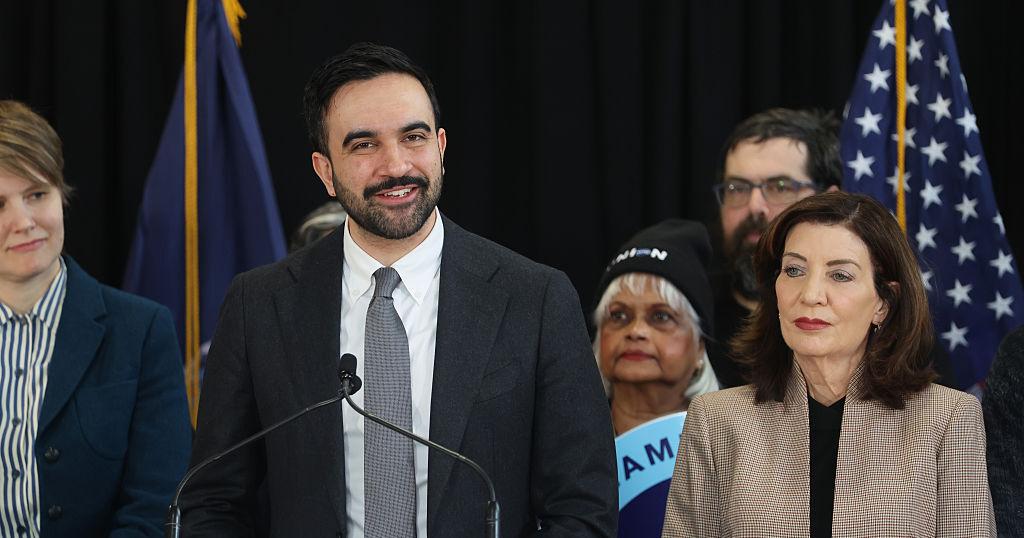
Still, the budding partnership between Hochul and Mamdani during his first weeks as mayor has challenged that history. On Jan. 8, the unlikely duo announced the first steps toward universal child care in New York City, a $4.5 billion plan. It was shrewd of Hochul to support universal child care, since the annual per-child cost in New York ranges between $18,000 and $26,000, placing a great deal of pressure on young families and making living in the state more onerous.
Mamdani responded to Hochul’s support with a probably too sanguine statement: “This victory represents much more than a triumph of city and state government working in partnership. It is proof that when New Yorkers come together, we can transform the way government serves working families.”
Predictably, that feeling of harmony between them turned into conflict overnight. Given, his bold agenda, Mamdani clearly needs more state funds to meet the promises he ran on. He has threatened budget cuts if Hochul does not move forward with his plan to raise taxes on wealthy New Yorkers (corporations and individual millionaires) or hand over to the city a larger share of state money.
The governor in turn is running for reelection in 2026, which has hardened her opposition to new taxes. She also feels that her budget plan contains funding for what she called “ambitious” free child care and housing plans in pursuit of goals she shares with Mamdani. So far, it’s a stalemate, and hopefully some compromise will ultimately be negotiated.
If the Mamdani-Hochul relationship becomes a workable one, it could become a model for how the progressive and moderate wings of the Democratic Party function together.
The energy and vision that a figure likes Mamdani brings for Democrats is a necessity. Currently, the party is dominated by professional pols like Chuck Schumer and Hakeem Jeffries, who might be skilled tactically but come off as uninspired and incapable of dealing with President Donald Trump’s demagogic onslaught.
Even if the alliance is an uneasy one, for the Democratic Party to win elections and govern, it needs both wings to work together. If Mamdani and Hochul can learn to achieve a semblance of unity, finding issues they can both support and making concessions when their positions clash, the Democrats will be much stronger politically.
Obviously, there are many states and cities in which Mamdani could not dream of winning an election. So, he still needs Hochul’s link to Democratic moderates as much as she needs his star power and charisma.
Hochul has grown in office. She has awakened to the housing shortage and introduced plans to remove construction bottlenecks. And she has excited transportation advocates with new plans to extend the Second Avenue subway. She has also introduced legislation to severely limit state and local law enforcement cooperation with federal immigration enforcement. The proposed “Local Cops, Local Crimes Act” aims to bar the use of local jails for civil detention and stop police from acting as federal agents.
I am not saying that the alliance between the governor and mayor will work seamlessly. It will constantly be challenged as different issues come up. But for the Democratic Party to deal effectively with the autocratic and corrupt practices of the Trump administration, unity is much more significant than maintaining purity.