
There were days late last season when I’d walk through the Jets locker room and try to figure out how many players on the roster would actually be sticking around in 2026. The number was low — somewhere around 50 percent of the roster or less felt like a safe bet.
There will be significant turnover for the Jets in the coming months, especially as they enter the offseason flush with cap space (somewhere in the range of $80 million) and draft capital. Free agency comes first, but the NFL Combine is at the end of the month. The Jets will start to formulate a plan for a crucial draft in which they hold four picks inside the Top 44 — two in the first round and two in the second — and 11 selections total.
For general manager Darren Mougey and head coach Aaron Glenn, a strong draft will greatly improve their chances to survive beyond 2026. Glenn and Mougey’s first draft was solid — they aced their first-round pick (Armand Membou); a few other selections (TE Mason Taylor, CB Azareye’h Thomas and safety Malachi Moore) flashed potential, though still have a lot to prove.
Here’s our first seven-round projection of 2026 for the Jets. (Note: Pro Football Focus’s mock draft simulator was used as a starting point to figure out who might be available at each spot. The draft order for the first two rounds is set; selections beyond that are subject to change due to the distribution of compensatory picks.)
1st round, 2nd overall: Arvell Reese, LB, Ohio State
Glenn is expected to take over defensive play-calling, though we don’t know exactly what sort of scheme he’ll be running just yet. In Detroit, he ran an aggressive 4-3 defense, but the coaches he’s hired on defense thus far would indicate he might be angling for more of a 3-4 defense. New defensive coordinator Brian Duker and safeties coach Ryan Slowik come from the Dolphins, where they ran a 3-4 under Anthony Weaver, and defensive line coach Karl Dunbar comes from the Steelers, where they ran a 3-4 under Mike Tomlin.
The best part about Reese: He can fit either front, though he’s particularly intriguing as an edge rusher in a 3-4, especially considering he played a hybrid linebacker/edge rusher role at Ohio State. If it is a 3-4 and the Jets wanted a more traditional edge rusher, Texas Tech’s David Bailey might be an intriguing fit.
As for Reese: The Athletic’s Dane Brugler has him as the No. 1 prospect in this draft and referred to him as “somewhere between Micah Parsons and Jalon Walker in terms of his pro projection.” The Jets need to infuse the defense with playmakers and game-changers and Reese fits the bill — especially as an intriguing Swiss Army knife for Glenn to deploy.
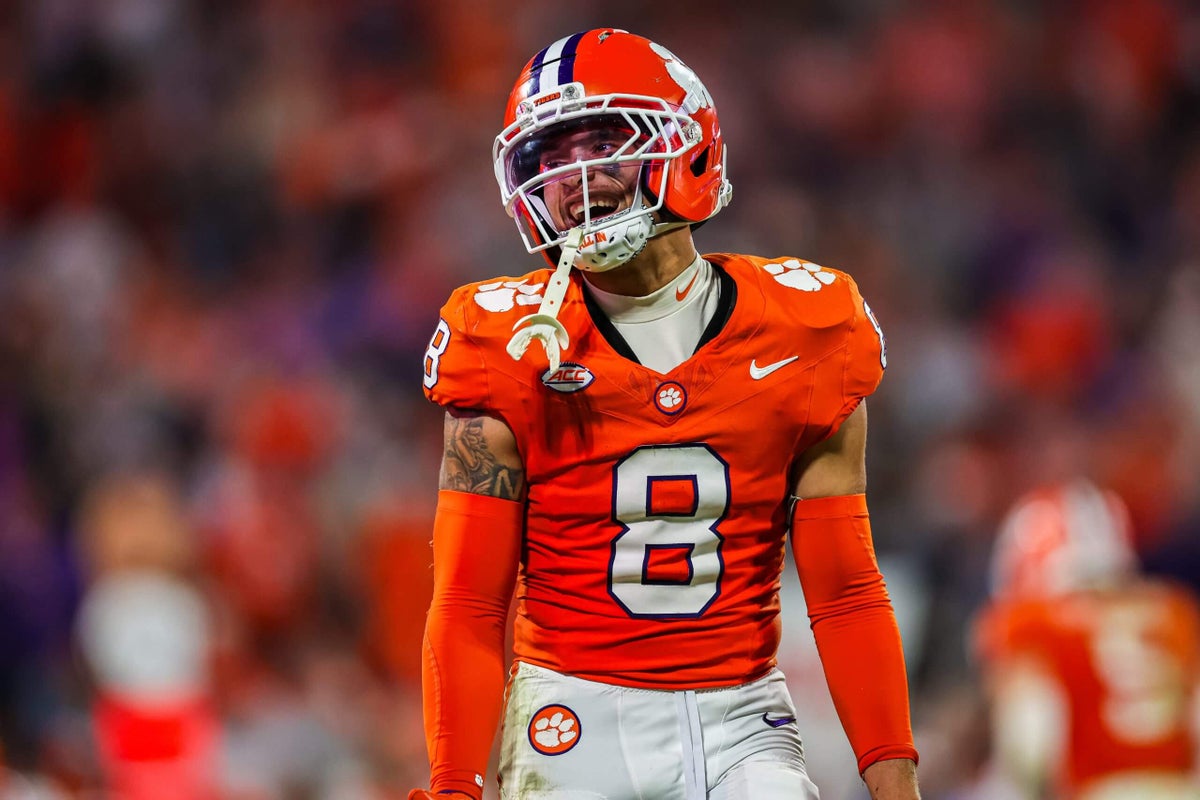
1st round, 16th overall: Avieon Terrell, CB, Clemson
The Jets drafting a cornerback this early might not appease the fans — especially since this is the pick they got back for trading away Sauce Gardner — but they are in position to draft the best player available, and there is nobody in their cornerback room to point to as a no-doubt No. 1 corner. Brandon Stephens was solid last year and Jarvis Brownlee and Thomas both showed promise, but not enough for either of them to be locked into starting jobs. It would be safe to say that any secondary that went an entire season without intercepting a pass needs help.
It is true that Terrell didn’t technically intercept any passes last year, but he’s a playmaker. He forced five fumbles, deflected nine passes and forced nine incompletions. He intercepted two passes in 2024. Brugler wrote this about Terrell in his latest rankings (where Terrell ranks 18th overall): “You would have liked to see more interceptions from him, but he posted impactful production the past two seasons (combined 25 passes defended, eight forced fumbles) and plays with a ‘Honey Badger’ aura.”
(Note: In this mock draft simulation, wide receivers Makai Lemon, Carnell Tate and Jordyn Tyson were already taken.)
2nd round, 33rd overall: Ty Simpson, QB, Alabama
The expectation should be that the Jets come out of this draft with at least one quarterback. The question is where they select one. Simpson has a case for getting picked 16th, though the reality is he’d be best suited for this slot (if not a trade up into the back half of the first round). He seems to be the clear-cut No. 2 quarterback in this class, though there is a significant gap between him and the No. 1 (Fernando Mendoza).
Simpson clearly has talent worth developing. He’s just not a quarterback who should be plugged in right away as a starter. He needs some seasoning. The list of quarterbacks to succeed with his level of experience (15 career starts in college) is small. But picking Simpson here would put less pressure on him to step in right away as a starter for the Jets, especially since I expect them to add a veteran (or two) of note this offseason first.
Brugler has Simpson ranked 34th and The Athletic’s Nick Baumgardner wrote this in his latest mock about Simpson: “The first half of Simpson’s 2025 season was worthy of top-10 consideration. The second half, especially during Alabama’s stretch drive, barely looked like that of a top-100 prospect. But Simpson is an athletic, talented and smart passer whose best football is ahead of him. Being able to watch for a year might be ideal.”
2nd round, 44th overall: Omar Cooper Jr., WR, Indiana
The Jets need to upgrade their wide receiver room around Garrett Wilson (what else is new?). Adonai Mitchell showed some promise and will play a role in 2026 but the Jets shouldn’t go into this season with him locked in as the No. 2. I’d expect them to invest in the position during free agency and consider drafting someone in the first round too. Cooper would be a good value at this spot in the second round. He was the leading receiver (69 catches, 937 yards, 13 touchdowns) on the best team in the country. He is 6 feet, 204 pounds and his best skill is run-after-catch. He ranked 13th among all wide receivers in yards after the catch (494) and he only had two drops on 91 targets.
Brugler wrote that Cooper “plays with above-average strength, athletic coordination and competitiveness at the catch point. He opens his stride to create windows for his quarterback and shows a savvy awareness for his surroundings to secure the ball mid-air.”
4th round, 103rd overall: Bud Clark, S, TCU
The Jets need to add multiple starting-caliber safeties this offseason, even if they view Malachi Moore (a fourth rounder last year) as a starter. I’d expect them to invest in the position in free agency and the draft — and the goal should be adding players with a documented history of forcing turnovers.
Clark is on the older side for a prospect (he comes to the NFL after six years at TCU) but he’s one of the better ballhawks in this draft. He had 15 interceptions over the last four years, including four (one returned for a touchdown) plus seven pass deflections in 2025. He graded out well across the board in 2025 in PFF’s system, including against the run (24th of 198 safeties to play at least 500 snaps) and in coverage (53rd). He’s versatile, playing 313 snaps in the slot, 250 in the box and 160 at free safety last season.
5th round, 175th overall: Trey Zuhn, OL, Texas A&M
It is likely the Jets will look at bringing back one of John Simpson or Alijah Vera-Tucker to be their left guard, which would lock in their starting five — but they also should be adding offensive linemen, both for depth and to develop. Zuhn is one of the more intriguing mid-round prospects because of his versatility: He played both left tackle and center in college and is viewed as someone who can play all five positions in a pinch. His best position in the NFL is probably center.
The Jets re-signed veteran Josh Myers to a low-cost, two-year contract but he’s not a long-term solution, which makes Zuhn an intriguing target to develop.
5th round, 178th overall: Rayshaun Benny, DT, Michigan
Benny was a standout at the Senior Bowl and played well in 2025 after developing behind Mason Graham and Kenneth Grant previously. He has long arms and Brugler views him as an instant-impact player — and the Jets certainly could use some depth at defensive tackle to go with Jowon Briggs and Harrison Phillips.
6th round, 193rd overall: Tanner Koziol, TE, Houston
Koziol had a nice season at Houston last season after three years at Ball State: 74 catches for 727 yards and six touchdowns. He’s big (6-6) and led all FBS tight ends in contested catches (20 on 27 targets). The Jets have Mason Taylor and Jeremy Ruckert but could use a big-bodied threat such as Koziol to add to the mix.
6th round, 207th overall: Bryce Boettcher, LB, Oregon
Boettcher also played well at the Senior Bowl and projects nicely as a depth piece at linebacker — someone who can contribute right away on special teams. He graded out well in coverage at Oregon too, which was an issue for Jets linebackers in 2025. Boettcher had a productive 2025: 136 tackles, 5.5 for loss, one sack, one interception, two forced fumbles and six pass deflections.
7th round, 218th overall: Roman Hemby, RB, Indiana
The Jets still have a decision to make with Breece Hall, though a seventh-round running back doesn’t really impact that. Glenn wants to field a team that emphasizes the run and it can’t hurt to add talent to the backfield. Hemby was highly productive for a dominant Indiana team (1,120 yards, seven touchdowns) and was previously a productive pass-catcher too, nabbing 111 over his last three seasons at Maryland before transferring.
7th round, 242nd overall: Eli Heidenreich, FB, Navy
Glenn likes to carry (and use) a fullback, and Andrew Beck will be a free agent, so why not take a swing at the end of the draft? Heidenreich was productive both as a rusher (499 yards, three touchdowns) and pass-catcher (941 yards, five touchdowns) in 2025.