
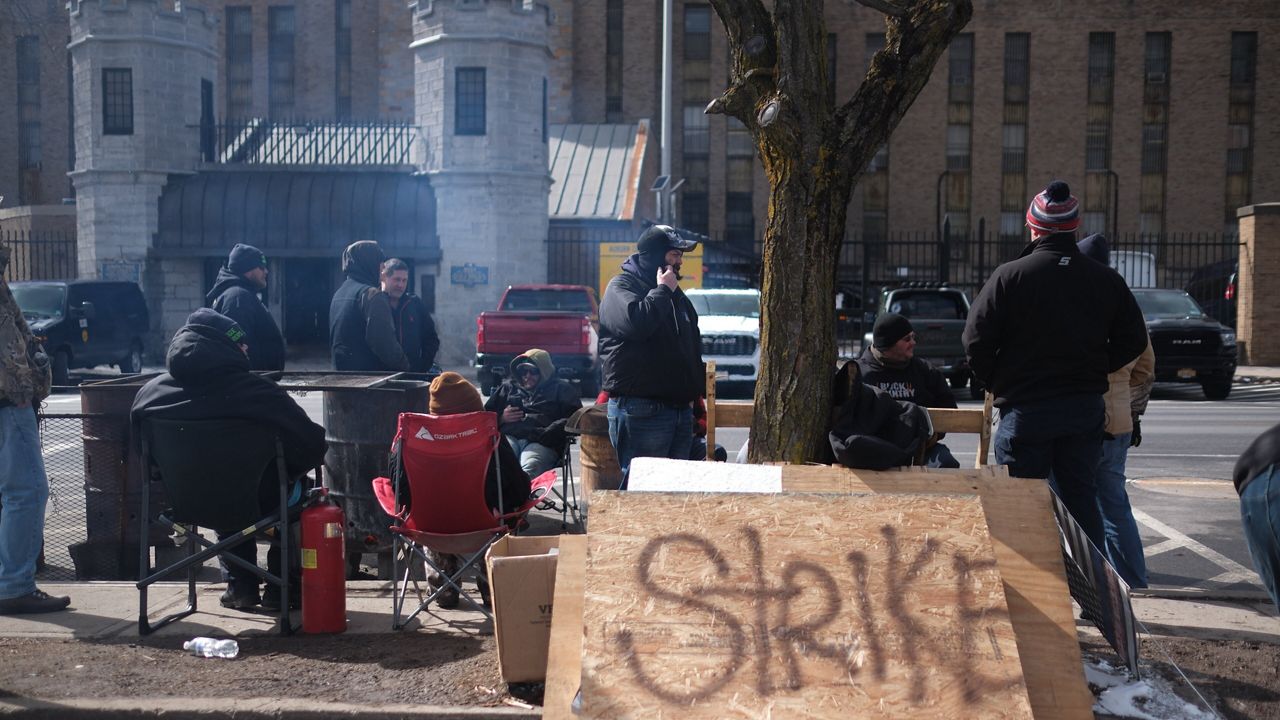
Nearly one year after the illegal correction officer strike in New York’s prisons began, state Department of Corrections and Community Supervision Commissioner Dan Martuscello worked Thursday to convince state lawmakers at the annual budget hearing on public protection that the situation was, in fact, moving in the right direction despite a continued staffing crisis.
“We’re not where we need to be for staff,” he confessed to state lawmakers.
Martuscello said the department is still short 4,600 correction officers. That’s little movement since the days following the strike when the number was placed at more than 4,000 vacancies.
“We had to get the attrition rate under control and we had to get staff in, so that was going to take some time,” he explained when pressed by state Assembly Correction Committee Chair Erik Dilan.
Martuscello spent the summer and fall of 2025 touting a robust recruitment effort that, according to the numbers provided, at least appears to be generating interest, telling Dilan that there were 130 people in the next class of appointments next week while touting other hiring incentives. Martuscello added that retention issues are improving thanks in part to those incentives.
He offered that DOCCS has seen 155% more people taking the exam to become a correction officer and a 43% increase in graduates from the academy. Despite a pool of 20,000 total people who are eligible to become an officer, there are still National Guard troops in state prisons, costing New York taxpayers more than $500 million this fiscal year and more than $1 billion total since the strike began.
“We have drawn down from upwards of 7,000 National Guard down to 2,700 and we continue to look at those numbers and work with the National Guard, but that is not the long-term sustainable solution,” he said.
The strike wasn’t the only reprise of a 2025 issue to be covered at the hearing.
Chief Administrative Judge Joseph Zayas was asked by state lawmakers if he felt that the changes to the state’s discovery laws made in last year’s budget and pushed relentlessly by Gov. Kathy Hochul were making a positive difference.
He believes that are, and elaborated in an interview after his testimony.
“We have law clerks and court attorneys in the courtroom bringing the attorneys together early on and there is a schedule of events whereby such and such a date this has to happen, there is more holding parties accountable,” he said. “Getting the prosecution to give the information over to the defense at a time, and once that happens the defense is unlikely to file a motion or a challenge to the discovery decision.”
He said he was unable to say at this point if there has been a true decrease in dismissals related to technicalities as the governor had hoped, stressing that the law only took effect in August, and he also couldn’t say if there was a need for further changes without that data.
Zayas left the door cracked for exploring further changes.
“It’s something we’ll look at. We want to see how this new iteration of the discovery bill works out,” he said.
It had been looking as though Hochul was gearing up for another criminal justice budget fight. The Democratic majorities in both houses of the state Legislature had serious concerns with Hochul’s discovery proposal last year and the debate fueled the latest state budget in 15 years.
Following a shooting in Albany in which 10 people were shot and one killed, several of them juveniles, during the July 4 weekend — existing calls to similarly revisit the state’s Raise the Age Law, which works to keep juvenile offenders out of adult courts — were amplified.
The state’s district attorneys and many Republicans pushed throughout the fall to see the law tweaked, while defenders of Raise the Age stressed that it had not been properly funded.
Hochul ultimately chose not to pursue statutory changes to the law, and seemingly put the ball in the Legislature’s court to offer their own suggestions.
“I listen to the Legislature about their priorities, and they’ll have their chance to weigh in on this as well,” she said.
Zayas weighed in at the hearing, and said afterward that calls for more funding make sense.
“More programs, so adequately funding the places where were sending these young people to get treatment, and then adequately funding the detention facilities — like in New York City they’re at capacity,” he said.
But it isn’t just about the number of dollars allocated, which Hochul’s proposal keeps stagnant.
State Assemblymember Gabriella Romero carries a bill which would reorganize the funding streams for those programs, clearing bottle necks which block access to the programming that advocates say is crucial for young people to get themselves on the right track.
“To cut the red tape to make sure they’re getting immediate access to the funds as opposed to the process where it is right now, it goes to the counties, its reimbursable grants, it takes a lot of time to actually get access to those funds,” she said.