
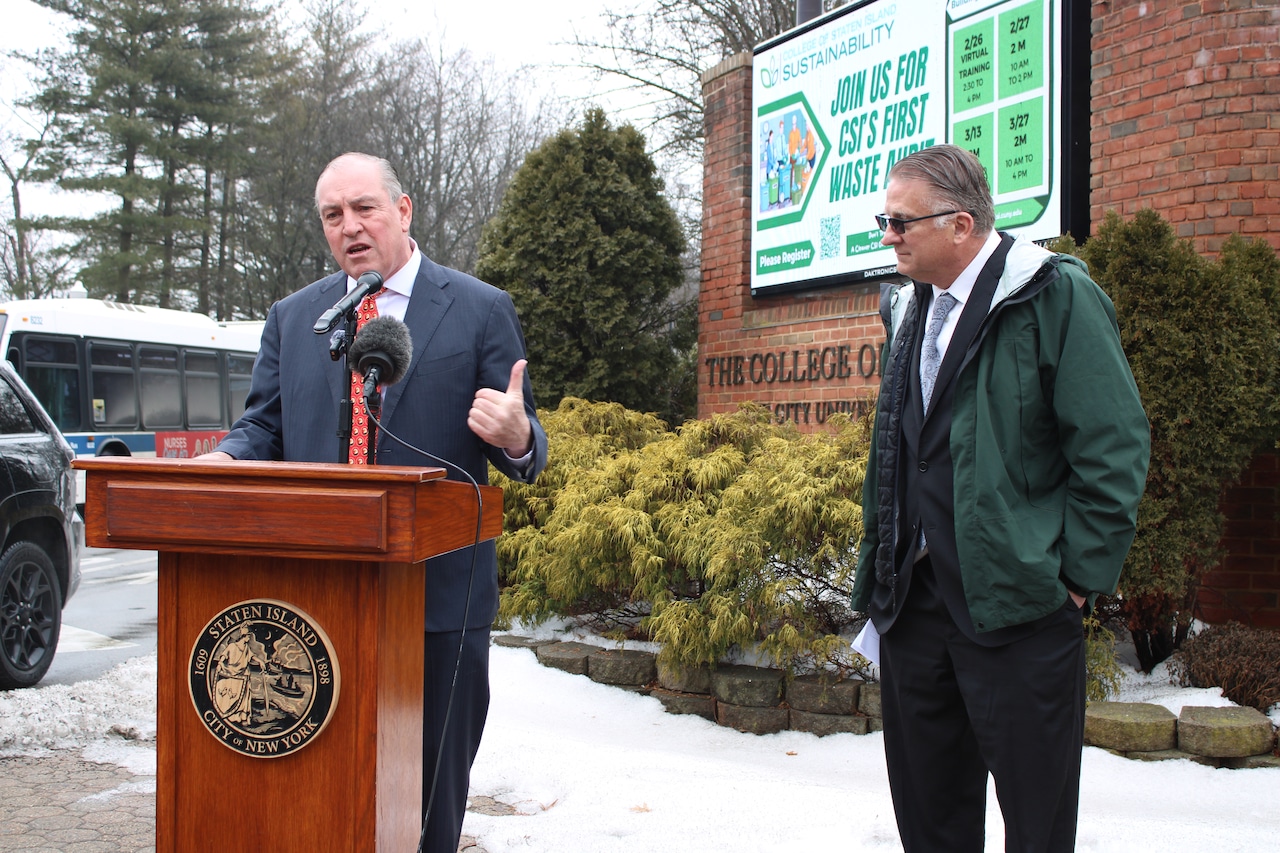
STATEN ISLAND, N.Y. — Borough President Vito Fossella on Wednesday blasted a proposal to construct affordable housing on CUNY campuses, arguing that turning over parking areas at the College of Staten Island in Willowbrook would disrupt a campus that depends heavily on cars.
“We’re here today to say it’s a really bad and it’s a really dumb idea. It will hurt the students. It will hurt the faculty. It will just hurt the flow,” stated Fossella, a Republican. “Let’s take away hundreds or who knows how many parking spots, which would only compromise the quality of life for the students and the faculty and College of Staten Island.”
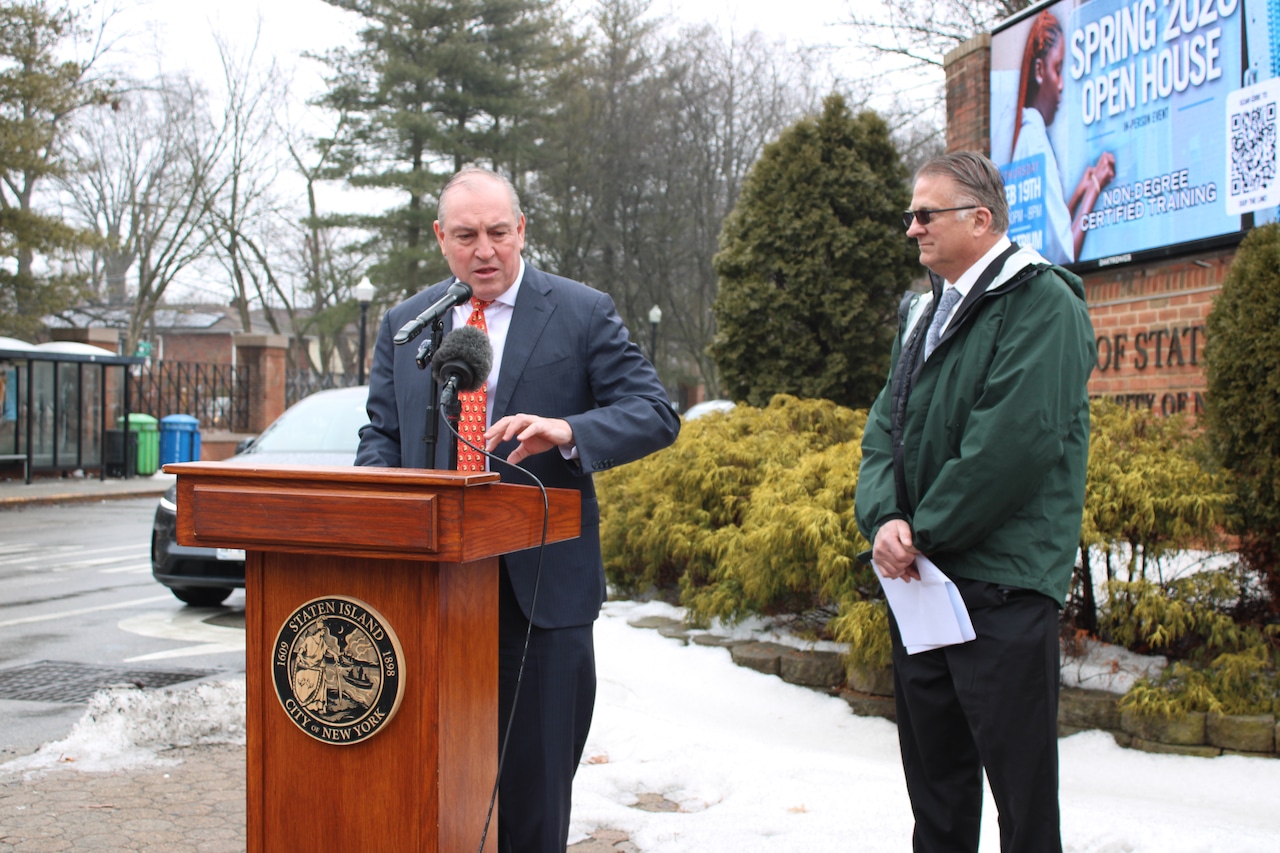 Borough President Vito Fossella, left, joined College of Staten Island Professor Jonathan R. Peters to oppose a proposal that could eliminate hundreds of parking spots on a campus where spaces are already limited outside the Willowbrook campus on Wednesday, Feb. 18.(Staten Island Advance/SILive.com|Nicolette Cavallaro)
This statement follows a report from a think tank that recommended converting underutilized parking lots and vacant spaces on CUNY campuses into affordable housing.
The Center for an Urban Future, a nonprofit organization focused on reducing inequality and boosting economic growth, released the report recommending Mayor Zohran Mamdani undertake the initiative.
The project could generate between $30 million and $55 million annually for the city and City University of New York campuses, the group estimates.
The center’s analysis identified specific development opportunities at multiple locations and highlighted the College of Staten Island’s Willowbrook campus.
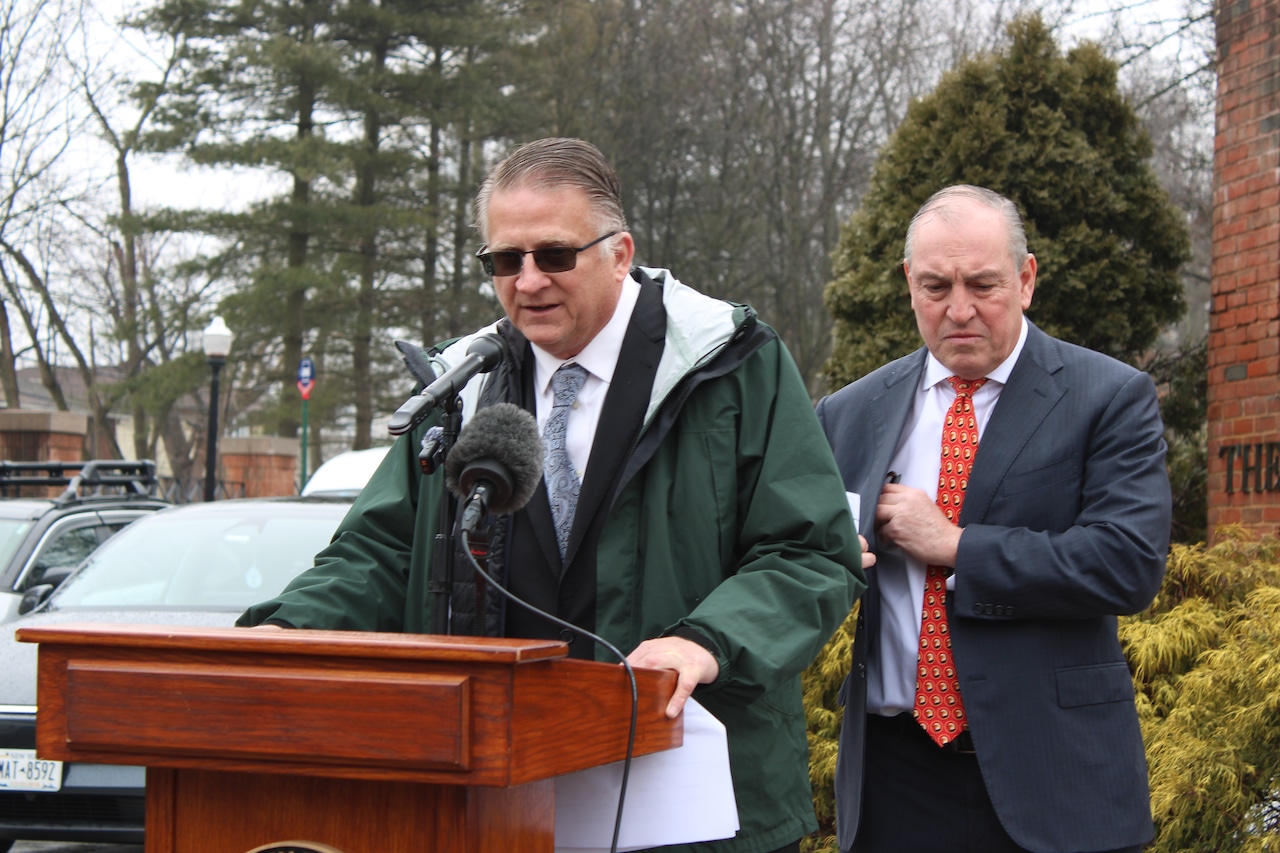 Borough President Vito Fossella joined College of Staten Island Professor Jonathan R. Peters to oppose a proposal that could eliminate hundreds of parking spots on a campus where spaces are already limited outside the Willowbrook CUNY campus on Wednesday, Feb. 18.(Staten Island Advance/SILive.com|Nicolette Cavallaro)
The 204-acre campus has more than 25 acres devoted to parking. According to the report, redeveloping a single 5-acre parking site could generate between $500,000 and $900,000 in annual revenue. The group claims the plan would preserve most campus parking.
This raised concerns among Staten Island officials, residents and students who often rely on cars to reach the campus, as public transportation is limited.
According to the borough president, the campus currently has approximately 2,600 parking spaces for the 8,700 students who utilize parking decals, meaning parking is already limited.
Jonathan R. Peters, a professor of finance and data analytics in the Lucille and Jay Chazanoff School of Business within CSI, shared his concerns for how faculty and students would attend class if parking became even more limited.
“This is not Hunter College, where we have the 4/5/6 train in the corner of our building. Our students, our faculty, our staff, rely on automobiles. It is very difficult to get to and from other areas of Staten Island to this campus,” said Peters. “If transit was here and if we were seeing improvements, you’d have some ideas about what you could do further, but I would suggest that we think clearly about how it would function if this was actually done.”