
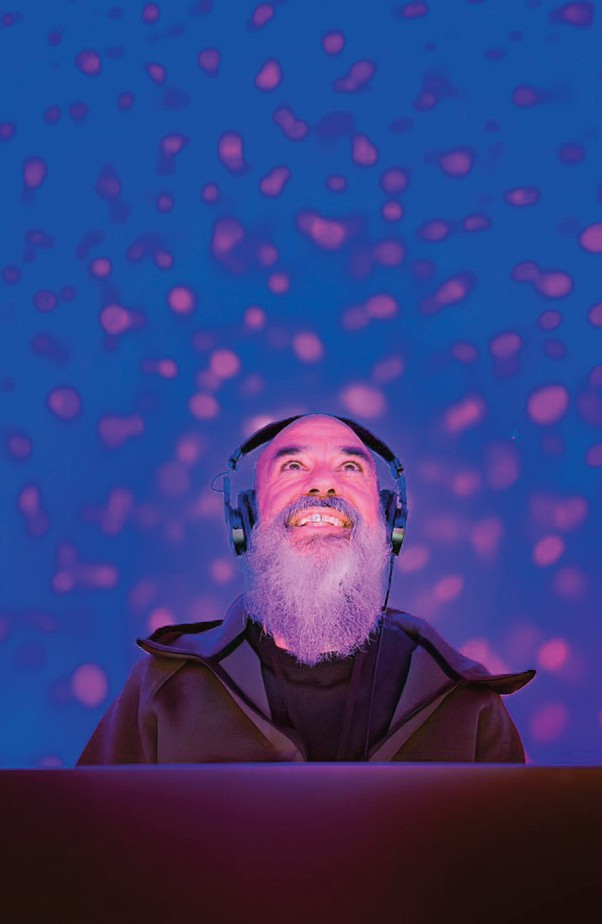

Onel Mulet is a New York–based filmmaker, composer, and media producer whose work lives at the intersection of sound, story, and social memory. A bilingual, award-winning artist with roots in Cuba and the Caribbean diaspora, Mulet has shaped documentaries, immersive audio, and visual media that move fluidly between the political, the poetic, and the personal. His music and sound design—heard on platforms including HBO, PBS, and Showtime—blend Afro-diasporic rhythms, improvisation, and cinematic restraint, while his films foreground voices often left at the margins. As a longtime producer, engineer, and educator in New York’s media ecosystem, Mulet brings a rare combination of technical mastery and soul, creating work that feels both deeply grounded and unmistakably contemporary.
He moved to Jackson Heights in March of 2017. He loved the neighborhood with its rich ethnic diversity, its deep culture, the local NY history, and its 7 train which was two blocks from his apartment. In 2024 he moved to Rockaway Park to be near the girl of his dreams and to be near the ocean. The ocean has been his constant since the day he was born. It’s so comforting to hear the sound of the surf so close by. The community in Rockaway has taken him in to its loving embrace and shown him a tremendous amount of love.
 NB: Other than the amazing diversity, what do you love most about living in Queens (or Queens in general)? How has Queens changed over the years?
OM: I think what I love most about Queens are my neighbors, the people in Queens, the character of Queens’ people, friendly, warm, funny, kind, and empathetic. Queens grew to include technology and business and finance, but it’s never outgrown its roots and I’m glad to see the filmmaking roots of New York back in Queens as well.
NB: How does Queens inspire you? What are some of your favorite places to be inspired in Queens?
OM: I think the most inspiring thing about Queens is this notion of infinite possibilities. My favorite places in Queens are the shore in Rockaway and the boardwalk, Flushing Meadows Park, and Astoria.
NB: What advice do you have for readers who are hoping to develop their musical practice? Is musical talent innate and/or can it be taught/developed? How important is daily practice? Do you ever get stage fright/camera shy/performance anxiety or have advice about overcoming it?
OM: My advice for anyone who wants to develop their musical talent is do something every day. It doesn’t have to be a bunch of hours. It could be five minutes but as long as you do it every single day, I promise you you’ll see growth. I get stage fright every time. I’ve always had stage fright and it never goes away. When you hold yourself to a certain standard and you work so hard at something, you’re gonna have the jitters, you’re gonna have butterflies in your stomach. And all you can do is breathe through it; just breathe. Remember how much you love to do this and try to stay in the present moment.
NB: How important is personal connection and communication (networking) in your industry?
OM: Personal connections and communication are extremely important in an industry where trust is huge. The reason I have the track record and the jobs that I have that you see on my resume are because those people that invite me have deposited a certain amount of trust in me and this business is all about trust.
NB: What is the best piece of advice you’ve ever received? What is something you wish you knew a decade or two or three ago?
OM: The best piece of advice I’ve ever had was: build small, even the smallest things. The smallest gains contribute to your long-term success. Don’t wait for the big payout. I wish I knew about hot yoga. It would be to my health, the daily detox of being in a hot room for 60 minutes going through all the different poses in a moving meditation.
NB: Who are some of your favorite filmmakers, composers, media producer artists, and other creatives with a Queens connection?
OM: Some of my favorite filmmakers, I would have to say, Alfred Hitchcock, Sergio Leone, Akira Kurosawa, and Stanley Kubrick are probably some of my all-time favorite filmmakers. I admire them for their intense attention to detail and their commitment to their vision. Some of my favorite musicians, my great teachers and early influences like Dizzy Gillespie, John Coltrane, Count Basie, and Charles Mingus lived in Queens.
NB: What are your favorite restaurants, cafes, theaters, bookstores, exhibits, museums, communities, and venues in Queens? Favorite places to play your music?
OM: I love the food court in the basement of the Flushing Mall in Flushing where you find some of the absolute best Asian cuisine in all of New York City. My favorite diner in Queens is Jahn’s on 37th Ave. in Jackson Heights; Tacos al Suadero on 90th Street near Roosevelt Ave is my favorite Mexican restaurant. I also really enjoy Dosa Delight in Jackson Heights and El Chivito de Oro.
NB: What do you wish more people knew about being a filmmaker, composer, and media producer? What is something you wish you knew before you became a filmmaker, composer, and media producer?
OM: I’m still trying to wrap my head around what all of that is. I wish I knew more about delegating authority. I wish I knew more about color correction and lighting. I wish I knew more about the importance of artistic discipline, and networks and the true value of these networks. I spent a lot of time just doing things because I really loved doing them when I was driven by the love and the desire to just be doing all these things, writing music, playing music, making films.
NB: Do you have any events or projects coming up that you’d like to promote?
OM: Right now, I’m hard at work on a new film. It’s already been submitted to the Amsterdam International Film Festival. At least once a month we have a Yin And Flute Sound Bath at Hot Yoga Rockaway Beach located in Rockaway Park. I’m also offering in-person one-on-one and group Sound Baths in Queens and all over the five boroughs.
NB: If you could choose only one song or film to represent Queens, what would it be and why?
OM: It’s very difficult for me to choose one song or one film. Parts of Queens will conjure small short vignettes of so many different films and as you walk through the different neighborhoods and all the different promenades in Queens, you just have a whole playlist going on in your head of all your favorite songs
NB: What is a typical day like for you?
OM: A typical day starts like this lol. Wake up. Dana and I will go to hot yoga. We have a pretty steady, hot yoga practice. After yoga comes a nice hearty breakfast of very healthy clean whole foods and then at about 11 o’clock you will find me working on any of my projects or teaching classes until about the early evening. When it’s time to sit down for some more healthy food for dinner, we will talk about our day either over dinner or after dinner and then make it an early night, probably in bed by 10 or 11 o’clock to get started again and get an early start on the next day. That’s a weekday. On a weekend, we still get an early start. We try to get outside as early as possible to take in the day. There are so many outdoor activities to do throughout the year. It could be snowshoeing out on the beach during the winter or riding our bikes up and down the boardwalk. Then going out dancing at night or to a party or to a gathering with friends or go out and listen to some live music, watch a film, or go to any film festivals in any part of New York. There’s film festivals going on year-round in all of the five boroughs at any given time.
NB: Can you tell us more about how your music and sound design has been heard on platforms including HBO, PBS, and Showtime? What is it like having such a large reach for your music?
OM: I have a few different short films that I have worked on that have been on HBO Showtime and another documentary feature that has been on PBS. It’s always exciting to work with great filmmakers on these amazing projects and I never really know where they’re gonna end up; it’s just a lot of fun working on the projects. I enjoy getting on Spotify or on any of the networks and I get a real kick out of watching a film that I’ve worked on. It gives me a great amount of satisfaction and fulfillment.
NB: What’s a wild story (PG-13) you have about NYC before the times of cell phones or social media? If you weren’t in NYC then, what’s a story you have of NYC past (or the past)?
OM: This is a pretty tame story, but I guess it’s one that comes to mind. I remember my friend Danny visiting me from Florida and I took him to Veselka on the Lower East Side, one of my favorite places to eat. As we’re sitting down to have something to eat after we ordered, I’m telling him how I heard that this restaurant was Philip Glass’s favorite place to eat or one of his favorite places to eat and he’s even in the mural that’s painted inside the store I mean in the restaurant, and as I’m telling the story, I look over to the next table and who’s sitting next to us––Philip Glass is sitting in the table next to us
NB: How do you know when your song or films (or piece, or any type of art) is “done” (finished editing, complete)?
OM: I don’t feel like any piece of art is ever finished. I think you have at some point to pick a pause or a breaking point and decide that you’re done there because simply it has to be finished at some point. And I just feel like one film or a piece of music is just one continuation after another and you take into the next film or the next album or the next song––you take all the lessons you learned in the previous one into that one and you just pour that into that particular piece or that particular film and that’s the way I feel about the continuity of art.
NB: Can you tell us more about how you bring “a rare combination of technical mastery and soul, creating work that feels both deeply grounded and unmistakably contemporary”? How does your work “move fluidly between the political, the poetic, and the personal”?
OM: There’s a criteria. It involves honesty, dignity, commitment, and terms of fluidity. I really don’t see it that way. When making art you strive for this fluidity, in this continuity, but in all honesty making art is messy and you have to get your hands dirty to really dig deep into your soul and to dig deep into what you’re doing.
—Nicollette Barsamian
The Local-Express interview series was originated on July 3, 2013 by Nicollette Barsamian.