
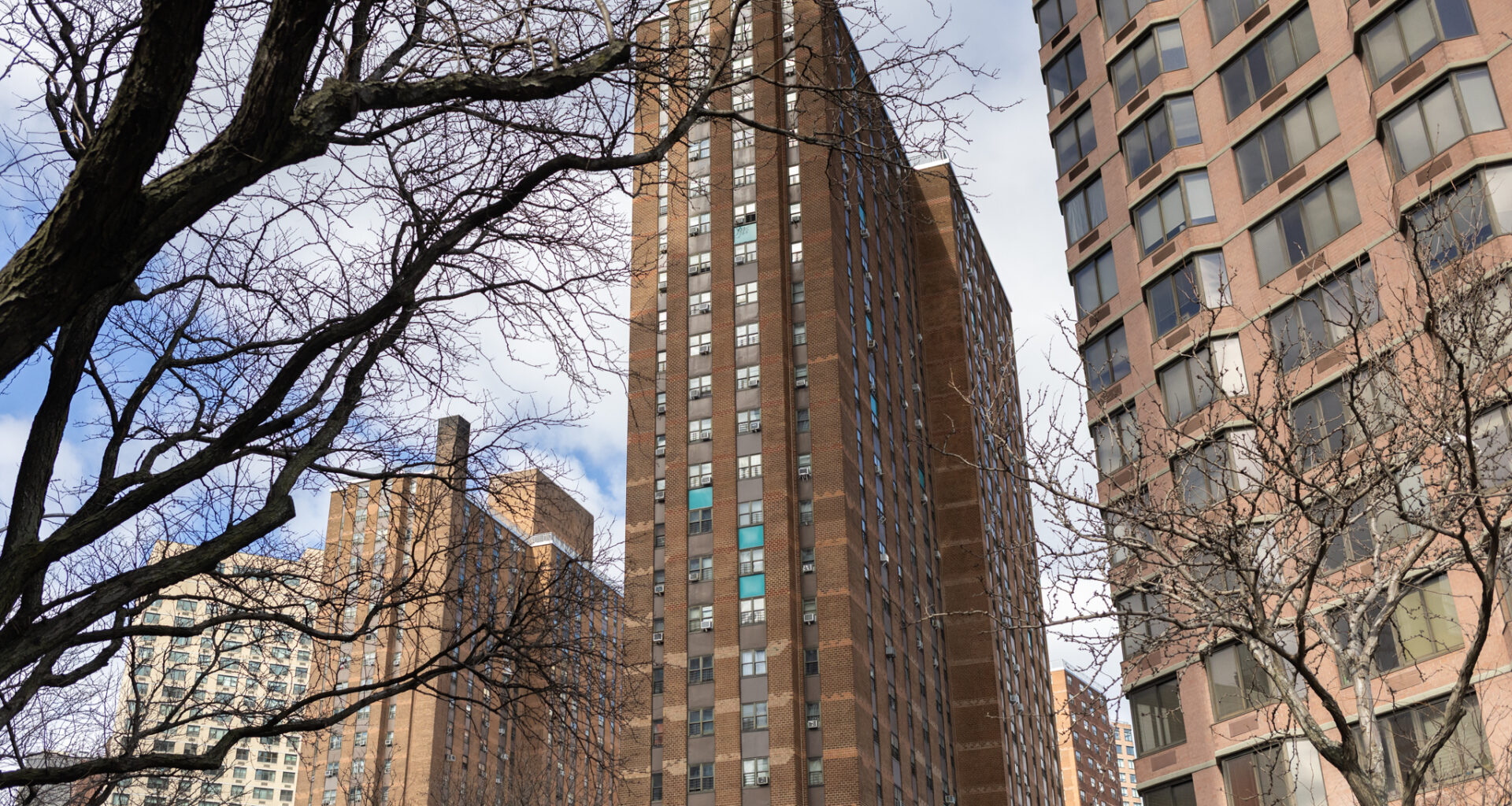
Residents in a public housing development in Yorkville are facing a pivotal choice: remain under current federal funding known as Section 9, or enter into a new arrangement to help secure the billions of dollars the New York City Housing Authority (NYCHA) needs in repairs.
Stanley Isaacs Houses is the first development in Manhattan to hold an election on whether to leave Section 9, the federal program that has paid for public housing for decades, or leave for either the Permanent Affordability Commitment Together (PACT) program or the New York City Public Housing Preservation Trust.
Under Section 9, the local housing authority is the property’s landlord. With PACT, private companies, often in partnership with a nonprofit, typically take over management and maintenance of the buildings while NYCHA would retain ownership. Under the Trust, its board could raise money for needed repairs through bonds while NYCHA continued to manage the buildings.
Late last week a mandatory 30-day voting period began. Tenants can vote by mail, online or in-person during the final five days.
As the process started, residents were divided about the future of the complex and how it should be funded — and some were unclear about how the consequential vote could affect their home.
Isaacs is one of many public housing developments citywide with dire physical problems that will face a similar choice about how to address millions in necessary repairs. The three towers at the 61-year-old development overlooking the Harlem River will require more than $248 million in repairs over the next two decades, according to NYCHA’s most recent Physical Needs Assessment from 2023.
Saundrea Coleman has lived with the reality of that funding shortfall for years and has actively advocated for change. She is one of the more than 1,000 New Yorkers who call Isaacs home. In 2019, she sued NYCHA for failing to provide adequate living conditions at Isaacs and the neighboring Holmes Towers.
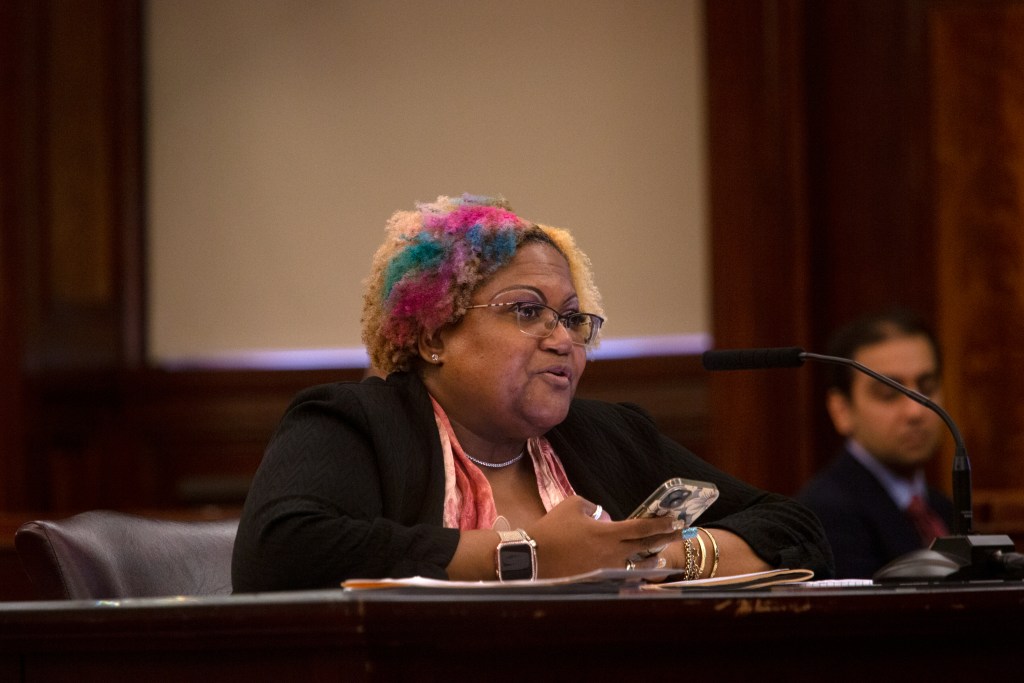 NYCHA resident Saundrea Coleman testifies at a City Council hearing on private building management in public housing, May 3, 2022. Credit: Ben Fractenberg/THE CITY
“It’s not easy living in public housing. It’s traumatic for some of us sometimes, because we get beat up in so many ways,” she told THE CITY.
If tenants opt to remain in Section 9, they can push NYCHA for improvements, but their complexes will not receive widespread rehabilitation. Still, while Coleman knows how badly her complex needs repairs, she is asking her neighbors to vote for the status quo.
On two recent frigid Saturdays, Coleman and other members of her group “Save Section 9” went door-knocking in the complex to inform residents about the election and to lobby against the two new funding programs.
The canvassing at one point devolved into a heated exchange between Coleman and the complex’s resident association, underscoring how contentious the election has become.
While Coleman was door-knocking with other residents, members of the resident association interrupted and told them they needed approval from development leaders.
“They told me I couldn’t organize, and that’s my right,” Coleman said. “I feel they’re trying to suppress my influence, because people trust my judgment. Keep in mind, a lot of people don’t even know what Section 9 is, and they live in NYCHA.”
Tenants advocating to “Save Section 9” are not the only ones mobilizing over the vote — unions are also involved, pushing for residents to pick the Trust. NYCHA has a project labor agreement with unions for major repair work. Under PACT, construction can be done by nonunion labor brought in by the private management, and with Section 9, there is not much hope for funds for these projects.
On Jan. 22, members of the Plumbers Local 1 and the District Council of Carpenters canvassed at Isaacs Houses to ask tenants to vote for the Trust, handing out flyers and offering coffee and donuts. Last spring, members of Local 79 campaigned for the Trust option at Hylan Houses in Bushwick. More than 85% of tenants there voted to join the Trust out of 176 cast ballots.
The Plumbers Local 1 and the District Council of Carpenters did not reply to THE CITY’s request for comment.
Hello Section 8?
Both PACT and the Trust are ways NYCHA has touted to generate the money needed to rehabilitate its developments by changing how complexes have been historically funded.
If residents approve a plan to leave Section 9, complexes will switch to Project-Based Section 8 funding that can leverage federal rental subsidies to access conventional loans or raise money through bonds to fund building renovations.
A major difference between the two programs is who manages the properties. Under PACT — the city’s version of the federal Rental Assistance Demonstration (RAD) program — the private companies, and in some cases nonprofit partners, that take over management and maintenance for the units would pledge millions of dollars for repairing the units. In return, they collect the publicly subsidized rent.
NYCHA began transitioning developments to PACT a decade ago and has already converted 40,000 units with the goal of converting an additional 22,000 units by 2028.
Lawmakers passed legislation four years ago that established the Trust as a non-profit affiliation of NYCHA with nine board members that could raise billions of dollars through bonds. If tenants choose the Trust, NYCHA would continue to manage the properties.
“Both PACT and the Trust marks a switch from the kind of very unstable and underfunded Section 9 funding to a better funded Section 8 funding,” said Jessica Katz, who leads the NYCHA Regeneration Initiative and served as chief housing officer under former Mayor Eric Adams. Katz also played a part in the Trust’s legislation passage by lobbying for it as Director of the Citizens Housing and Planning Council nonprofit.
Katz explained that the Trust gives residents an option for widespread repairs other than private management under PACT. “We heard NYCHA residents calling for a public option, and so we thought it was really important to provide that tool and to provide the choice itself,” she said. “Having an option is really important because the mistrust is so deep.”
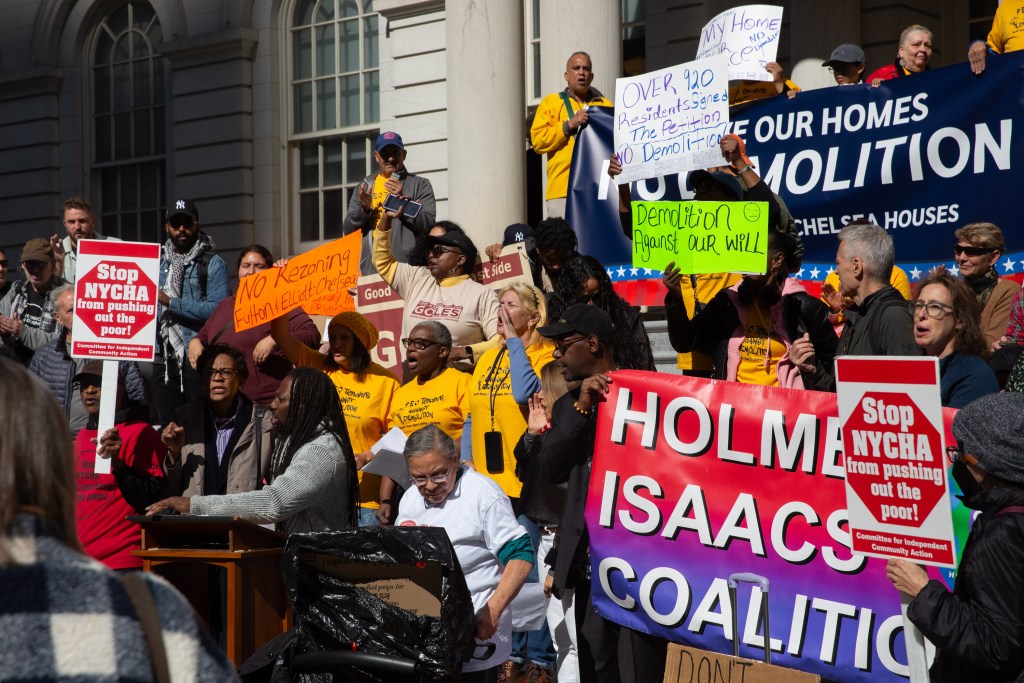 Residents of the Fulton and Elliot-Chelsea Houses and Holmes-Isaacs Coalitions protest outside City Hall NYCHA’s plans to allow private developers to rebuild the complexes, Oct. 10, 2024. Credit: Ben Fractenberg/THE CITY
Miguel Penalo, an Isaacs Houses resident, told THE CITY he wants his complex to remain in Section 9. “I’m gonna leave everything as it is,” he said. “I don’t have any problem. Every time I need something, they help me. Every time I call, they come the next day.”
Recent votes by tenants would not have happened without the Trust’s creation. That’s because tenant choice is baked into the Trust’s legislation —residents must approve it before their development can join.
Seven elections have been held so far, with a slim majority of complexes — four of seven — choosing the Trust. Nostrand Houses in Brooklyn became the first development to enter into the Trust in December 2023.
Not all public housing complexes will get a choice at all. According to NYCHA press secretary Michael Horgan, NYCHA’s criteria for bringing the Trust vote to complexes includes how badly developments need repairs, whether the Trust would generate enough money to fund those repairs and whether a development’s size and number of units would make construction easier compared to other properties.
NYCHA estimated it will cost $78.3 billion to rehabilitate public housing citywide.
Mistrust Runs Deep
As tenants try to make the best choice, many say NYCHA mismanagement has eroded their faith in the corporation and its future plans for their homes — but many also fear what would happen if they give up Section 9 status.
Some worry they will lose the rights guaranteed to them as Section 9 tenants. Others fear that under PACT, tenants would be more likely to be evicted.
According to a December 2024 audit by the comptroller’s office, evictions by private managers with PACT occurred at a higher rate than those by NYCHA and other private landlords. The report showed that eviction rates at PACT developments had an eviction rate of 0.57% — 91 evictions out of 15,983 units.
“Tenants have every reason to be skeptical, if not distrustful, given that the Housing Authority has not always been honest,” said Alex Schwartz, professor of public and urban policy at the New School. “[NYCHA] went from being considered the best performing big city housing authority in the country to a troubled housing authority. They have every reason, I think, to be wary.”
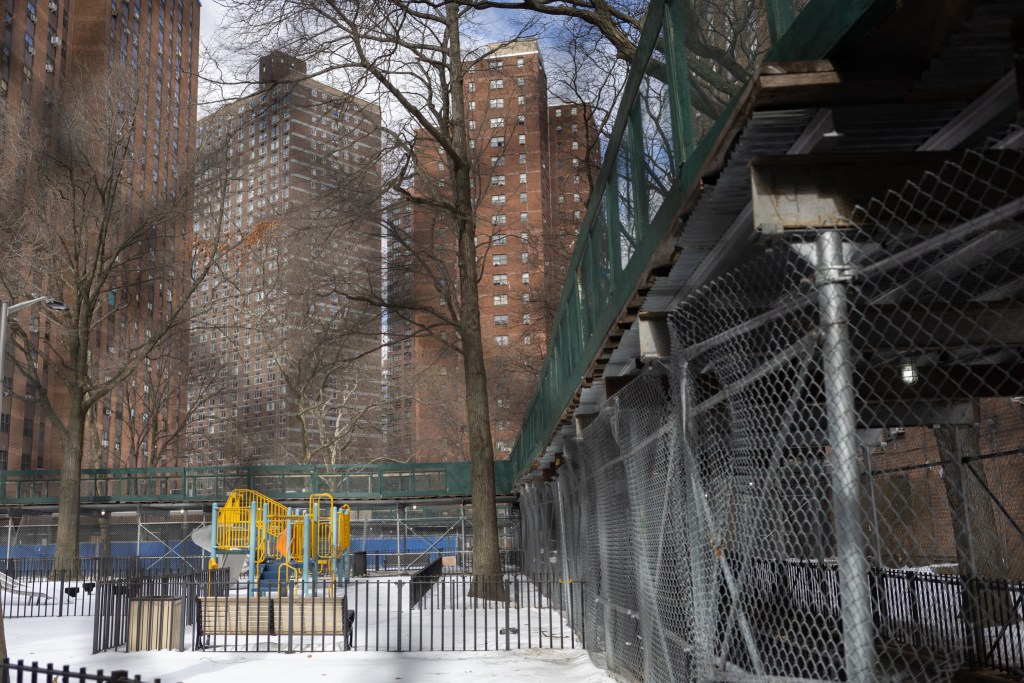 Residents of the Isaacs Houses in Yorkville were set to vote on joining the New York City Public Housing Preservation Trust, Feb. 12, 2026. Credit: Ben Fractenberg/THE CITY
When a development leaves Section 9, certain conditions do change for residents. Tenants in Project-Based Section 8 housing can no longer request a transfer to another public housing development. Instead, they may be eligible to receive a portable housing choice voucher for a prospective rental in the private market anywhere where Section 8 vouchers are accepted. They can still request transfers within their development.
Under PACT, tenants pay rent to the new management group and are not protected by an ongoing federal monitor’s oversight. For both programs, it is likely NYCHA may temporarily relocate residents for months in cases where severe repairs are necessary — with residents having the right to return.
But overall, despite NYCHA’s history of mismanagement, experts say residents have good reason to expect they will not lose their homes and will retain protections.
NYCHA maintains that under PACT and the Trust, residents maintain their rights under Section 9 housing, including tenants not being re-screened upon conversion and rent remaining 30% of household income. The Trust’s legislation states that tenant protections “shall be consistent with those afforded to a public housing resident.”
Some tenants falsely believe that units could be rented out for market value when a development leaves Section 9 — like the rents of the private apartments that line the blocks surrounding Isaacs, where a studio averages more than $3,000 per month.
According to Schwartz, there is little risk of that because NYCHA still owns the land under PACT and the Trust, and because strict regulations would prevent it. As long as tenants abide by their leases, pay rent and do not destroy property, he said, they do not have to worry about losing tenant protections.
“I think that there’s some fear mongering, and there’s some ideological opposition to the idea that private companies should manage the public asset of public housing, but I think there are a lot of protections in the system,” Schwartz said. “If there isn’t any funding going into replacing key building systems and renovating apartments, that’s going to be the real problem, not the theoretical risk of privatization.”
For Coleman, the question of whether she’ll have her rights under the Trust or PACT is simple: NYCHA’s promises on that point can’t be believed. She is also dead set against “any forms of privatization.”
“I don’t want us to not get repairs, but there’s other ways of getting the repairs done,” she said. “You’re an entity that has disinvested, that has mismanaged funds over the years, over decades, because its Black and Brown people in its majority.”
Coleman has been a resident of Isaacs Houses since 2015, the same year a tenant knocked on her door and told her about NYCHA’s proposal to build a 50-story tower on a playground at Holmes Towers. She has been advocating for improved public housing conditions ever since.
She would like to see Isaacs rehabilitated through “Comprehensive Modernization,” a program NYCHA launched at two developments to rehabilitate large amounts of lead-based paint and mold, using a one-time allocation of city funds without the complexes leaving Section 9. NYCHA plans to bring Comprehensive Modernization to two additional developments via disaster recovery funding, but only to developments damaged by Hurricane Ida.
But those were special cases, and getting that kind of money for all complexes in the city is a longshot.
In an interview with THE CITY from November, Mayor Zohran Mamdani said he supported “doubling the amount of money we spend on preservation for NYCHA,” but where this money would come from is unclear, and funding for public housing is a huge ongoing need.
In the meantime, hundreds of thousands of New Yorkers continue to live in buildings that have billions of unmet needs.
“I think we’re moving in the right direction, but I still think you see reasons for mistrust and disappointment every day,” Katz said. “With an $80 billion capital gap, there is no leadership, policy, procedure, work, order, system, tech, solution — nothing. You just need that money.”
Isaacs Houses residents can vote online or by mail with materials sent to eligible until March 16. Voters may vote in person the final five days of the voting period, beginning March 12. Email vote@nycha.nyc.gov by March 6 at 12:00 p.m. if you need additional assistance voting.
Related