
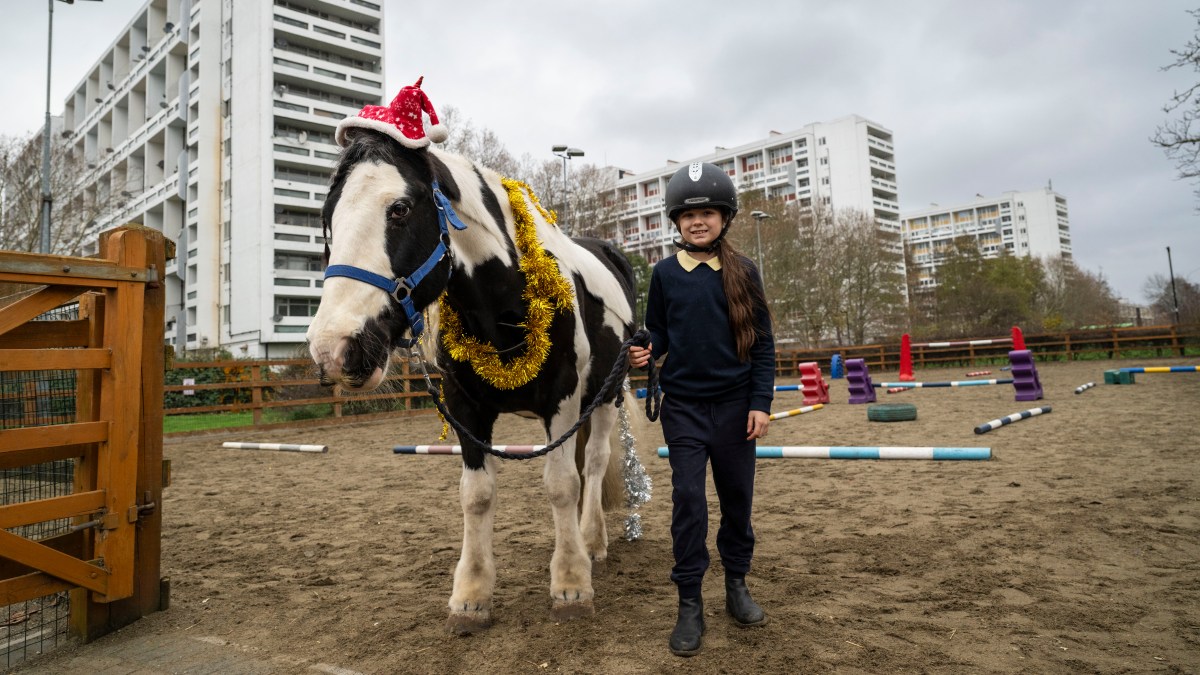
Tucked away in south London, horses line up outside their stable ready to be brushed and cuddled by bouncing children. Volunteers sweep up muck and staff members prepare dinner. These pampered ponies are living the dream.
Stars of the show though they may be at the Ebony Horse Club, they are here to help. The aim of the charity, whose president is the Queen, is to increase the life skills, wellbeing and aspirations of children who have not had the easiest start in life. Many come from low-income families or have had difficult upbringings and a large proportion have additional needs such as autism. The charity not only gives them the chance to ride — a proven stress-reliever — but to develop skills around, and beyond, the stables.
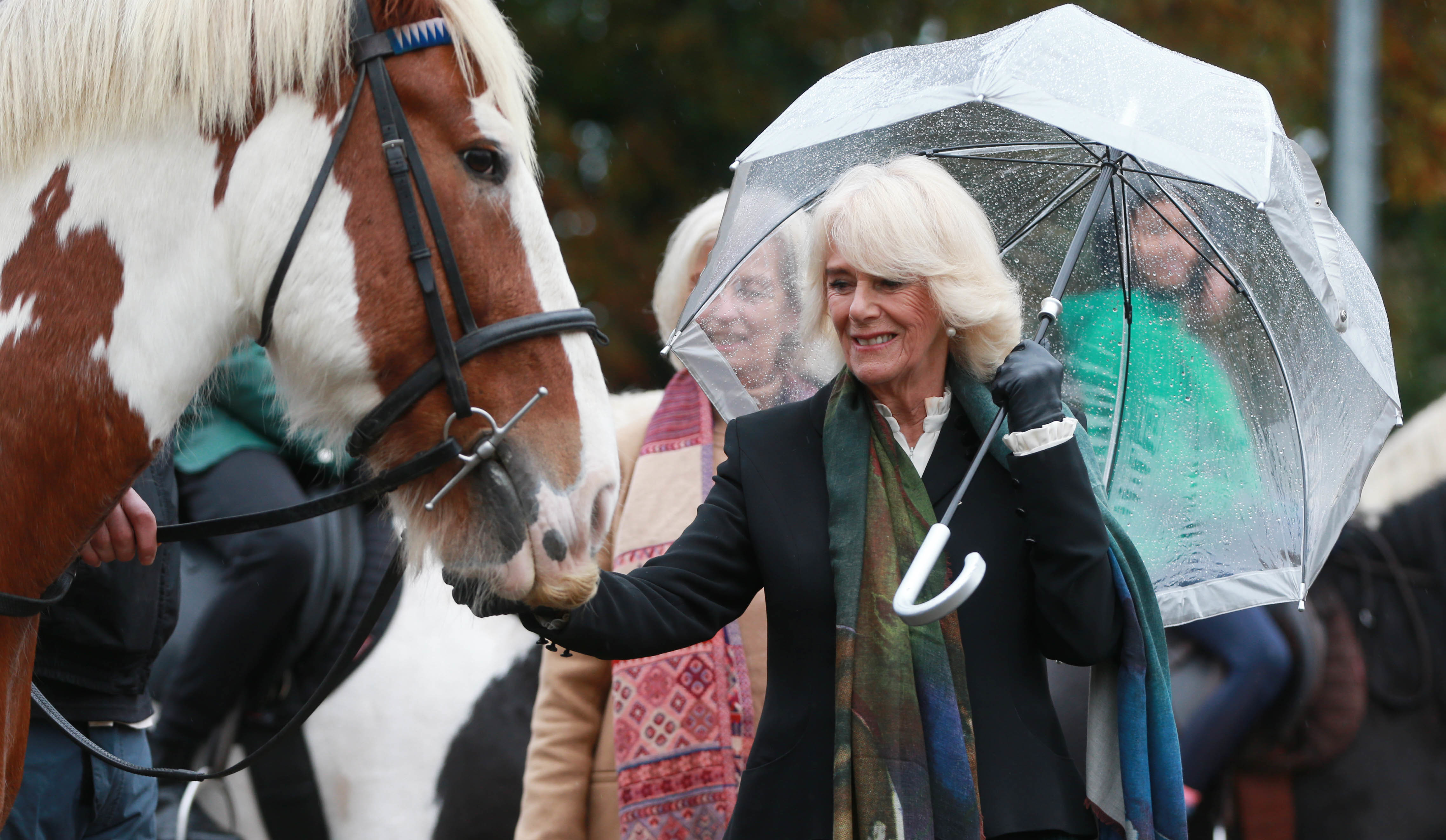
The Queen visiting the charity in 2020. She has also been known to greet its groups of children on visits to Ascot
IAN VOGLER/DAILY MIRROR/PA
Minutes from the cacophony of buses and buskers on Brixton Road and abutting the train tracks, this is an unusual spot for a riding stables. It often surprises visitors. Sid Holdsworth stumbled upon the site during a walk through Brixton in 2022. Now she is the organisation’s chief operating officer. Having spent her childhood with horses and her adulthood working for charities, she “felt so much synergy with what we’re doing, why we’re doing it, and why we’re dong it here”.
“Brixton’s incredible and it’s got so much personality, so much vibrancy and culture,” she says. “There is so much to celebrate and be proud of and enjoy. But it is also an area that has experienced repeated traumas over the last, you know, for ever — particularly with young people.”
The centre, run by staff and volunteers, started just after the millennium as an after-school provision and became a charity in 2011. It offers riding lessons, organises educational trips to offices or parliament and facilitates days out to the polo or Ascot, where Camilla has been known to greet the children. They have a “grow your own” system: volunteering programmes where the young people can learn the inner workings of the industry by being immersed in the running of the stables (from helping the younger children to mucking out). This often results in them securing jobs at the stables.
As we are sipping our teas in the lounge — with sofas in the centre, board games piled on the table and a shelf stacked with riding hats and boots lining a wall — a group of giggling school children bursts through the doors and bundle together on the sofa. They are here because their nearby school signed them up. This is how most children are introduced to the charity. They will soon be heading outside to groom their four-legged friends before taking them into the arena for some equestrian games.

Sid Holdsworth says the charity helps children to create “joy and love and friendships”
LUCY YOUNG FOR THE TIMES
Ebony works with nine local schools and independently with other children, who could have approached the charity themselves, been signed up by family or been referred by their GP or a social worker. The charity sees two or three groups a day. The waiting list, as so often with charities in less privileged parts of London, is substantial.
As we stand outside, watching the children pass around brushes to commence pony-pampering, Hugo, one of the horses, gently nudges Holdsworth, who rummages through her pockets for treats while describing the positive effects horses have on the children. One is building trust. Not all the children at the centre can count on many positive adult relationships in their lives, but they can quickly build a rapport with the instructors; after all, when you are sitting on top of an animal with a mind of its own, you have to trust that the instructors will keep you safe and secure in the saddle. “They develop these really deeply trusting relationships with adults, which is so important for young people,” says Holdsworth while Hugo, outraged that snack time has been brought to an end, muscles his head into Holdsworth’s pocket to investigate for himself.
Horses lend themselves to empathy and kindness, explain staff. Approach a horse with aggression or boisterousness and that’s what you’ll get back; approach with compassion and warmth, and the favour is returned. It’s not hard to see how that might translate to life beyond the stables and relationships with peers, parents and teachers.

Instructors lead children through equestrian games
LUCY YOUNG FOR THE TIMES
“I think so much of the work we do is also centred around creating joy and love and friendships because that is so much of what is missing,” says Holdsworth. “When the young people come through the gates, you see their shoulders drop and you see them relax. They might have come from a stressful day. The community might be going through a difficult period. They might have seen something that no child should see but they come through the gates in our little oasis here and they get to be children and enjoy being a child. It’s just magic.”
• The smartest way to see London — on horseback
Ebony has helped to write countless success stories. Many children go on to work in the industry or study at university, others became accomplished riders. One standout is Khadijah Mellah, who joined Ebony at 12 years old, and in 2019, when she was 18, became the first British Muslim woman to win a major horse race in the UK.

The stables’ location among Brixton’s estates is an important feature
LUCY YOUNG FOR THE TIMES
Mellah is by no means the only triumph that the charity had a helping hand in. Shanika and Shanice, twins from Brixton, started coming to Ebony aged eight. “For the first I would say two, three years I was literally petrified of horses,” Shanika says with a giggle. “I used to be so scared to get on the horse. I used to be scared to lead the horse. Even touch the horse.” Gently but firmly told to either lead the horse or not come back, she summoned the courage and hasn’t looked back.
“I’ve done stuff that if I wasn’t at Ebony I would have never been able to do,” she says. She studied equine management at college, which was funded by Ebony, has ridden at Olympia, worked at a stud yard and met both the late and current Queen, as well as equine royalty Pippa Funnell and Mary King. She also credits Ebony with helping her to grow in confidence.
Shanika and her sister have returned to Ebony to work and help other children like them. This full circle moment has been rewarding for them. “A lot of the kids that come obviously have some trouble at home or trouble at school,” Shanika says. “So a lot of them come to Ebony as a safe space. They’ll come in and help in the yard because it helps them. If Ebony wasn’t in Brixton, a lot of the kids would probably be in trouble on the streets.”