
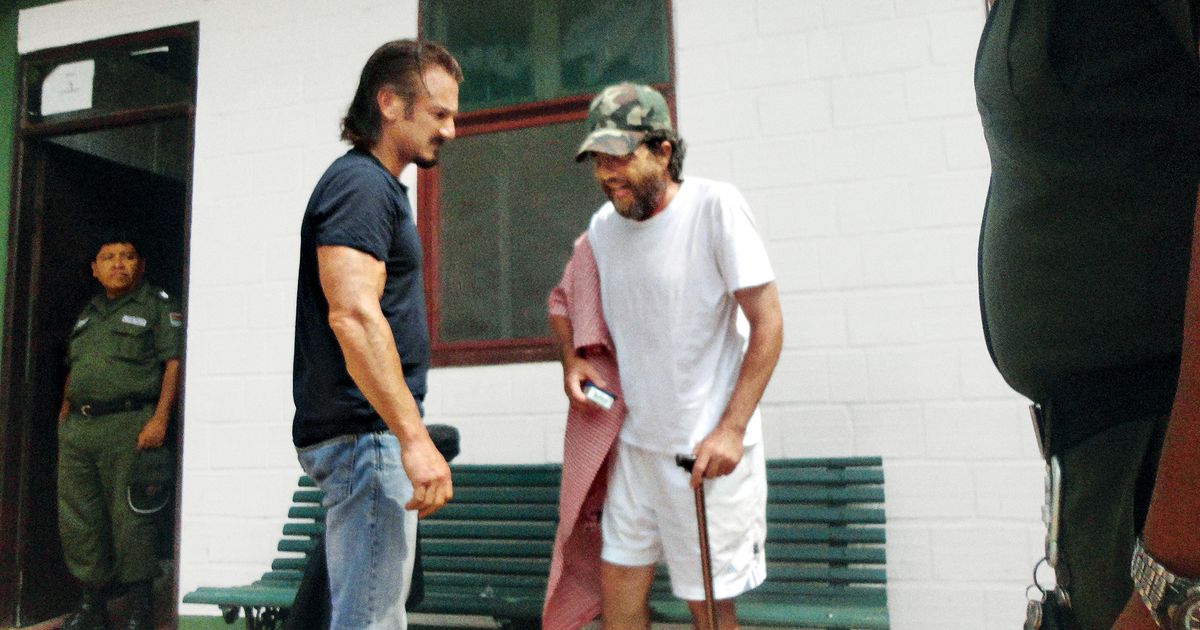
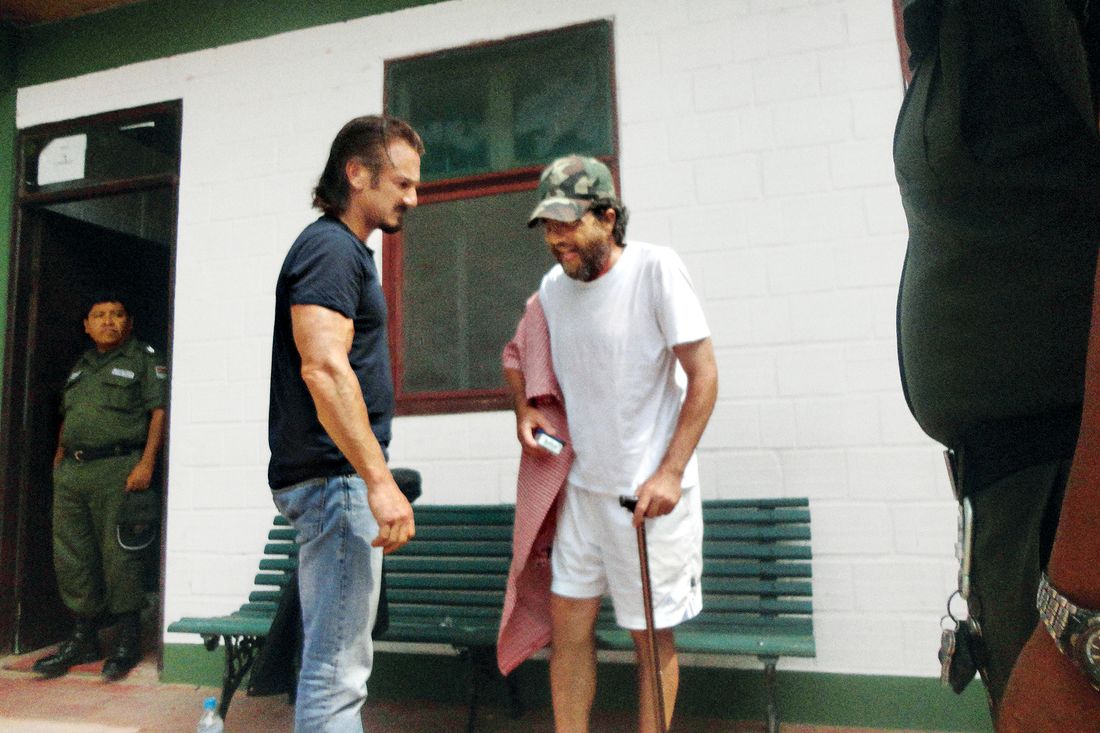
Sean Penn with Jacob Ostreicher in Palmasola prison.
Photo: STR/AFP/Getty Images
Sean Penn always knew that rescuing Jacob Ostreicher from his years of Bolivian imprisonment would be difficult. Ostreicher, a then-52-year-old Hasidic businessman who had moved to the country from Brooklyn to manage a rice farm, got stuck there for two and a half years after he was accused of money laundering and criminal organization. His detainment in one of Bolivia’s most brutal prisons had attracted international attention — ABC News’ Nightline had run a segment about his incarceration; it was covered by the New York Times, the BBC, the Associated Press, and the Bolivian and Jewish press. It seemed like he would never get back to the States. Until suddenly, in December 2013, he returned. The Bolivian justice minister claimed Ostreicher had slipped away while out of prison on house arrest. Chaya Gitty Weinberger, Ostreicher’s daughter, told the Times that her father had been “dropped off in Pacific waters,” then released — but only after her uncle had negotiated a ransom. A State Department spokesperson would only confirm to news organizations that Ostreicher was in the United States. What really happened remained a mystery, though there were some cryptic clues: New Jersey representative Chris Smith, who had testified in Congress to advocate for Ostreicher’s freedom, released a statement thanking “Sean Penn for his tireless work to free Jacob.” As it turned out, that tireless work was much more literal than anything previously reported. Over the span of a year, during which he starred in The Secret Life of Walter Mitty, the actor had been making plans to smuggle Ostreicher out of Bolivia by land, by air, or, if necessary, through the heating vents of a hospital.

April 2012 | After an American Hasidic man, Jacob Ostreicher, was detained for months without charges in a dangerous Bolivian prison …
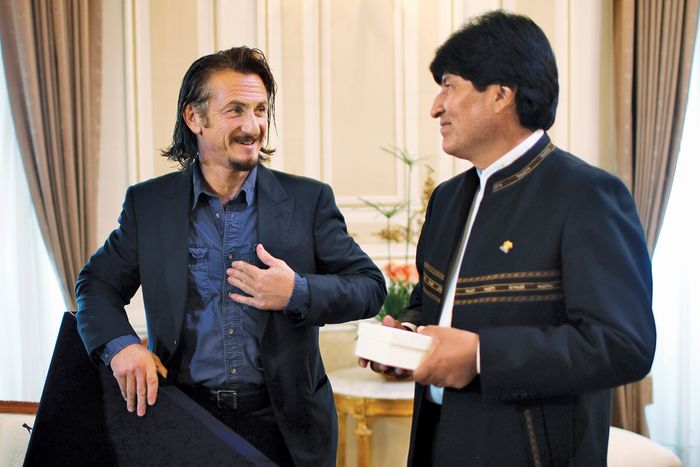
October 30, 2012 | … Sean Penn lobbied Bolivian president Evo Morales, a fan of the movie star, directly on his behalf.
Photo: Courtesy of Steve Moore (top); Juan Karita/AP (Penn, Morales)
Jacob Ostreicher grew up in the ultra-Orthodox Satmar communities of Williamsburg and Borough Park, insular stretches of city blocks known for black hats and strict rules. He learned Yiddish before English and was forbidden from reading secular books, watching TV, and going to the movies. He attended yeshiva and was observant of the religious laws. But he was a precocious and intensely curious youth, eager to explore beyond the bounds of his tight-knit sect. He’d sometimes pop into city courthouses to watch cases being deliberated and dreamed of being a lawyer. As an adult, he learned how to fly single-engine planes, despite, or perhaps because of, his fear of heights. In his 20s, he went into his father’s flooring business, where he succeeded as an extroverted salesman. He did well enough that by his 30s, he was driving a Jaguar and skiing in the Alps. He married and later divorced a woman he met through a matchmaker. Eventually, he got remarried to Miriam Ungar, a twice-divorced mother with three kids who was, Ostreicher says, the woman of his dreams. They had a happy marriage, five children between them, a strong community in Borough Park, grandchildren, and wealth.
Until the 2008 stock-market crash. Seeing business dry up and his portfolio take a hit, Ostreicher consulted his money manager, a Swiss lawyer named André Zolty, on how to make an investment with big returns. Zolty’s answer was, in a word, “rice.”
Global demand was high, Zolty said, and nowhere is the climate more perfect for growing than in Bolivia, where land is cheap and labor cheaper. He suggested Ostreicher invest in one of his ventures — a relatively new rice farm in Santa Cruz, a tropical area of the country known for lush lowlands with dependable rainfall and humidity. The farm was being managed by a Colombian lawyer in her early 30s named Claudia Liliana Rodríguez Espitia, who had interned at Zolty’s firm in Switzerland as a graduate student. Zolty maintains Ostreicher and other investors in the enterprise were told it was risky or even dangerous because of Bolivia’s political climate — a claim Ostreicher hotly disputes. But both of them had high expectations: If all went well, the biggest investors were practically guaranteed to make millions.
Ostreicher was dazzled by the potential for a vast fortune. Bolivia was one of the few countries to welcome Jews during the Holocaust, and he began to see the project as a way to give back. He’d create jobs for the Bolivian people, he thought. He’d build schools.
Soon, Ostreicher was taking an eight-hour flight followed by a seven-hour off-road Jeep ride to see the farm. He’d told Ungar he was going just to look. Only some of the land, which spanned multiple parcels and totaled at least 50,000 acres, was cultivated, but the plan was to expand each year, which meant more rice, more profit, more wealth. As Rodríguez Espitia showed him around, Ostreicher began to imagine a kosher cattle ranch on parts of the property. He decided to put his savings in the roughly $26 million project. He returned to New York happy and confident. “This farm will change our lives,” he told Ungar.
As Ostreicher tells it, it was nearly two years before he came to believe that Rodríguez Espitia was stealing from the business. He told the AP in 2011 that she had skimmed millions of dollars from the venture, put her own name on many of the deeds, and paid for farmland with a check that bounced. Before anything could be done about it, she disappeared. (Rodríguez Espitia disputes this.)
Ostreicher says he was frantic, but most of the investment was not in the bank; it was already planted in the ground. The investors could still recoup their losses as long as someone could oversee the harvest and get the books in order. Zolty put Ostreicher up for the job.
It was tough work to get Ungar onboard. She was adamantly against the idea of the two of them moving semi-permanently to Bolivia to manage the farm, as was Ostreicher’s father, a Holocaust survivor who ruled the family with an iron fist. Ostreicher pleaded with his wife. Yes, he acknowledged, neither of them knew much about agriculture or rice or South America. And no, they didn’t speak Spanish. But Ungar was great at accounting and Ostreicher would buy a book on farming. It would be an adventure.
He wore her down. In December 2010, the couple moved into a house in the city of Santa Cruz de la Sierra that served as the farm’s office and koshered the kitchen. Zolty revoked Rodríguez Espitia’s power of attorney (“I made a big mistake to trust that woman,” he told the AP in 2012). He put Ostreicher in charge of managing the investment. Ungar tackled the numbers, and Ostreicher set to work on the rice harvest. He says he convinced farmworkers who were threatening to walk off the job to stay and had freshwater wells dug in the fields. For the coming harvest, which he estimated would be 35 million pounds of rice, Ostreicher put in a massive order for burlap bags, each proudly stamped with the name of the new company: Coliagro. He also filed a police report against Rodríguez Espitia in March 2011 accusing her of fraud. (Rodríguez Espitia denies that she stole money from Ostreicher and says that her part of the work, sowing the rice, was done. She had traveled abroad, including to her residence in Switzerland. Later, she would return to Bolivia. She says she also filed her own police report accusing Ostreicher of stealing the rice she planted.)
Around that time, an investigator began visiting the farm to ask questions; Ostreicher believed they were there to help with a case against Rodríguez Espitia. But the inquiries seemed to stray beyond the purview of Ostreicher’s complaint. Concerned, Ostreicher contacted the U.S. chargé d’affaires, who “told me to tell them everything, show them everything, and they’ll leave me alone,” Ostreicher says. So he did, giving the authorities the location of the storage silos, receipts for the farm equipment, and details about the harvest, which was turning out to be even greater than anticipated — worth some $13 million. Ostreicher was satisfied when he learned of Rodríguez Espitia’s arrest in May.
On June 3, 2011, just before heading back to New York for the holiday of Shavuot, Ostreicher was asked to come to the office of a specialized police unit focused on drug trafficking to answer one last set of questions. This time the mood was different — hostile. Ostreicher was handcuffed and shoved against the wall. “I’m not the criminal,” he shouted. His first call was to Ungar, who had already flown home for the holiday. Trying to keep the fear from his voice, he told her to call the U.S. Embassy in Bolivia. There was a misunderstanding, but she shouldn’t worry. “I’ll be in New York in time for Shavuot. By Monday for sure,” he told her.
Ostreicher spent that night in a ten-by-ten-foot holding cell in Santa Cruz, bare except for a bucket brimming with human waste, its overflow coating the floor, and remained there for several days. He paced angrily back and forth, holding his pants up with both hands because the police had taken away his belt.
An aide to the U.S. Embassy came to see him, trying not to gag at the smell. She brought small mercies: a towel to sit on and some fresh fruit to eat. What she couldn’t bring was any hope that the U.S. Embassy could fix this. Bolivia’s relationship with the U.S. had recently been deeply strained; President Evo Morales, a leftist ally of Venezuela strongman Hugo Chávez, had expelled the American ambassador in 2008 (but not all embassy staff) as well as Drug Enforcement Administration officials. And besides, as far as anyone in the U.S. knew, Ostreicher might have done something illegal.
One of Ostreicher’s Bolivian lawyers told him he would likely be freed as soon as he had a hearing but only if he paid a bribe. The money would be for the judge and others who needed to be “taken care of,” Ostreicher remembers the lawyer explaining. Ostreicher pushed back, but his lawyer told him that if he didn’t pay, he’d get sent to prison, and Bolivian prisons could be deadly. Ostreicher got him the money. So he thought he must not have heard correctly when, the next day, sitting in a courtroom, his translator told him that the prosecution had accused Ostreicher of money laundering and criminal organization. There were no charges yet. While the prosecution assembled its case, Ostreicher would be sent to prison.
Ostreicher was quickly learning that Rodríguez Espitia wasn’t in trouble for complaints he’d filed with police. She had been arrested on accusations of money laundering in connection with a Brazilian drug trafficker: Several of the parcels of farmland she had acquired and planted allegedly belonged to the criminal. (Years later, she was acquitted.) And Ostreicher was embroiled in the investigation.
He was also learning that in Bolivia, if someone is arrested under the suspicion of money laundering, the government can seize the arrestee’s assets — which, in this case, included thousands of tons of rice Ostreicher had harvested. Ostreicher’s translator told him to stuff cash in his sock. In Palmasola prison, where Ostreicher was headed, you can buy your life, he said. No money, no life.
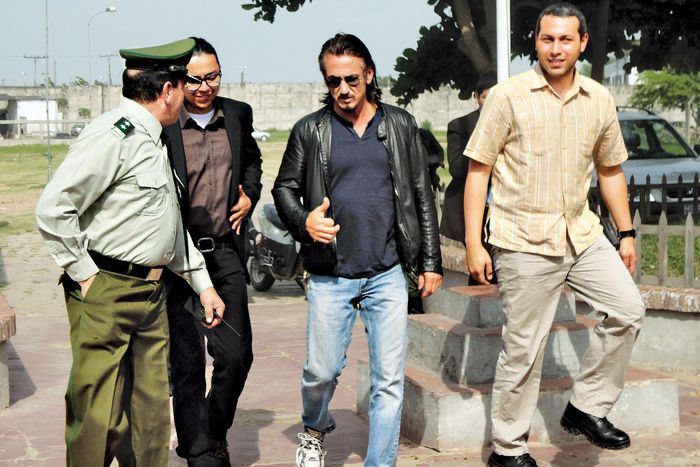
October 31, 2012 | Penn’s clandestine trip to the Bolivian prison where Ostreicher was being held was made public after guards leaked photos …

December 12, 2012 | … Which brought global attention to the case.
Photo: STR/AFP/Getty Images
At Palmasola, though police guard the perimeter, inmates run several of its demarcated sections, the largest of which resembles a village. The 5,000-odd prisoners are not just the cooks, the doctors, the landlords, and the janitors; they are the guards, the administrants of punishment, and sometimes the executioners. Those with the longest sentences take on “governor” roles — they make the rules everyone else has to operate by.
Standing outside the barbed-wire walls of Palmasola that first day, Ostreicher anticipated he’d be the only American and Jew inside. Certain he was about to be killed, Ostreicher called his wife to ask for forgiveness and say “good-bye.” “I told her we would never see each other again,” he says. “It was the hardest phone call I’ve ever made, before or since.”
The main processing guard looked at Ostreicher’s paperwork and told him through his translator that he was being sent to a dangerous area of the prison. But if Ostreicher paid him $500, he’d send him to a safer area. Ostreicher got him the $500. Did he want a cell, or did he want to live outside? $100. What about blankets, a pillow, and a mattress? $100 more. For an additional $50, Ostreicher could even have a TV.
Another guard stepped in and tried to grab the one object Ostreicher had brought with him: his tefillin bag, which carried two small leather boxes containing Torah passages and which he used for prayer every morning. His father had given it to him when he was 13 years old. This was where Ostreicher drew the line. “I told him I’m not going in without my tefillin, so if he wants to take it, he might as well kill me now. I was so angry at God and myself. I told my interpreter to give the guy the rest of my money, which was $300,” he says.
An early sleepless night was punctuated by screams that seemed to be coming from just a few feet away. The next morning, a man’s lifeless body was sprawled on the ground near where Ostreicher slept, his neck slit. Ostreicher put on his tefillin and prayed to be as strong as his father was in Auschwitz and his mother in Bergen-Belsen. He beseeched God to give him the strength to live through the next few days until this horrible misunderstanding could be cleared up.
The U.S. Embassy aide tried to negotiate a safer situation for him, convincing guards to let him sleep on the floor of the chapel within the prison. But when Ostreicher saw the cross on the chapel wall, he refused. “I told her, ‘Are you out of your freaking mind? I don’t know why God put me here, but it’s not to sleep under a cross,’” he says.
Over the phone, Ungar begged him to change his mind. Their rabbi also tried to convince Ostreicher to sleep in the chapel if it would save his life. “ ‘You think it’s such a good idea, you come here and sleep under the cross,’” Ostreicher recalls saying. “My mother spent seven months staying alive in Bergen-Belsen. I’m not staying alive under a cross.”
Instead, Ungar and Zolty sent him money, which Ostreicher used to pay $1,700 up front and $250 per month in “rent” for a better cell in a section of Palmasola called PC4. “It was still the worst place I’d ever seen, but compared to where I was living, PC4 was a seven-star hotel,” Ostreicher says. Cells were larger and cleaner, and there was an actual entry gate to the pavilion that surrounded them. Ostreicher remembers that the landlord of the pavilion, also a prisoner, paid another prisoner in cocaine to act as the doorman and guard. Ostreicher had a six-by-ten-foot cell with just enough room for him to pace. “That’s all I did most of the day, pace or rock back and forth, shaking like a leaf,” he says.
When Ostreicher did venture out, he would carefully count his steps. Thirty-nine steps to the shower stalls, where men were shooting up and having sex. Forty-seven steps to the entrance of the pavilion. One hundred and sixty steps to the front gate, where the police stood with guns. The counting was a survival tactic: At night, the transformer would often blow and Ostreicher would have to find his way back to his cell in the total darkness and screaming chaos that followed.
Meanwhile in New York, Ostreicher’s family was frantically trying to bring him home. Ungar was working with lawyers, compiling paperwork that she hoped would prove her husband’s innocence. She also spent long stretches in Bolivia, paying bribes to the prison guards so she could bring Ostreicher bags of kosher food.
Finally, on September 23, 2011, three and a half months into Ostreicher’s incarceration, he had his first bail hearing. Ostreicher’s lawyers came armed with thousands of pages of documents that they hoped would show the court that the farm was aboveboard. At first, it seemed like there would be a breakthrough: A judge ordered that Ostreicher’s pretrial detention be terminated and that he be released on bail while the prosecution prepared formal charges.
Ostreicher was sent back to Palmasola and waited to be released, but instead the judge revoked his own order without explanation. Soon after, the judge was appointed to a higher court. “That was the first time I realized there was major corruption going on,” Ostreicher says. “I didn’t know the depth of it, I couldn’t make sense of it, but I knew I was in some serious shit.”
The prosecutors’ case, according to a 2013 indictment, alleged that both Ostreicher and Rodríguez Espitia were part of a scheme to launder money on behalf of the Brazilian drug trafficker Maximiliano Dorado and his brother. (Dorado, also known as “Golden Boy,” escaped from a Brazilian prison in 2001 while serving a sentence for drug trafficking, murder, and money laundering.) Prosecutors said that the Dorados used Rodríguez Espitia as a straw man, putting farmland and machinery under her name to conceal their ownership. Rodríguez Espitia then planted rice — and Ostreicher harvested it — on the drug trafficker’s lands. Police had begun looking into the Dorados in December 2010, around the same time Ostreicher came to Bolivia to run the farm. After searching one of the Dorados’ urban properties in an anti-narcotics operation, authorities launched a full-scale financial investigation that uncovered records and documents that prosecutors claimed linked Ostreicher and Rodríguez Espitia to the Dorados. As a result, they seized the properties, livestock, equipment, and rice that Ostreicher was managing. The indictment alleged that Ostreicher knew of the Dorado brothers’ ties to narco-trafficking and still, as Zolty’s emissary, authorized Rodríguez Espitia’s transactions. Zolty was not charged in the indictment.
But these formal charges against Ostreicher wouldn’t come down until later — more than two years after his initial arrest. He says he was told almost nothing about what he was alleged to have done; in Bolivia, the government can hold a person without charges for 18 months. In practice, the lawyers told Ostreicher and his family, it could be much longer. Ostreicher and, separately, Rodríguez Espitia were imprisoned without understanding the full case against them.
Steve Moore, a private investigator and former FBI agent, was alerted to Ostreicher’s case by Ungar’s son. Moore had become well known for his advocacy on behalf of Amanda Knox, whose wrongful conviction in Italy for the 2007 murder of her study-abroad roommate was overturned while Ostreicher was in prison. He flew to Bolivia to research the case. “I saw right away that it was a scam,” Moore says.
“First of all, they were prosecuting Jacob, or threatening to, for financial crimes. But they hadn’t subpoenaed his bank records, which is the first thing you do when you’re investigating a financial crime,” says Moore, who compiled a report with his findings in June 2012. “The second thing was there was no intent to take him to trial.”
The farm machinery was seized, and millions of dollars of rice had been removed from the silos, an effort that would have required hundreds of trailer loads. “The totality of the circumstances convinced me that this was a government-sanctioned kidnapping,” Moore says. “I thought, Within six months, he’s either going to be freed or dead, and I didn’t see how we were going to get him out.”
Moore pretended to be Ostreicher’s relative in order to visit him in prison. “I’ve been to a few scary places in my career, and Palmasola was right up there. It was like Lord of the Flies,” Moore says. Ostreicher still remembers the sobering advice Moore gave him after his visit. “He said to me, ‘Promise that you will do whatever you have to do to survive in this place,’” Ostreicher says. “He told me, ‘You don’t have to ever tell anyone what you did — not your wife or your rabbi nor in a book that you write. Just make me a promise that you’ll do whatever it takes to get out of this hell vertical, not horizontal.’”
Ostreicher recalls being beaten viciously on Yom Kippur for being out of his cell after curfew, Jewish prayers playing in his earbuds as the blows fell. Another time, he was thrashed with rods, his blood soaking into ground already damp from the pummeled bodies of other men. During one beating, another prisoner intervened. “He offered to get me out of there. All I had to do was buy him a bag of coca leaves and then hire him at $10 a day to be my bodyguard,” Ostreicher says. There was just one string attached: If Ostreicher was ever late with a payment, the man would kill him. It was a deal Ostreicher couldn’t refuse.
Not long after that, a fellow prisoner deliberately bumped into Ungar while she was visiting, which Ostreicher had been led to believe was a direct provocation that could not go unaddressed or the next bump would be with a knife. Ostreicher gave his bodyguard $100 to make sure he didn’t have to see the guy again. “When you’re treated like an animal, you become an animal,” he says.
Two members of Congress visited Ostreicher and testified in U.S. hearings on his behalf, including Representative Chris Smith, who even flew to Bolivia in June 2012 for one of Ostreicher’s bail hearings. Smith later told The Wall Street Journal that he witnessed the Bolivian Interior Ministry’s director of legal affairs, Fernando Rivera Tardío, threatening to penalize the judge if he went forward with the hearing. The judge suspended it.
After these court appearances, Ostreicher would be sent back to prison, where not even his bodyguard could protect him from raids by police. “They would march in, tear up your cell, walk all over your bed with wet, muddy boots, then make all the prisoners strip naked and bend over so they could probe our genitals with their sticks,” he says. Occasionally, Ostreicher would get offers from the prosecution asking him to admit guilt, but he would refuse. One of his lawyers had told him that even if Ostreicher signed a document saying he was guilty, they wouldn’t let him go. They could use the coerced confession to hold him indefinitely. The days were terrifying and endless. Thirty-nine steps to the bathroom. Forty-seven steps to the pavilion door. A hundred and sixty steps to the front gate.
Fellow prisoners told Ostreicher that his only hope of getting out was if President Morales intervened on his behalf. However, Morales was a vocal critic of the U.S., so it seemed unlikely. Venezuelan president Chávez could pressure him; unfortunately, Chávez was even more critical of the U.S. than Morales.
The only hope, as these prisoners saw it, was the one American whom Chávez liked quite a bit: the actor Sean Penn. Penn and Chávez had worked together on getting relief to Haiti after a 2010 earthquake left hundreds of thousands displaced on the island. “I told my wife, ‘If Hashem wants to get me out of this prison, he’s going to have to call Sean Penn,’” Ostreicher says. He cold-called Penn’s agent at CAA in Beverly Hills. The operator hung up on him. Ungar also tried calling. They hung up on her, too.
By then, she had also made contact with officials at the Aleph Institute, a Jewish organization that provides support to incarcerated people. The director of constitutional advocacy at the organization, Rabbi Zvi Boyarsky, began to ask people at Shabbat dinners and Chabad-sponsored lunches, “Does anyone know Sean Penn?”
Everything changed after ABC’s Nightline aired a segment in May 2012 with Terry Moran, who had flown to Bolivia to document Ostreicher’s situation in Palmasola. Moran interviewed Ungar just outside the prison gates, asking what it felt like when she left after a visit. “Torture,” she said, tearing up. “The pain of watching him watch me leave — he stands behind the gate and he sees my anguish and he runs in to make it easier for me to leave. He’s thinking of me, and he’s the one suffering.” Not caught on-camera was the moment guards discovered Moran’s crew was filming. The team from ABC ran, but Ungar was caught. It was an agonizing two hours before she was brought to Ostreicher, sobbing in a way he’d never seen before. She told him that the police warned her never to come back or they would throw her in jail, too. She had to say “good-bye” for good.
“After she stopped visiting me, I gave up on life,” Ostreicher says. The couple still spoke on the phone, but their conversations became more sporadic and argumentative. It wasn’t just the danger Ungar could no longer afford to put herself in. The way Ostreicher was changing scared her. He was hardening from the abuse, and his mental health was deteriorating. He was often drunk and grew his hair long like the toughest prisoners. Their growing estrangement “was more punishment than what the Bolivian government did to me,” Ostreicher recalls. “I was ready to pack it in. I didn’t give a shit. I was hoping to die.” Putting on his tefillin every day felt excruciating, such was his anger toward God. “I told Him if He was truly the creator, then He should take me home,” says Ostreicher.
Certain he was going to die in prison, Ostreicher went on a hunger strike. It lasted for months. He became emaciated and developed a tremor. One day, down to 107 pounds and hallucinating, he heard a loud bang at his cell door. He had enough presence of mind to grab the knife he kept by his bed, though when he saw that it was a member of the disciplinary prison staff, he put the knife down. There would be no fighting back.
It must be payback for the Nightline interview, he thought. Now he would be murdered; the only mystery was how. Would he have his neck slashed, or would he be beaten to death? Prisoners lined the walkway to watch as Ostreicher was hauled away. He was praying — praying that the end would be fast and merciful, praying his death could somehow mean something. But when the gate opened, the person standing on the other side was not his executioner. There instead, looking like the Messiah with a tan, was Sean Penn.
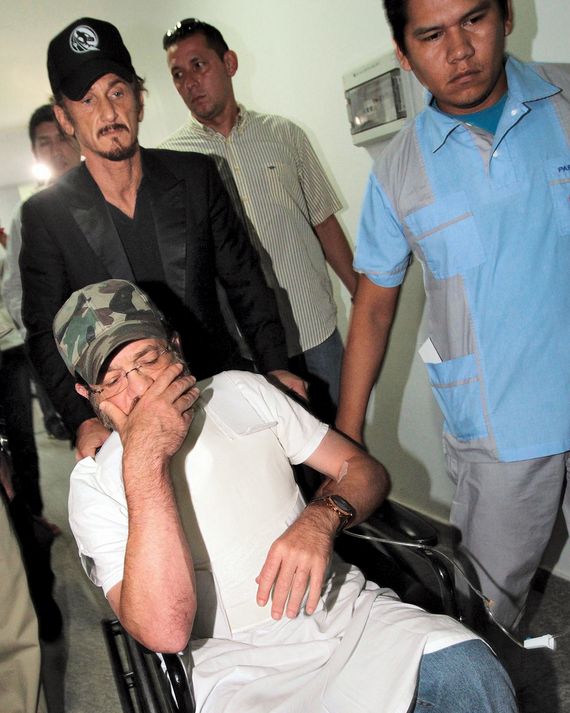
December 12, 2012 | After over 20 hearings, Ostreicher was still detained without charges …

May 20, 2013 | … And Penn testified on his behalf before Congress.
Photo: STR/AFP/Getty Images; Paul Morigi/WireImage/Getty Images (hearing)
At a Shabbat lunch in Los Angeles after the Nightline episode came out, a man told Rabbi Boyarsky of the Aleph Institute that he didn’t know Penn but he did know Mark Wahlberg’s bodyguard. Maybe that would help? Which is how the rabbi ended up pleading Ostreicher’s case, first to the bodyguard and then directly to Wahlberg, who agreed to give Penn a call. “The people who talked to Mark Wahlberg knew I had a relationship with Chávez,” says Penn. “What they didn’t know was that around two weeks before, I had gone on a diplomatic visit to Bolivia and had a very simpatico meeting with President Morales himself.” The two had gotten to know each other while Penn was working with Haiti as an ambassador-at-large.
At 65, Penn is a two-time Oscar winner and a Hollywood elder statesman, an actor who has been called, many times in his career, one of the best in his generation. But he is also an idiosyncratic celebrity. He has flown to Ukraine to encourage soldiers and has bailed New Orleans residents out of floodwaters. To assist with disaster relief after the 2010 earthquake in Haiti, Penn lived for months in a tent, working to rehouse residents and get them medical care. His ad hoc disaster-relief nonprofit, now called CORE, overcame the optics of being a movie star’s pet project to become a respected organization. In 2020, it set up early coronavirus testing sites throughout the country, including a massive pop-up operation at Dodger Stadium that could handle up to 7,500 patients a day.
All the while, Penn has remained something of an ambassadorial thrill seeker, chain-smoking cigarettes and inserting himself into areas where American diplomacy can’t reach.
After hearing from Wahlberg, Penn spoke to Ungar, who put him in touch with Moore, the ex–FBI agent, who laid out his findings and his theory of Bolivian corruption. Penn checked with contacts in the U.S. State and Treasury departments. Persuaded that Ostreicher’s imprisonment was indeed an injustice, he made plans to fly to La Paz, Bolivia’s administrative capital, immediately.
“My Spanish is nonexistent today, and it was limited at the time,” Penn says. “What I was able to offer the situation was going to be based on having had a good, friendly connection with Morales. It wasn’t going to be very effective on the phone.” He also knew he had to act fast; Ostreicher’s body was starting to fail as a result of his hunger strike.
Morales and Penn kicked a soccer ball around and each made asks: Morales wanted the international community to legalize coca leaves, a product that has many medicinal uses but is also used to make cocaine. Opening legal markets for the leaf could help lift his country out of poverty, Morales said. He asked Penn to essentially become Bolivia’s ambassador for coca leaves before the U.N. Penn let that possibility float as he asked about freeing Ostreicher. “I told Morales, ‘Last thing you want is to have an American die in your prison who’ll later be proven innocent,’” Penn says. Morales gave Penn the use of one of his own military aircraft to fly to Palmasola that night.
“The guy I’d seen on Nightline no longer existed,” Penn says of his first impression of Ostreicher. “He was a stick figure, starving and shaking. I told him, ‘Look, I believe in your innocence and I’ve spoken to President Morales and he believes you’re innocent. I’m going to get you out of here.’”
Penn negotiated Ostreicher’s release into a hospital and says he was assured by Morales that everything would be fixed. But Penn worried that those who stood to profit from the rice might be even more threatened by Ostreicher if he were outside the prison walls. He worried that “any security detail that could be formed to protect Jacob in a hospital” could harbor an infiltrator sent to kill him. It was at that point that Penn got in touch with Chávez. “I said, ‘Look, this guy needs to leave the prison tonight. It’s real. He’s gonna die,’” says Penn. Chávez flew his own officers to Bolivia to protect Ostreicher in the hospital.
News that Penn had visited Ostreicher in Palmasola during his trip to Bolivia broke after El Deber, a newspaper based in Santa Cruz, published a series of photographs of Penn in the prison. Visitors generally can’t bring cameras into Palmasola, but the journalist Guider Arancibia convinced an officer to leak him pictures of the encounter. (Officers accused of releasing the photos were later fired, Arancibia said.)
“What would have happened if I hadn’t published those photos? Jacob would have died,” says Arancibia, who continued to report on Ostreicher’s case, including on negotiations happening between the U.S. government and Bolivia. “It was a worldwide scandal.”
The actor returned to Malibu, confident that Ostreicher would soon be freed. But weeks later, he was again denied bail. Bolivian police arrived at the hospital to return the emaciated American to Palmasola. The Venezuelan officers stopped them. “I was scared shitless. I knew that if I returned to Palmasola, it was a death sentence,” says Ostreicher.
Penn decided to change tactics. What if he broke Ostreicher out of the country himself? He says he ran the idea by new U.S. chargé d’affaires Larry Memmott, the embassies of two countries neighboring Bolivia, and a high-ranking State Department official in the region. “And it was indicated, ‘Don’t tell us what you’re doing, but go for it,’” Penn says.
Accompanied by a professional extractor posing as a translator, Penn flew back to Bolivia for Ostreicher’s next hearing. Together they visited Ostreicher at the hospital. “They had him in a guarded room, and it was like a single barbed-wire fence outside,” says Penn. “Real low security, which I liked, because I thought, Okay, we should do this soon if we’re going to do it. Who knows if he’s going to get returned to Palmasola.”
The visit cheered Ostreicher. “Sean sat next to me, put his hands on my hands, and looked me in the eye,” he remembers. “He said, ‘Jacob, listen to me very carefully. I will not stop until I get you home.’” While Penn poured drinks for both the patient and the guards, keeping them distracted, the extractor snooped around, mapping out a possible escape for Ostreicher through the heating vents.
Penn accompanied Ostreicher to the hearing, wheeling the emaciated American, who was wearing a bulletproof vest, into the courtroom. “I kept saying, ‘You’re going to go home tonight,’” Penn says. “He kept telling me I was wrong — that I was buying the whole charade.” The case was remanded from an appeals panel back to the trial judge. Ostreicher was no closer to being free. “If it’d been a theater, it would’ve been a bad high-school play with the archvillains twirling their mustaches, telling their lies and laughing about how fucked they were able to make this guy,” says Penn.
Penn whispered into Ostreicher’s ear that he could be smuggled out. Much to Penn’s surprise, Ostreicher refused. “The things that happened in prison were dehumanizing, and he had lost it. So that’s who I was dealing with,” Penn says. Ostreicher had also become fixated on seeking justice. “Jacob told me, ‘I’m going to get my money back and see these guys go to prison,’” Penn says. “I said to him, ‘If that changes, let me know.’ I had a life back home. I have two kids of my own. I couldn’t keep doing this if he didn’t even want to go home.”
Then, suddenly, Ostreicher appeared to be vindicated. Perhaps in part because of Penn’s advocacy, which he would take all the way to Capitol Hill, a rift seemed to grow in the Bolivian government. In November 2012, while Ostreicher was still in the hospital, the country’s interior minister, Carlos Romero, announced in a press conference that there was a vast extortion ring within the government and that Ostreicher’s case had led to the first arrests in Romero’s effort to dismantle it. According to court documents, a network of members of the judiciary and the public prosecutor’s office had conspired to keep Ostreicher in prison while other government officials — from DIRCABI, the agency in charge of seized assets — sold thousands of tons of rice from the farm he managed. (One of the arrested officials was accused of receiving nearly $10,000 in illicit proceeds from the sale.) Still others had demanded that Ostreicher pay them bribes in exchange for his freedom. The so-called ringleader was Fernando Rivera Tardío, the Interior Ministry’s director of legal affairs, who Congressman Smith testified had verbally intimidated a judge at one of Ostreicher’s hearings.
Some 40 people in and outside the government would eventually be implicated as more details about la red de extorsión and its victims were published in the news. The AP called it the biggest scandal ever to face the country’s judicial system. Like many other implicated officials, Rivera Tardío pleaded “guilty” before going on trial, though he had maintained his innocence. (His reasoning: Serving a prison sentence would surely be easier than enduring the uncertainty of pretrial detention.) He was sentenced to three years in prison.
Ostreicher quickly became one of the most recognizable men in Bolivia, his photograph splashed across newspapers. His long ponytail, camouflage hat, and reddish beard became emblematic of the case.
By the time his next court hearing rolled around, Ostreicher recalls, his legal team felt confident that he’d soon be released. The arrests in the past months didn’t technically absolve him, but they appeared to show high-ranking officials had corrupt motivations for imprisoning him. The lawyers flew Ostreicher’s wife in, thinking it might help his chances. The judge, Eneas Fátima Gentili Álvarez, ruled that he could post bail, which meant he could trade his six-by-ten cell at Palmasola for house arrest. Guards stationed outside would limit his freedom, and Ostreicher would have to pay their salaries.
That night, December 18, 2012, was the first time in a year and a half Ostreicher and his wife were together outside prison, but they couldn’t have felt more far apart. She wanted him to try to escape — it would be much easier to do so from house arrest in Santa Cruz de la Sierra than from within the prison. She had worked so hard on his behalf. But again, he refused. She accused him of caring more about money than about her. He accused her of not understanding his need for justice. The next morning, she flew back to New York and he understood that his marriage was perhaps permanently damaged.
It wasn’t just that Ostreicher wanted to reclaim the rice. He was descending into a kind of madness. Was he trying to relive the Holocaust, to fight back in a way that his parents never could? It seemed like the struggle itself was what gave his life meaning. Memmott, the chargé d’affaires, describes going to have dinner with Ostreicher during that time and Ostreicher pointing at a neighbor’s antenna, telling him, “See that antenna? That’s the one the CIA is using to broadcast messages into my brain telling me to kill myself.” Memmott was alarmed. He told Ostreicher that he was in charge of everything the U.S. was doing in Bolivia and he knew of no such thing. Ostreicher shook his head: “That’s exactly what you’d tell me if what I was saying were true.”
Ostreicher was also obsessed with the investigation into the alleged extortion ring. “People back home thought I was a drug dealer,” he says. He testified in court and joined Bolivian TV shows to talk about his case; it seemed like the only way to clear his name.
Then, one day, Ostreicher called Penn from house arrest: “If there was ever a movie made about this crazy story, would you promise to play me?” Only after Penn agreed, humoring him, did the prisoner finally say, “Okay — then get me the fuck out of here.”
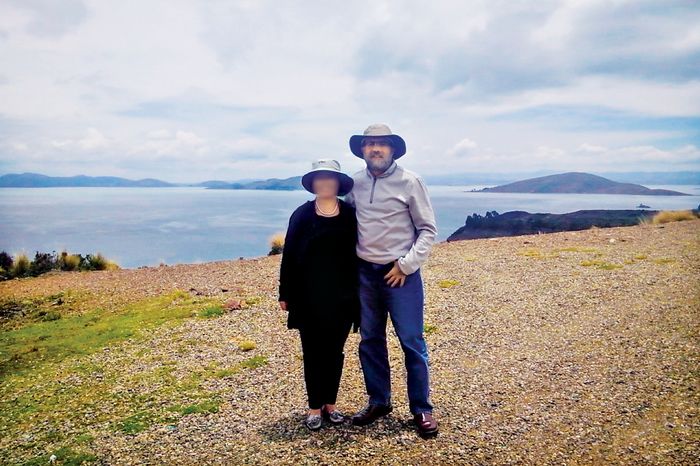

December 13, 2013 | A former Marine helped Ostreicher escape by disguising him as her husband, and insisted the two take Polaroids together as part of their cover.
December 13, 2013 | A former Marine helped Ostreicher escape by disguising him as her husband, and insisted the two take Polaroids together as part of… more
December 13, 2013 | A former Marine helped Ostreicher escape by disguising him as her husband, and insisted the two take Polaroids together as part of their cover.
Sylvia Black remembers the December morning in 2013 when they smuggled Ostreicher out of the country as a mild one. Five feet tall with a wide smile and a sharp, no-nonsense attitude, Black (a pseudonym) was a private investigator who had recently married her second husband, Bill Stewart (also not his real name). Both had served in the military and worked overseas in surveillance and countersurveillance. Black had some expertise in South America; both had assisted on rescue operations for people trapped in foreign countries.
When they heard from a friend at “the other State Department,” or CIA, that there was someone who needed help getting someone out of Bolivia and “the State Department wouldn’t help but also wouldn’t interfere,” she knew the subtext of the mission. If the pair were caught, they’d be on their own. The job would be funded in large part by the victim’s family. The couple agreed to help.
Ostreicher had been given detailed instructions, and he tried to follow them carefully.
To start, he told his government minders that he was going to fly to La Paz to pick up kosher food for the week, something he was routinely allowed to do under house arrest. He gave the housekeeper the rest of the day off before leaving for the plane.
Once in town, he went to Jewish community hub Chabad, picked up food, then went to the park where Black was waiting. He saw her wearing a round hat, red shirt, and blue pants as planned. The two made eye contact. She started walking.
When they got to the hotel room where Stewart was waiting, Ostreicher was hysterical. He feared it was only a matter of time before the police came running. They might already be on their way. Black needed to keep him focused. If one of the most recognizable men in Bolivia was going to escape unnoticed, he had to look like someone else — and in this case, that someone else was Stewart. Black and Stewart had created a falsified visa application with a doctored image that overlaid photos of Stewart with Ostreicher’s face. Ostreicher would use Stewart’s passport to get over the border.
While Stewart quizzed Ostreicher on his assumed birth date; address; and parents’, brothers’, and sisters’ names, Black got to work on his disguise. Like all Hasidic men, Ostreicher had payess, or sidelocks, that had not been cut since he was 3 years old. They had to go. “I said, ‘I can’t cut them,’” Ostreicher says. “But Bill said, ‘If you don’t match my passport, you’re not leaving this room.’” They were cut. Same with the ponytail Ostreicher had become so attached to: His head had to be shaved, makeup applied to his newly revealed scalp. His beard was grayed, and he was given new glasses and clothes. All the while, he was practicing: “My name is Bill Stewart. I’m from Lincoln, Nebraska. I was born on May 14, 1962.” Ostreicher and Black would be posing as a married couple on a backpacking trip, so Stewart insisted on taking Polaroid photos of them together. She kept the photos in her purse to bolster their cover story.
Back in Malibu, Penn spent the day pacing and smoking. He was trying to monitor the operation from his den as best he could but had very limited visibility. “If needed, we had a plane and pilot on standby,” he says. But the plan with Black was overland and depended, in large part, on luck. “The professionals had taken over.”
Once Black was out of the hotel and in a car with Ostreicher, she had her hands full keeping him calm. The chloroform she had with her wouldn’t be useful. Ostreicher needed to be awake and present for his cover to work. But she had given him a water bottle filled with vodka in hopes it would subdue his panic. And now, drinking and sobbing about his relationship with Ungar, Ostreicher was overwhelmed by the escape and what awaited him in freedom. He said he wouldn’t leave, terrified that his maid and lawyer might be blamed for his escape. Black told Ostreicher they would say he had been kidnapped.
Finally, the car got to the Peruvian border. They got out, and after Ostreicher used Stewart’s passport, Black sent it back to her husband with the driver, hiding it in a book. Black and Ostreicher went to a local airport for a flight that would take them to Lima. There, Black handed “the package” over to U.S. Embassy staff, who, she understood, would get him safely on a plane to the States. Penn had tipped off U.S. officials in Lima to Ostreicher’s arrival. “Once they knew it was happening, it became important to them,” he says. “They had an American coming to their border, and they had people there, and they were helpful.” (In a statement, a State Department spokesperson said, “As the Department told the media at the time, the U.S. Government did not have anything to do with Jacob Ostreicher leaving Bolivia.”) Not until after he had taken off did Ostreicher find out he wasn’t going back to New York — he was flying to Los Angeles, where Penn was waiting.
Ostreicher sat in first class suspended in a state of despondency. He’d left New York a proud, wealthy man with a strong marriage, respected in his community. Now he was returning physically diminished and psychologically broken. He had no idea if he could save his marriage or if he would face a community that might look at him with suspicion for the rest of his life.
As he got off the plane, Ostreicher saw Penn waiting for him in the breezeway along with armed guards from Homeland Security and TSA. Penn ushered Ostreicher into a car, where a doctor was waiting, and the group headed to a hotel in Santa Monica, where Ostreicher could recuperate and hide from reporters. When the press eventually tracked them down, Penn was decisive about the next move. “Sean said to me, ‘My house is your house,’” says Ostreicher. “I slept all day long, and Sean would come over and speak to me and rub my back and tell me everything was going to be okay: ‘Hang tight, it’s all good.’”
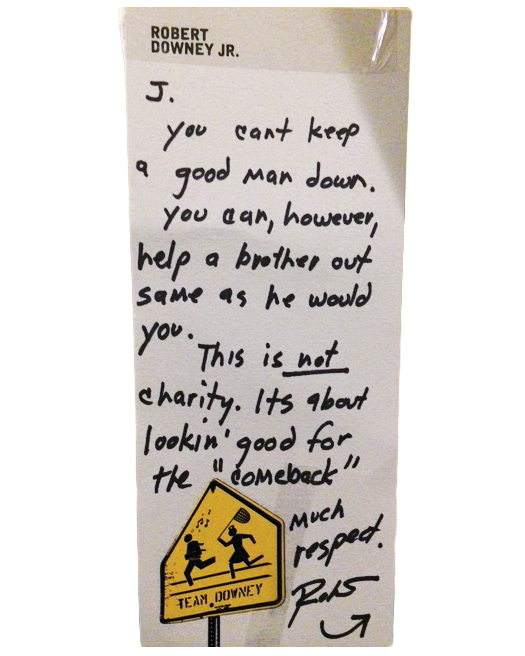
Back in the States, the Ostreicher was buoyed by Penn’s friends, including Robert Downey Jr., who sent Ostreicher a box of clothes.
After Penn moved Ostreicher temporarily into his Malibu home, he offered him therapists and experts in addiction to combat the heavy drinking, which hadn’t ceased. Friends including Danny Trejo and Robert Downey Jr. worked in shifts to talk with Ostreicher or watch over him. At one point, a big box arrived filled with Gucci pants, shirts, sweaters, suits, and coats exactly in Ostreicher’s size, along with a Harry Winston watch. The note: “This is not charity. It’s about lookin’ good for ‘the comeback.’ Much respect, Robert.” “When I got that box, I cried like a child,” says Ostreicher. “In Palmasola, I’d seen the worst of humanity. But now I’d also seen great compassion and bravery. From Sean, for sure, but also from Sylvia and Bill. From my lawyers in Santa Cruz. From Steve Moore, who’d testified on my behalf so many times, and Larry Memmott, because he kept my escape secret. And here, again, from Robert Downey Jr.”
But Ostreicher was heartbroken. Ungar knew of his return but wouldn’t talk to him and has not spoken to him since. (She did not respond to multiple requests for an interview.) Penn urged his guest to allay his suffering by returning to synagogue. “I said to Sean, ‘Who are you, the agnostic, telling me what to do? I’m not ready to meet God yet. I’m not going,’” Ostreicher says. But Penn insisted on going to services with him and holding the prayer book. When the congregation started to sing “L’Cha Dodi” to welcome the Sabbath, a prayer Ostreicher had recited thousands of times before, the wall he’d had to build around his heart began to crumble. “I started breaking up with tears and crying,” Ostreicher says. “Sean said, ‘You’re going to feel better about yourself, Jacob. Just keep on praying.’ I was so incredibly moved by this agnostic guy giving me the courage to pray to God.”
Slowly, Ostreicher started to heal. He came to believe his experience in Bolivia had deepened his faith. “I realized that when I gave up on Hashem, I wanted to die,” he says. “I realized whatever is going on is much bigger than I can understand. I stopped asking the question and just stayed the course. That’s what kept me alive.” Chaya Gitty Weinberger, his daughter, flew to Los Angeles with her children to see him. “I told Sean, ‘I can’t see them because I don’t have a white shirt.’ So Sean gave me one,” Ostreicher says. “I said, ‘I’ll need a black suit,’ so he took me into his walk-in closet with many different suits and said, ‘Jacob, pick one of them.’ I told him, ‘I can’t see them without a black hat.’ He said, ‘I’ll be right back.’ And he jumped into his pickup truck and comes back with six different hats. He said, ‘One of them must be the right one. Now, come on. Let’s go meet your grandkids.’”
When Ostreicher’s grandchildren saw him, they didn’t recognize him. “I stood in the middle of the room and said to them, ‘Do you want to hear an interesting story?’” Ostreicher remembers. “ ‘Do you know there was a man who was very strong and who wasn’t afraid of anyone?’ They all nodded, and I said, ‘This is the man, Sean Penn. Do you want to see how strong he is?’ And I said to Sean, ‘Please, go down on your knees.’ So right there in the middle of the room, Sean went down on his knees. I called out to my grandkids, ‘Do you want to feel his biceps?’” One by one, they crept over to the Oscar winner kneeling on the floor and felt his biceps.
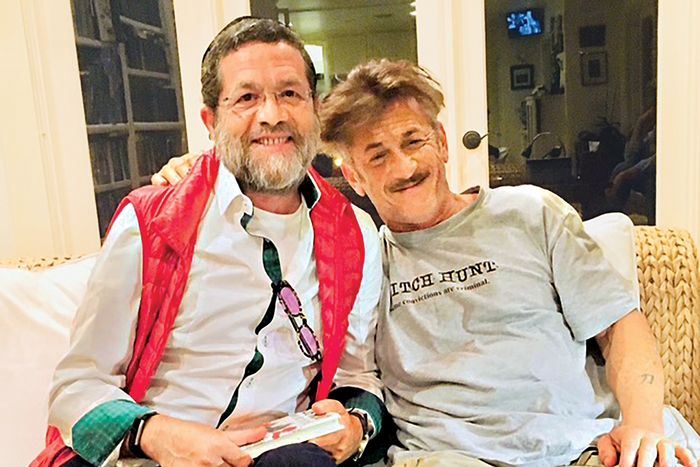
May 8, 2018 | Once back in the States, Ostreicher lived with the movie star temporarily.
Photo: Courtesy of Linda Burstyn
The charges that were eventually filed against Ostreicher, Rodríguez Espitia, and the Dorado brothers in the money-laundering case came down two weeks after Ostreicher fled the country. The Bolivian government declared him a fugitive, and a top minister accused the U.S. government of orchestrating his escape. Morales resigned in 2019. “This administration has not considered making any value judgments about a situation that occurred under a previous administration,” a source in the Bolivian government says, though they would not confirm whether there is a current extradition request for Ostreicher. Rodríguez Espitia, who spent more than a year and a half in various prisons, was eventually acquitted, in 2024, by a three-judge panel. Her lawyers had argued that she, too, was a victim of the extortion ring and that although she had a business relationship with Maximiliano Dorado, she was unaware of his criminal record. None of the banks her money moved through had ever flagged any transaction as suspicious. “He should have stayed and proven what he said because he did a lot of damage to me and the hundreds of families who received a salary thanks to us,” Rodríguez Espitia says of Ostreicher. She and Zolty are fighting to regain assets still entangled with the government. They now say they plan to hold a vote with investors, including Ostreicher, on whether to sell the land. Hearing this infuriated Ostreicher. “I wouldn’t want to be in the same country as these people again, let alone in another business deal,” he says. “This whole thing is completely insane.”
Thank you for subscribing and supporting our journalism.
If you prefer to read in print, you can also find this article in the February 23, 2026, issue of
New York Magazine.
Want more stories like this one? Subscribe now
to support our journalism and get unlimited access to our coverage.
If you prefer to read in print, you can also find this article in the February 23, 2026, issue of
New York Magazine.