
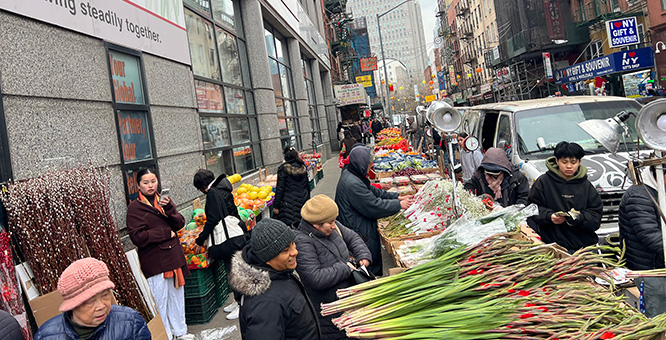
Chinatown Faces Shrinking Asian Population and Fewer Businesses
In Lower Manhattan’s Chinatown community, the Asian population has contracted by more than 20 percent (from approximately 52,000 to 41,000) in past decade, according to a new report from the Asian American Legal Defense and Education Fund (AALDEF), a national organization (based in Tribeca) that seeks to protect the civil rights of Asian Americans.
The December report, “Mapping Chinatown: Displacement in Boston, New York City, and Philadelphia,” documents the construction of new luxury housing and higher rents in the historic Chinatowns of the Northeast. The number of national chains and non-Asian establishments increased, while industrial uses declined. Manhattan’s Chinatown was home to more than 70 industrial firms in 2013, but now has only 37, with food-related and wholesale uses dominating the industries that remain.
Though Manhattan’s Chinatown continues to be served predominantly by small businesses and local chains, it has lost ten percent of its restaurants in the past decade. Increasingly, restaurants have shifted toward catering to younger and wealthier patrons, with an increase in boba shops, bakery chains, and snacks-only grocery stores. Concerns related to the ability of Chinatown grocery stores to provide Asian ingredients for residents making traditional cuisine at home was noted not just in New York, but also in Boston and Philadelphia’s traditionally Chinese communities.
Jan Lee, a third generation Chinatown resident and co-founder of Neighbors United Below Canal, said, “The artificially high free market has caused the demise of small business. In rent-stabilized buildings, they have to make up for low apartment rent and commercial units make up for that shortfall. In the concentration of small businesses in Chinatown, margins are so small and businesses are replaced by corporate gentrification. When people lament the fact that their local bodega is no longer there, their knee-jerk reaction is to blame the landlord. In reality, the store has been there for so long that the lease renewal would be so low and the landlord would have to sell the building or take a huge loss. From there, a new business – likely to be alcohol related – comes in.”
Mr. Lee suggested addressing this trend with creation of new mechanism, “legacy leases,” saying, “The city is responsible for helping retain small businesses, but no one gives landlords incentives to keep tenants.” Citing a building he owns, Mr. Lee explained, “a restaurant has been there since 1938 and they have signed leases beyond my lifetime. Yet, I don’t get any recognition for keeping the restaurant in Chinatown. Why are we giving corporate tax breaks to massive developers, but we can’t recognize the relationship between longtime landlords and commercial businesses? We should recognize something called a legacy lease, where the government says, ‘Here’s your tax break because you are essential to New York.’”
The issue of corporate gentrification is not unnoticed by the local government. “The AALDEF report confirms a very hard reality,” said State Assembly member Grace Lee. “The cultural and economic bedrock of Chinatown is being chipped away. For too long, this community has been a target for luxury developments and ‘mega-projects’ that ignore the needs of residents. We cannot allow Chinatown to be treated as a neighborhood of least resistance. We must continue to fight for the hard-working families and small businesses that have been at the center of Chinatown for generations.”
AALDEF notes that the lingering effects of Covid pandemic have left longstanding Chinatown businesses vulnerable to permanent closure. As businesses shifted to takeout and delivery models, Chinatown banquet halls and dining rooms were financially impacted, which ultimately contributed to a decrease in spaces available for the older population, who habitually gather in such venues.
The AALDEF analysis also highlighted the lack of green space in Manhattan’s Chinatown, where the heat vulnerability index is higher than any other local neighborhood and residents have higher risks of respiratory illnesses.
Wellington Chen, executive director of the Chinatown Partnership, offered a different interpretation of the report. He said, “Chinatown is the ‘can-do’ district. The impression I get from a majority of reports, including [the AALDEF’s], is that we have a tinted lens and certain biases are showing.” He added, “Human beings like to migrate and since the 1920s we’ve been losing population. In half a century or more, Chinatown has not built any housing – the last time was the Confucius Plaza tower in the 1970s. How do you expect the population to grow when you haven’t built any housing?”
“We should not panic and shortchange ourselves,” Mr. Chen said. “Chinatown is not dying, because we’ve been here since the 1830s and in four years, we will celebrate our 200-year anniversary. There is nothing wrong with Chinatown’s location: there is accessibility to Soho, the South Street Seaport, the ferry, etc. Yet, people say this area will die. That is not the case, it is their mindset. A brand new entrepreneur would say let me open something here, but not without elevators or modern fire technology or electrical wiring. In spite of some of those conditions, [New York’s Chinatown] still has a large resilient population.”
Mr. Chen concluded, “the lesson I want to emphasize is to do no harm. If you want to help Chinatown, don’t scare people unless you really have the data. Do not scare people and do injustice to the community.”