
Last month, President Linda Mills announced NYU IRL: a new initiative promoting device-free spaces on campus and encouraging students to connect with one another offline. The program introduces device-free game nights, mindfulness workshops and a Kimmel lounge called THE NEST — a drop-in space for board games, craftmaking and special offline activities organized by campus services. Mills’ email launching the initiative suggests that students struggle connecting to the campus community because they are distracted by their “devices and feeds.” But that struggle can’t be blamed on screen time alone.
NYU has always existed in tension with the city around it — but that disconnect has only intensified over the past few years, as administrators steadily reshaped the physical landscape of its campus. With walkways between university buildings fenced off or narrowed and previously public spaces increasingly gated and surveilled, the university has become more of a contained institutional enclave than a campus without walls.
Against the backdrop of aggressive spatial regression that prevents collectivity, Mills’ call for in-person connection feels absurdly disingenuous.
Over the past few years, NYU has followed an unmistakable pattern. A space becomes politically active. Students gather to remember, grieve, protest or simply be seen. The university responds with “temporary” enclosures, such as fences or walls, that become systematized after a few months. Those areas eventually reopen in a more controlled and fragmented form. Through rebranding meant to excite students — providing a “more welcoming environment,” more greenspace, a student-focused vision — NYU seems to believe it can get them to not question construction projects quietly designed to manage the circulation and memory of a space.
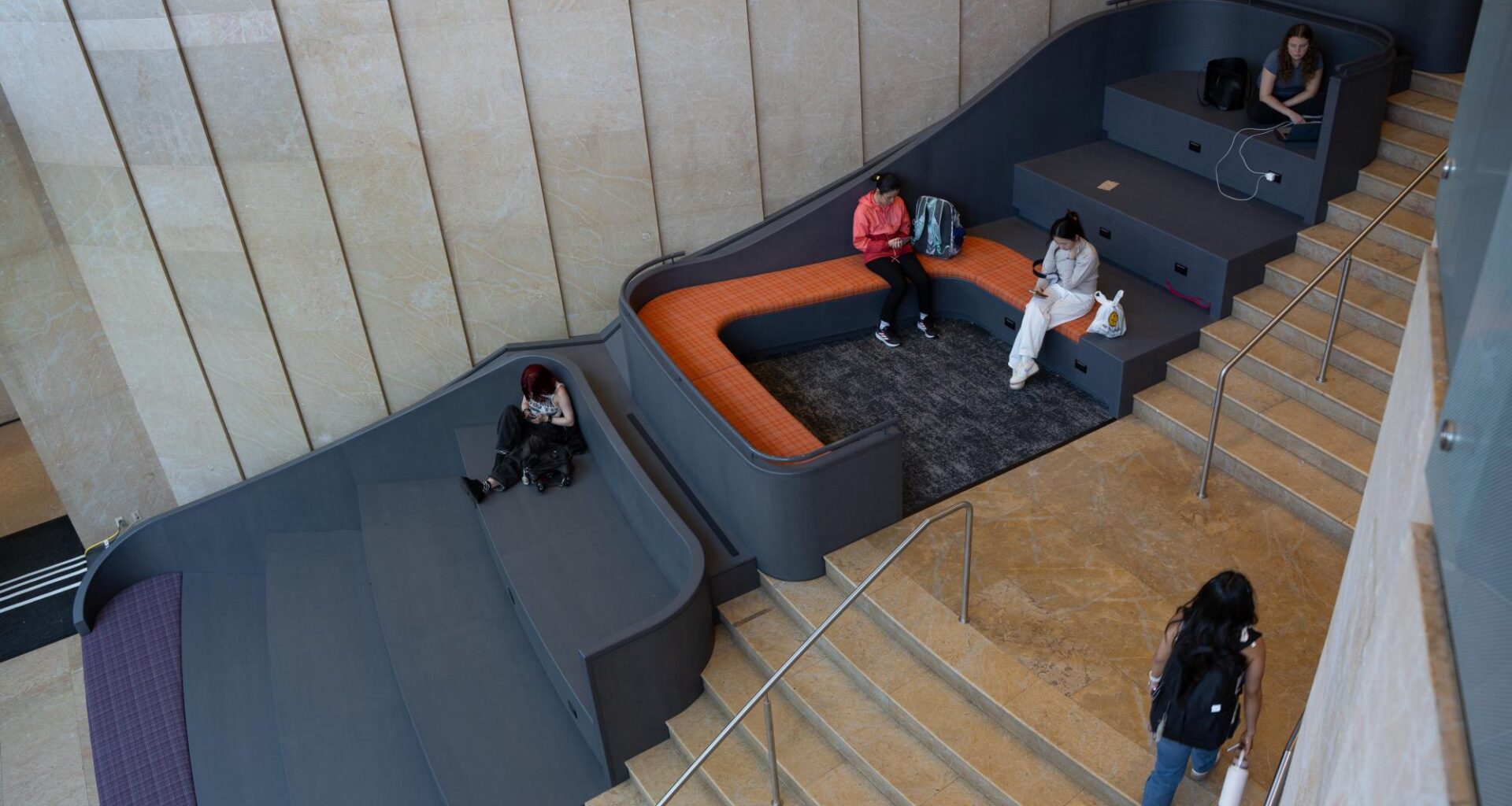
This cycle is observable everywhere you look on campus. Take the steps of the Kimmel Center for University Life, long used for vigils and various student gatherings. In October 2023, they were closed off temporarily following demonstrations honoring those killed in Gaza. After months with no explanation, the university announced plans to make the steps a new study space, conveniently cutting the staircase — and the ability to convene on it — in half.
During encampments at the Paulson Center, NYU closed the Greene Street walkway, a public throughway, as well as the building’s first floor, which had previously been open to the public. Belt barriers now encircle the lobby’s couches, where campus groups once held teach-ins and strikes, so students can’t gather — despite the slanted seating already designed to discourage comfort and use.
The university blocked off Gould Plaza the day after it saw more than 120 arrests, with a makeshift wall later replaced by a more permanent, NYU-branded barrier saying “our future taking shape.” That future, apparently, includes the construction of a new plaza with segmented spaces, controlled entry points, turnstiles and a layout that makes erecting tents or assembling in mass nearly impossible.
These cumulative enclosures — paired with increasing campus security and New York Police Department presence since Oct. 7, 2023 — have redefined campus life.
Then come the futile programs for connection and community, ostensibly created out of a desire to uphold heavily debatable university values. This type of faux tolerance, while frustrating, shouldn’t be surprising. The university similarly launched “open dialogue” initiatives to discuss the war in Gaza, preaching tolerance of different viewpoints after calling the police to arrest its own students for peaceful protest.
When looking for reasons students seem reluctant to gather, the university should consider that its role in punishing political action and the lingering memory of mass arrests have created another barrier to connection: hesitation. The administration has taught students that collective presence carries a safety risk — not always of violence or arrest, but of surveillance and academic consequences. They develop a baseline anxiety around visibility and start to self-regulate, calculating how their proximity to a previously contentious space may be interpreted by watchful campus safety and NYPD. In this climate, Mills’ request for students to “stop and chat” to those we run into or or “introduce ourselves to someone we’ve never met” feels detached from reality, as casual interactions and spontaneity require a sense of ease and lowered stakes, not constant caution.
By targeting pro-Palestine protestors, the university not only handicapped activists, but collectively punished the entire student body. Plazas and open spaces aren’t just used for protest: They are used for performances, club meetings and casual congregations. By creating an atmosphere that discourages assembly, physically and psychologically, Mills cannot credibly speak of building “our community, our neighborhood and our commitment to one another.”
As new students enroll, they will see our reengineered campus as a given. Without the memory of Gould Plaza as a commons, or the Kimmel staircase as a civic stage, there is no understanding of what was lost. They will see the design of the university as neutral, rather than a spatial logic encoded with repressive priorities. And if unchallenged, NYU will ultimately succeed at shaping the narrative behind these constructions.
The administration’s call for “IRL” connections might have been compelling if it were paired with a genuine restoration of open spaces. That means dismantling physical barriers, lessening police presence and opening spaces that tolerate discomfort or dissent, even when it is politically inconvenient. Communities form when they are trusted and allowed to occupy a space, not when restricted to controlled, curated environments. A true IRL campus needs open, free spaces to gather. Sanctioned, engineered and policed spaces will never replace public commons.
Linda Mills is right about one thing: We are “a community shaped by seeing one another.” But what does she think students see when they look up from their screens? They see increased security, physical barriers and thousands of cameras. It’s the hostile architecture, constant surveillance and extensive enclosures, which she and her administration have implemented, that are the reason we don’t see one another.
WSN’s Opinion section strives to publish ideas worth discussing. The views presented in the Opinion section are solely the views of the writer.
Contact Mehr Kotval at [email protected].