
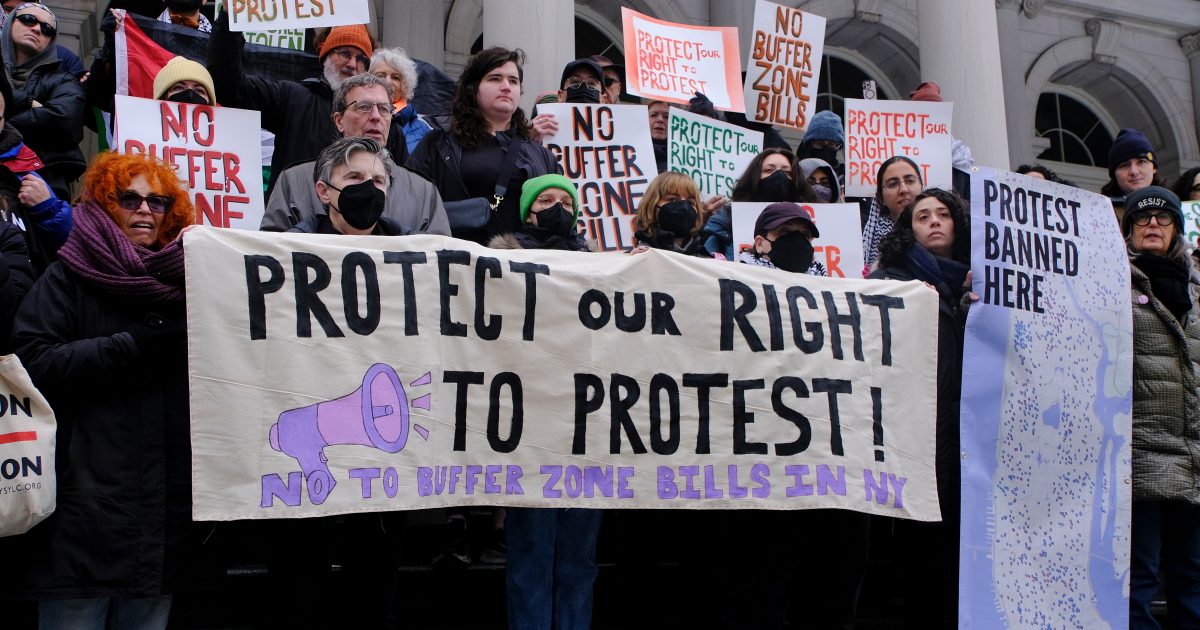
At a lengthy New York City Council committee hearing on Wednesday on bills to regulate protests outside of synagogues and educational institutions, mainstream Jewish groups and the NYPD did not seem to be talking about the same bill.
Jewish groups said the legislation would give increased power to the police to limit synagogue protests. The NYPD, however, said the bill does not give the police more power than it already has under existing law.
The bill, part of a package of proposals framed by Council Speaker Julie Menin as addressing bias in the city, has had the strong support of organized Jewish groups in New York. But the version of the legislation currently under consideration departs starkly from the one Menin originally proposed, and at the Wednesday hearing, mainstream Jewish groups appeared to be arguing in favor of bills that no longer said what they wanted them to say.
The first draft of the bill directed the NYPD to maintain barriers in response to “interference” or “intimidation” outside religious sites, and allowed the police to establish those barriers up to 100 feet from houses of worship. But the NYPD itself expressed concerns to Menin over the initial draft, and she has made significant amendments as a result. The 100-foot mandates no longer appear in the bill’s text, or in the text of a related bill that creates buffer zones outside of educational facilities.
On Wednesday, a slew of representatives from mainstream Jewish communal groups—including the UJA-Federation of New York, the Anti-Defamation League (ADL), and the Jewish Community Relations Council—spoke in support of the bills at the Council hearing. Yisroel Kahan, the ADL’s Orthodox liaison, cast Menin’s bill as one that “aims to create a security buffer zone for houses of worship,” while Ariel Savransky, the 92nd Street Y’s director of government and community relations, said the bill provides “additional protection to organizations at risk.”
Under questioning from Brooklyn City Councilmember Kayla Santosuosso, however, police department attorney Michael Gerber said the bills did not mandate buffer zones nor increase police power to create them. “Any time you have a fixed rule across the board, that is certainly going to raise constitutional questions,” Gerber said, appearing to acknowledge the department’s concerns with the plan proposed in earlier versions of the law. Responding to a question from City Councilmember Shahana Hanif, Gerber also noted that antisemitic speech outside houses of worship is generally protected by the First Amendment.
Instead, Gerber cast the amended bill as merely a tool allowing the NYPD to be transparent with the public about how they would handle protests outside religious institutions, and said that the bill does not give the police powers over protest activity that they didn’t already have.
Some council members questioned why the bill was necessary if it didn’t change anything about how the police would handle protests. “It appears the intent of this bill is duplicative of existing law,” said Councilmember Crystal Hudson. In response, Speaker Menin said the intent of the bill was to make sure that a protest like the November one outside Park East synagogue—in which demonstrators outside an event supporting immigration to Israel and the West Bank chanted “take another settler out”—would “never happen again.” She did not offer specifics on how the bill would do this, but spoke instead to a feeling of urgency among Jews. “Any suggestion that the bills aren’t needed is just minimizing what the impact has been to the Jewish community,” she said.
Civil liberties advocates continue to oppose the bills. In testimony on Wednesday, Justin Harrison, the senior policy counsel at the New York Civil Liberties Union, warned that the bills in question would increase police power to arbitrarily create and enforce limits to the detriment of protesters’ constitutional rights.
“Both proposals encourage viewpoint and content-based enforcement against disfavored speakers and messages, in that they offer the NYPD wide latitude to decide when, where, and under what conditions they should set up buffer zones, an exercise typically reserved for the courts, which are very limited in their ability to allow any infringement on the right to protest,” said Harrison.
Jennvine Wong, a supervising attorney at the Legal Aid Society’s Cop Accountability Project, argued that the bill could undermine a 2023 settlement reached with the NYPD in response to a lawsuit alleging that they violated the constitutional rights of those protesting police brutality after the murder of George Floyd. “That settlement required NYPD to minimize police presence at protests and demonstrations to ensure compliance with the First Amendment,” said Wong. “[Creating buffer zones] would necessarily increase police presence and risk greater surveillance of people of color.”
Even amid the confusion over what the legislation actually means, Menin’s amendments seem to have convinced more council members to sign on. Her original bill only had nine sponsors. The amended bill has 32 sponsors—six more than the majority needed for it to eventually pass.
If the bill passes, it will be up to Mayor Zohran Mamdani to sign it into law. That would place Mamdani between the Speaker—whose cooperation he needs to pass his legislative agenda—and parts of his base, which strongly oppose the bill. On Wednesday, Mamdani noted that the bill had been significantly changed from its original version, but did not commit to a position on the legislation.