


New York, United Stated; 11 23 2017: Rat seen eating seeds in Central Park©
Quick Take
Rats are one of the most enduring symbols of New York City.
An estimated three million rats live in the city, which is a little over one-third of the human population.
A new study found rats alter their vocalizations depending on the environment and level of ambient noise.
Scientists used AI and neural nets to analyse the subsonic, dynamic squeaks NYC rats use to communicate with each other.
To be a pest is to be underestimated. Sure, pests are annoying, but being a pest also requires a surprising amount of coordination and communication. That’s what researchers recently discovered about perhaps the most famous pest in the world: the New York City rat. Indeed, scientists from New York City, along with several from Germany, teamed up to learn more about this antihero of the Tri-State area. What they discovered was an incredibly detailed, complex, and nuanced communication system among these rodents.
As reported in several media outlets, including Popular Mechanics, the goal of the study was to learn more about the behavior of New York City rats and compare it to the characteristics of rats described in previous scientific literature. However, what these scientists found was remarkable. It seems that rats in the Big Apple modulate their communication methods via ultrasonic squeaking to align with their environment. For example, when on the subway, rats communicated more loudly than they did in quieter environments like Central Park. Let’s learn more about these fascinating findings and what they reveal about the social lives of big city rodents.
The New York City Phenom
New York City has an estimated three million rats, which is a little over one-third of the city’s human population.
©Sean Pavone/Shutterstock.com
(Sean Pavone/Shutterstock.com)
A lot has happened throughout New York City’s long and storied 400-year history. This has produced an assortment of symbols that have come to define the city, for better or worse. Sure, tourists show up looking for a foldable slice of pizza, a Broadway show, and a classic “I Heart New York” t-shirt. However, the most realistic and enduring symbol of New York’s gritty heart is the New York City rat.
The best contemporary estimates put the New York City rodent population at about three million individuals, a little over one-third of the city’s human population. They are big—sometimes massive—and often appear utterly unafraid of anyone. They will steal a slice of pizza right off your paper plate if you’re not careful, disappearing with it into a crevice or corner of the city’s many streets.
Although these rats are found almost everywhere in the Big Apple, their lives remain somewhat of a mystery. This legendary but opaque status inspired a team of scientists to better understand these rats, their behavior, and their social interactions.
Communication Breakdown
Researchers conducted fieldwork on New York City’s free-range rats using thermal imaging and ultrasonic audio recordings. Furthermore, they applied “cutting-edge artificial intelligence techniques to capture high-resolution movement patterns and generate 3D reconstructions of foraging environments, including subways, streets, and parks.” This helped the researchers break down and characterize rat social vocalizations across different environmental contexts. It also helped them compare patterns of New York City rat vocal communication with “the distribution of rodent vocalizations reported in the literature.”
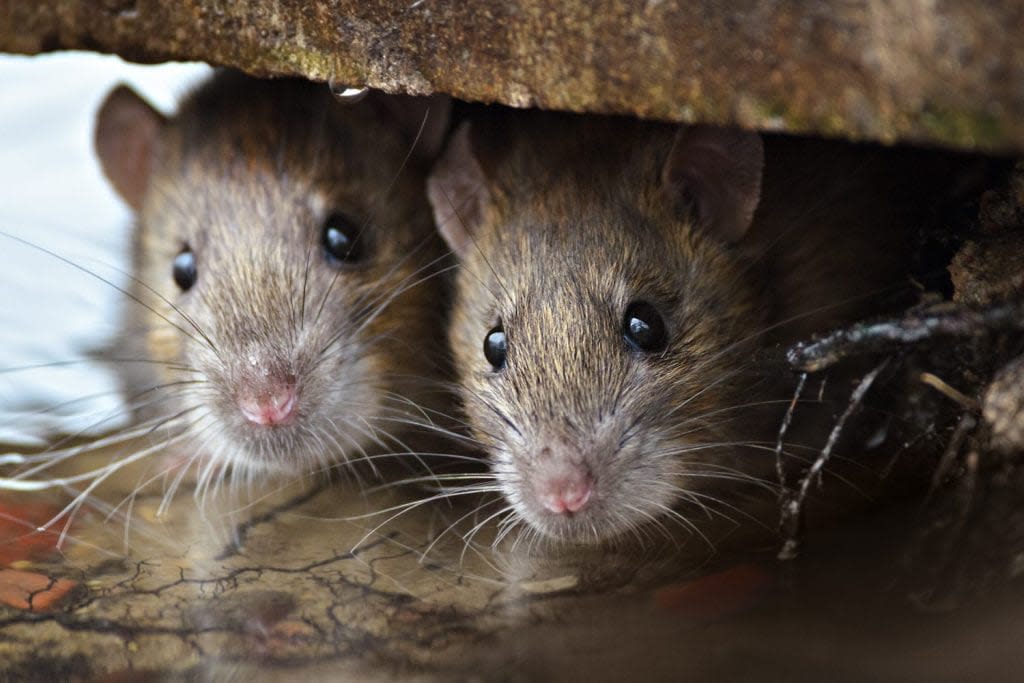
Researchers found that New York City rat vocalizations were routinely shorter than those of brown rats in other regions.
©Gallinago_media/Shutterstock.com
(Gallinago_media/Shutterstock.com)
What they found was remarkable. The study, titled “Computational Urban Ecology of New York City Rats,” showed that rats modulate their voices depending on the noise levels of their environment. Not only were New York City rat vocalizations “consistently shorter duration and lie outside of the historical frequency-duration range” typical of meta-analyses of brown rats, but they were also dynamic.
While scientists often study animal behavior in natural habitats, new technology now allows for the application of “mechanistic biological insights from laboratory-based studies to natural habitats where animals live.” To address this, the researchers used a deep neural network to account for ambient noise during their analysis of rat vocalizations. Their analysis revealed that rats vocalize much more loudly in environments with high ambient noise, such as the subway.
Emily Mackevicius, a co-author of the study from the Basic Research Institute, told Scientific American that NYC rats modulate their voices according to their environments. She said, “There was an ambulance going by, and you could look at that in the spectrogram, and the rat vocalizations were louder than the ambulance. They’re just kind of screaming to each other, but we just don’t hear it.”
As the world moves further into the 21st century, the tools available for scientific study continue to advance. This study likely would not have been possible without the advent of AI, which helped filter the minute frequencies of ambient noise from rat squeaks. An estimated 68% of the world’s population is expected to live in cities by 2050, highlighting the importance of studying urban animals.
The post I’m Squeaking Here! — Inside the Secret Sonic Language of NYC’s Rats appeared first on A-Z Animals.