
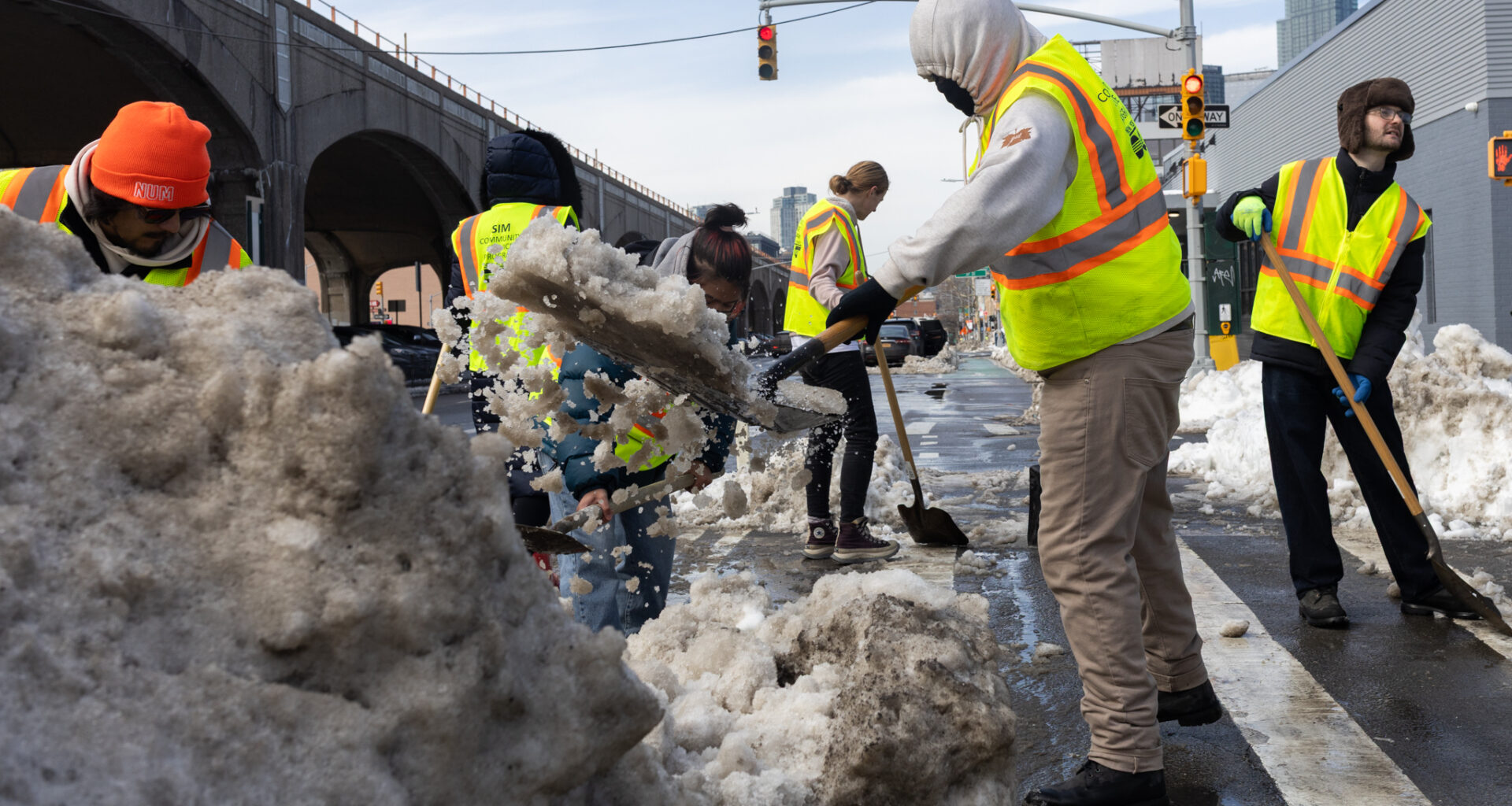
New Yorkers flocked to sanitation garages this week to answer the call for emergency snow shovelers. But those winter laborers may not have realized that they likely won’t get paid for that work until spring.
Several emergency snow shovelers who worked during January’s big storm have not been paid a month afterwards, they told THE CITY. And others who worked this week said payment information was unclear or not discussed.
Dan Bennette, a 38-year-old lifelong Queens resident from South Ozone Park who began working as a snow shoveler on Jan. 26, told THE CITY that he has not yet been paid.
“They just informed us that at the end of the season, when everything is finished, that’s when they’ll cut us a check,” Benette said. “Some people have the assumption that we would be paid weekly or bi-weekly.”
Joshua Goodman, a spokesperson for the sanitation department, said people who responded to the call for shovelers and worked this week may be paid in two weeks, but this is not guaranteed. Last year, it took between four and six weeks to pay workers, he said. On the city’s 311’s website, information about emergency snow shoveling work says payment could take up to 12 weeks.
For Bennette, he’s staying patient. The newlywed and aviation operations worker has been unemployed for about eight months — the longest he’s ever gone without a paycheck. So he welcomed the opportunity to work in the snow.
“This will get me up out of the house, off the couch and going out and being a productive person in society,” he said.
Others he worked with were not as easy-going about the pay wait. Bennett recalled that when a fellow shoveler this week learned DSNY would not pay until March, he stood up and walked out of the garage.
Yasmine, who spoke to THE CITY this week, said her son shoveled for the city after snowfall on Dec. 14 and had to wait until the beginning of February to get paid. When DSNY called him in January and again this week asking if he wanted to work, he said no both times. Instead, he shovelled private houses and driveways and got paid the same day.
“I believe more people would help if they paid them in an ample amount of time,” she said.
Chaos, Camaraderie and Getting the Job Done
Many of the workers THE CITY spoke to said they signed up after seeing Mayor Zohran Mamdani speak about the program on social media and touting a pay raise from $19.14 to $30 due to the blizzard.
That direct appeal was a hit; workers signed up in droves, the sanitation department said.
Last month, 1,500 people signed up to work as snow shovellers with the city over several days. But in the first 24 hours of this month’s blizzard, 1,400 people registered to work as shovelers.
The job was tough.
Peter Moskos, a professor at John Jay College of Criminal Justice, answered the call on Sunday after seeing Mamdani’s push for shovelers, signing up the same day at a garage in Astoria where shifts are 12 hours long.
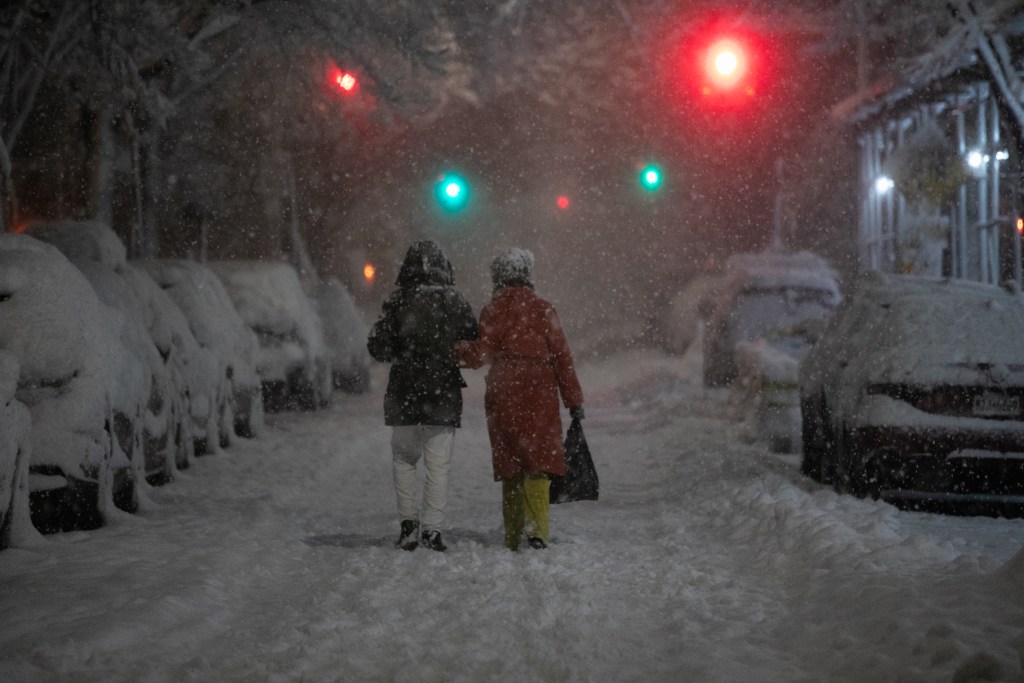 People walk through Fort Greene, Brooklyn as a blizzard descended on the city, Feb. 22, 2026. Credit: Ben Fractenberg/THE CITY
A sanitation employee gave his crew a brief talk before they started, telling them that no one had been paid for work in January, but DSNY is trying to speed up the process.
“He said, ‘Mandami gave you a raise, and Mandami wants four feet wide,’” Moskos recalled, referring to the four-foot-wide snow-clearing regulation that allows wheelchair users to pass on sidewalks.
They headed out to clear intersections, hydrants and bus stops, but while the shovelers were supposed to be taken out in a van, Moskos said the driver never showed up. So they headed out in the blizzard on foot.
“It’s all kind of chaotic and half-assed, but, you know, I wasn’t expecting a fine, well-oiled machine,” Moskos said.
Eventually, DSNY got a van for the shovellers to warm up in, but after about three hours of shovelling in the snow, the number of workers began to taper off.
When a van came to pick them up at 4 a.m., the driver asked Moskos if he wanted to finish his shift that was due to end at 8 a.m. He declined.
“Nope, I’m done. I got nothing to prove,” Moskos said. He woke up with tingly, numb hands the next day, “then I had to shovel my own walk,” he said.
Shovelers were still at work on Thursday after the storm, pouring salt and heaping snow into piles along Queens Boulevard. Some of the workers said they were unsure when they would be paid, but another said she was told she would receive money on March 1.
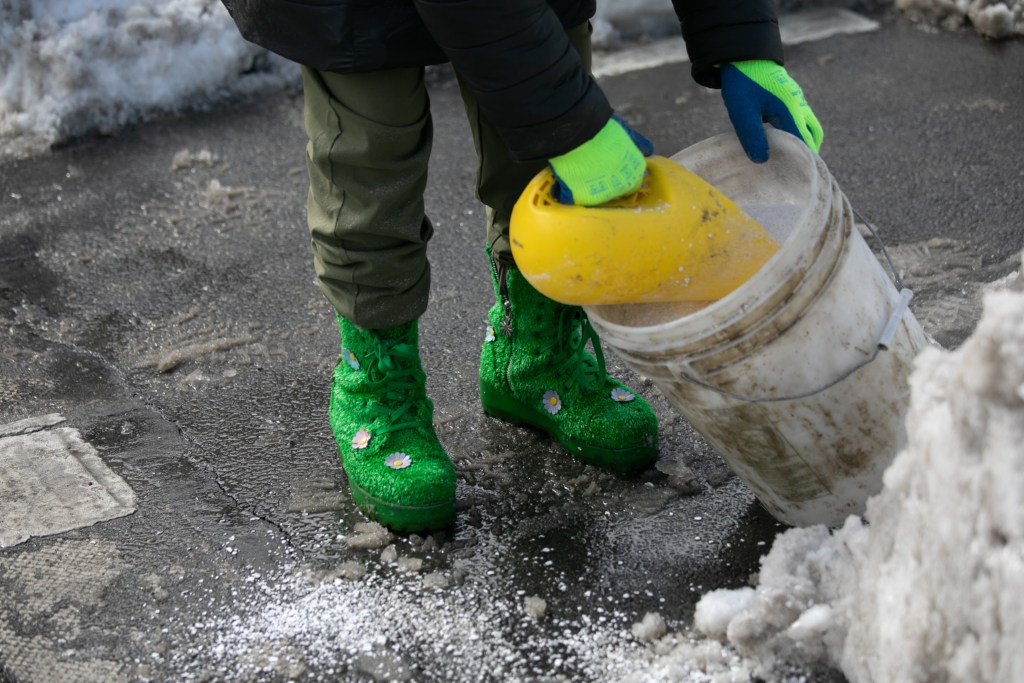 A temporary city worker salts a Sunnyside intersection, Feb. 26, 2026. Credit: Ben Fractenberg/THE CITY
David Torres, a 28-year-old Astoria resident who works part-time as an aircraft mechanic, signed up for the first time for extra income. “From what I heard, especially from commercials that Mandani has made, it was pretty much an available opportunity that I guess nobody really knew we had,” Torres said.
He hopes to be paid within a month. “As long as it’s within 30 days, I’m not going to be stressing about it.”
The city’s emergency snow shoveler program is nothing new — the city first began hiring emergency snow shovelers in January 1897 — but Mamdani’s promotion of it, and pay bump, brought renewed attention. That included scrutiny over sign-up requirements from Republicans, including from President Donald Trump during his State of the Union address, who chided Mamdani over his opposition to voter ID laws.
It also garnered a lot of praise from New Yorkers who gave credit for cleared-off sidewalks to Mamdani all over social media, though higher temperatures and wetter snow likely cleared the streets just as much as shovelers. In one video with 850,000 likes and 3.1 million views, a woman emotionally thanks the mayor and shovelers as she films a clear sidewalk. In another post with 730,000 likes and 3.3 million views, a man praised the shoveling initiative as “genius.”
“I can tell you, I didn’t expect this much attention nationwide on our emergency snow shoveler program,” Mamdani said on Wednesday. “It is a program that has existed for years. It is a program that has been part of responses to storms.”
David Michaels, a 36-year-old Gowanus resident, worked as a shoveler on Tuesday. He previously worked for the New York Public Library as a technical project manager until a layoff in May. He has been without a job since then, and said “this is easily the worst job market.”
Michaels was surprised that the paperwork the snow laborers filled out did not include direct deposit information. “I’m not gonna get a Venmo or a Cash App from the city of New York, but I feel like there’s ways to make this more efficient,” he said, “or to let people set up accounts online to make things a little easier. But Michaels said he understands “that’s a big ship to steer.”
Michaels enjoyed the camaraderie of the labor and the work itself.
“There’s a very material, physical thing that I just did,” he said. “I can point and be like, ‘I cleared that end cap. I moved that pile of snow, me and all these people we worked as a team, we got this done.’”
Plus, it’s good exercise: his Apple Watch told him he burned 2,500 calories over his shift.
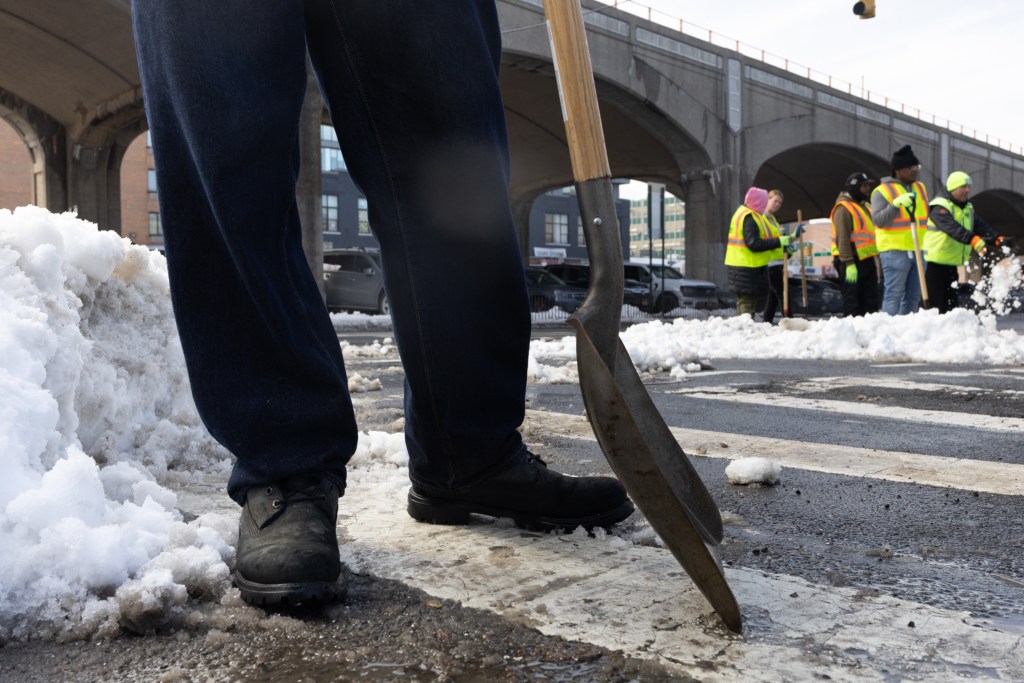 Shovelers clear a crosswalk in Sunnyside, Queens, Feb. 26, 2026. Credit: Ben Fractenberg/THE CITY
Related