
Mayor Zohran Mamdani’s broad affordability agenda should extend to four-legged New Yorkers, with funding for low-cost veterinarian services that could help overloaded shelters, a new proposal from animal welfare advocates says.
Voters for Animal Rights and Flatbush Cats, a non-profit that also provides low-cost vet care, last month released a policy proposal for the new administration focused on ways to better care for pawed New Yorkers.
Their pitch comes as the Mayor’s Office of Animal Welfare has been without a leader – or anyone else working in its tiny office – since the beginning of the year.
Allie Taylor, the founder of VFAR, has pushed in the past for many animal-welfare bills in the City Council, including successfully banning the sale of guinea pigs at pet stores. Her focus now, under a new administration, is on affordability – and the ways the city can help preventively and save money on its shelters.
“You have to have a lot of money to have a cat, a dog, a rabbit,” Taylor told THE CITY.
While their proposal doesn’t cite a dollar figure, the advocates pointed out that other city governments spend more per resident on pet care than New York City, and that most of that money goes to its shelters.
Their pitch is for the city to fund spay and neuter surgeries as well as low-cost veterinary clinics in every borough. They also want to add city-funded pop-up pet food pantries.
Both Taylor and Will Zweigart, executive director of Flatbush Cats, urged the Mamdani administration to appoint someone to lead the Mayor’s Office of Animal Welfare to figure out more ways to protect animals. The small office has a budget of $100,000 just to pay for its director, according to City & State.
“Put leaders in place to understand they have a job to do, and have them to enforce the laws we already have,” Zweigart said.
A spokeswoman for the mayor, Dora Pekec, said they’ll be appointing someone for the office “soon.” (There are other outstanding vacancies within city agencies, including Administration for Children’s Services, Department of Social Services, and Department of Cultural Affairs.)
Preventative measures that help keep pets with their owners could help the overburdened animal shelter system, Zweigart and Taylor said.
The city contracts with Animal Care Centers to operate the three shelters currently open in Queens, Manhattan and Staten Island. The Bronx and Brooklyn locations are under renovation or new construction, which has put a strain on the open shelters.
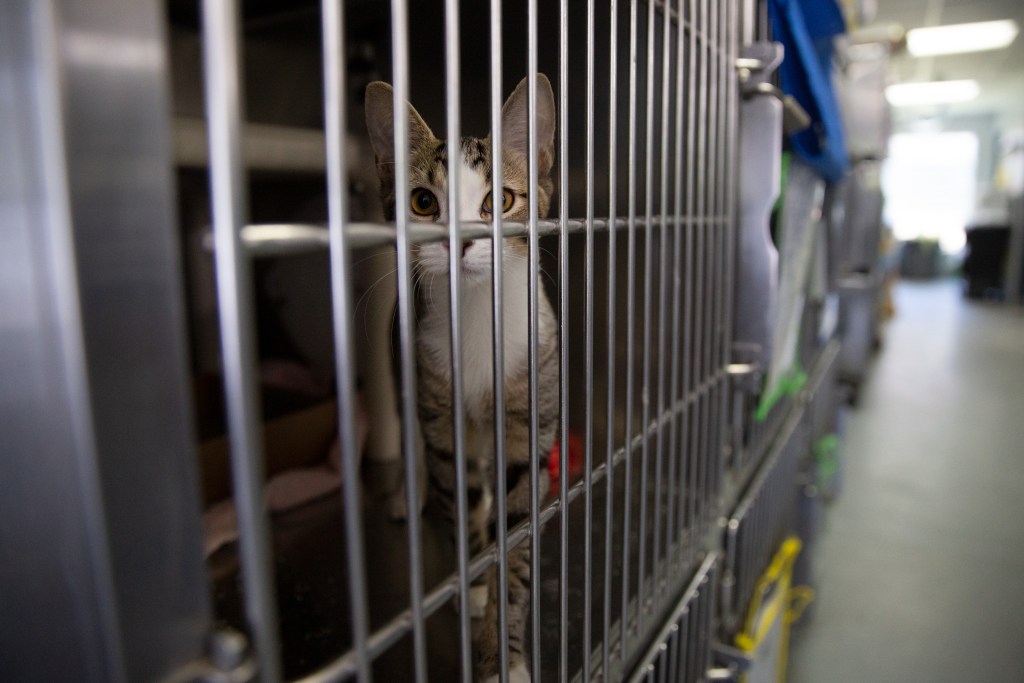 Animal Care Center staff placed cats in the hallway of their East Harlem headquarters because of overcrowding, July 31, 2023. Credit: Ben Fractenberg/THE CITY
Last year, ACC shelters took in more than 9,700 stray animals — dogs, cats, rabbits, and guinea pigs — and more than 6,530 were relinquished by owners. The city’s shelters frequently are at capacity.
One in three dog surrenders was due to housing insecurity, and most cat surrenders were housing insecurity or personal health issues, according to ACC’s 2025 data.
Zweigart launched a low-cost veterinary office with Flatbush Cats in Brooklyn, providing spay/neuter services and other care that could keep some pets in their homes.
“A shelter is always going to be a bottomless pit,” he said. “Your goal is to reduce demand on the shelter. What if we just kept pets with their families?”
Last September, the City Council approved $500,000 in the budget to expand affordable spay and neuter services for cats through Flatbush Cats, supporting 3,500 surgeries.
But that’s just around 2% of the annual need, Zweigart said. Around 190,000 cats would need to be spayed and neutered to get ahead of the city’s stray cat problem.
“The model that we’re talking about is scalable and a lot of what we’re bringing the mayor and the administration is bringing a solution,” he said.
Having pop-up food pantries can also help owners keep their pets, he said. Former Councilmember Bob Holden, a Democrat, introduced a pet food pantry bill last year, but it was never voted on and has not been reintroduced this session.
“Your budget ebbs and flows,” Zweigart said. “To be able to give people something simple like pet food for a few months could be the difference between keeping their pet with them.”
Related