
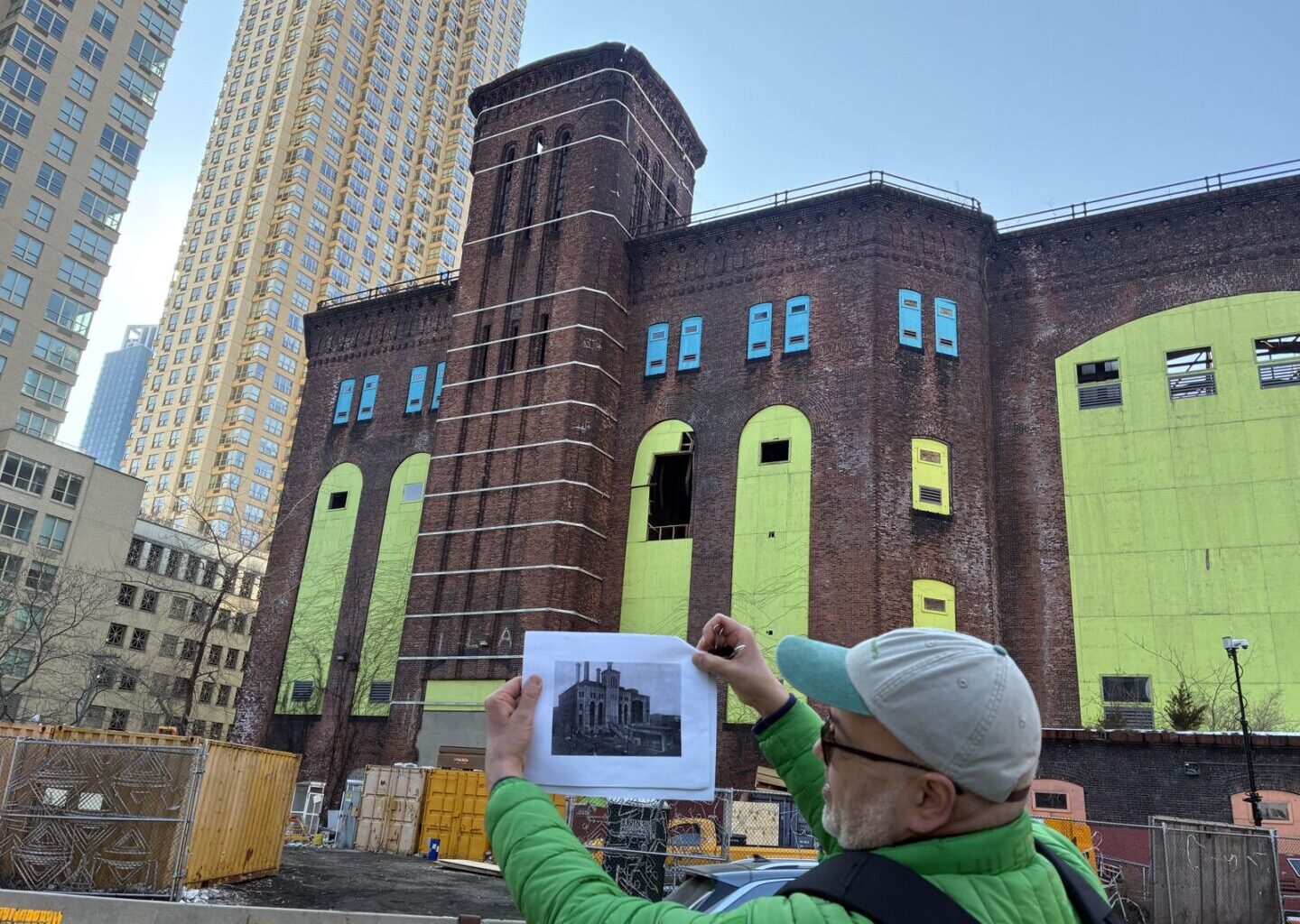
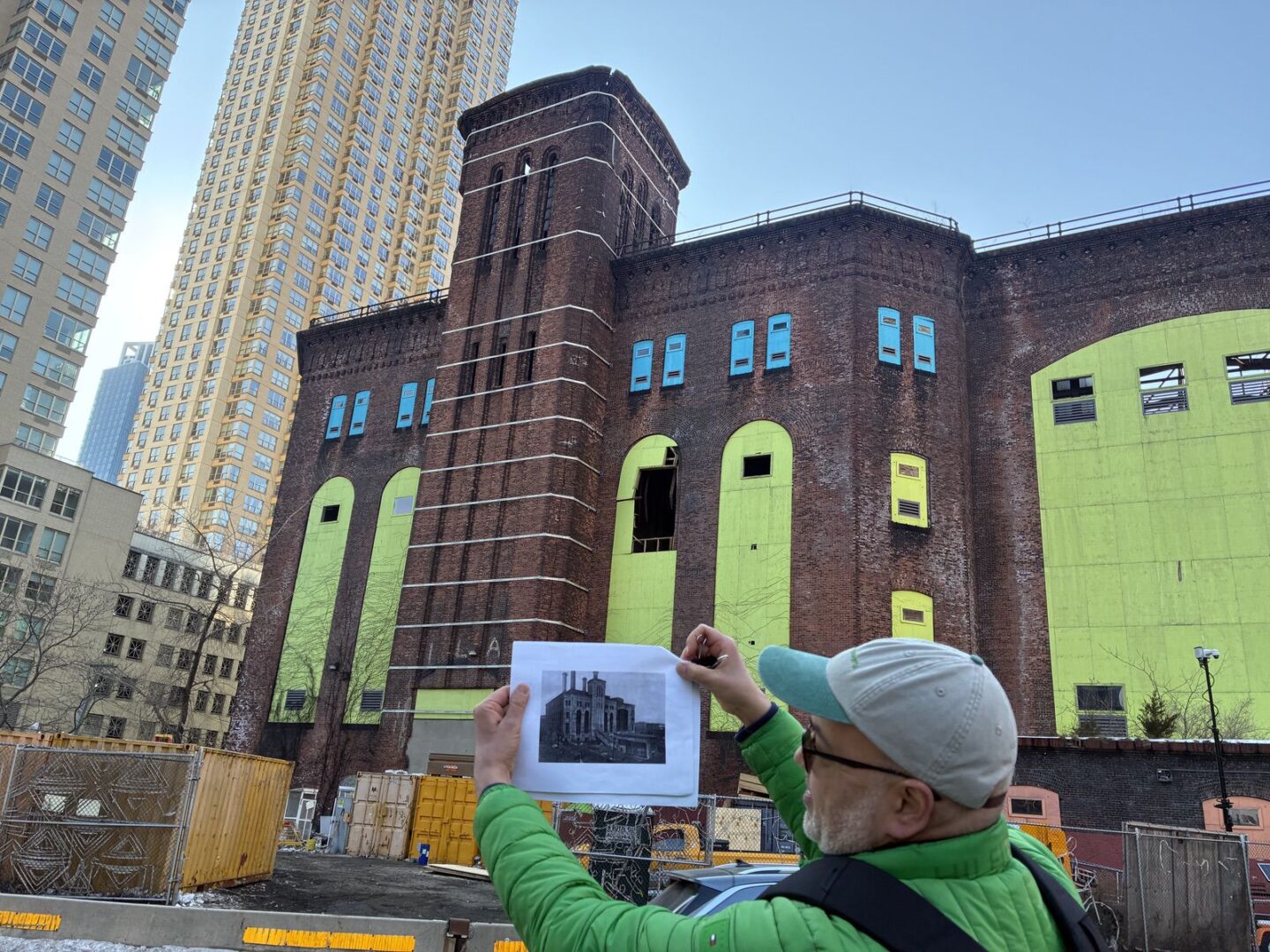
 John Gomez holds up a historic photo of the powerhouse. Photo by Darren Tobia.
The sight of construction workers at the historic H&M Powerhouse in Jersey City is always a welcome sign to John Gomez.
For one, it means the concern about its potential collapse, news of which came from Mayor James Solomon’s office, had subsided — for now.
“Obviously, the road is open now, so there is no emergency,” Gomez said.
It also means that the work of emptying out the structure could soon be complete sometime in December, reaching a long-awaited milestone when the city government can finally begin planning its future.
In big cities, large-scale historic preservation projects take a lot of money, work, and public support. For the last few weekends, Gomez, founder of the Jersey City Landmarks Conservancy, has been leading $15 walking tours of the neighborhood in an effort to drum up excitement. The next tour is on February 28. Other dates can be found at the conservancy’s website.
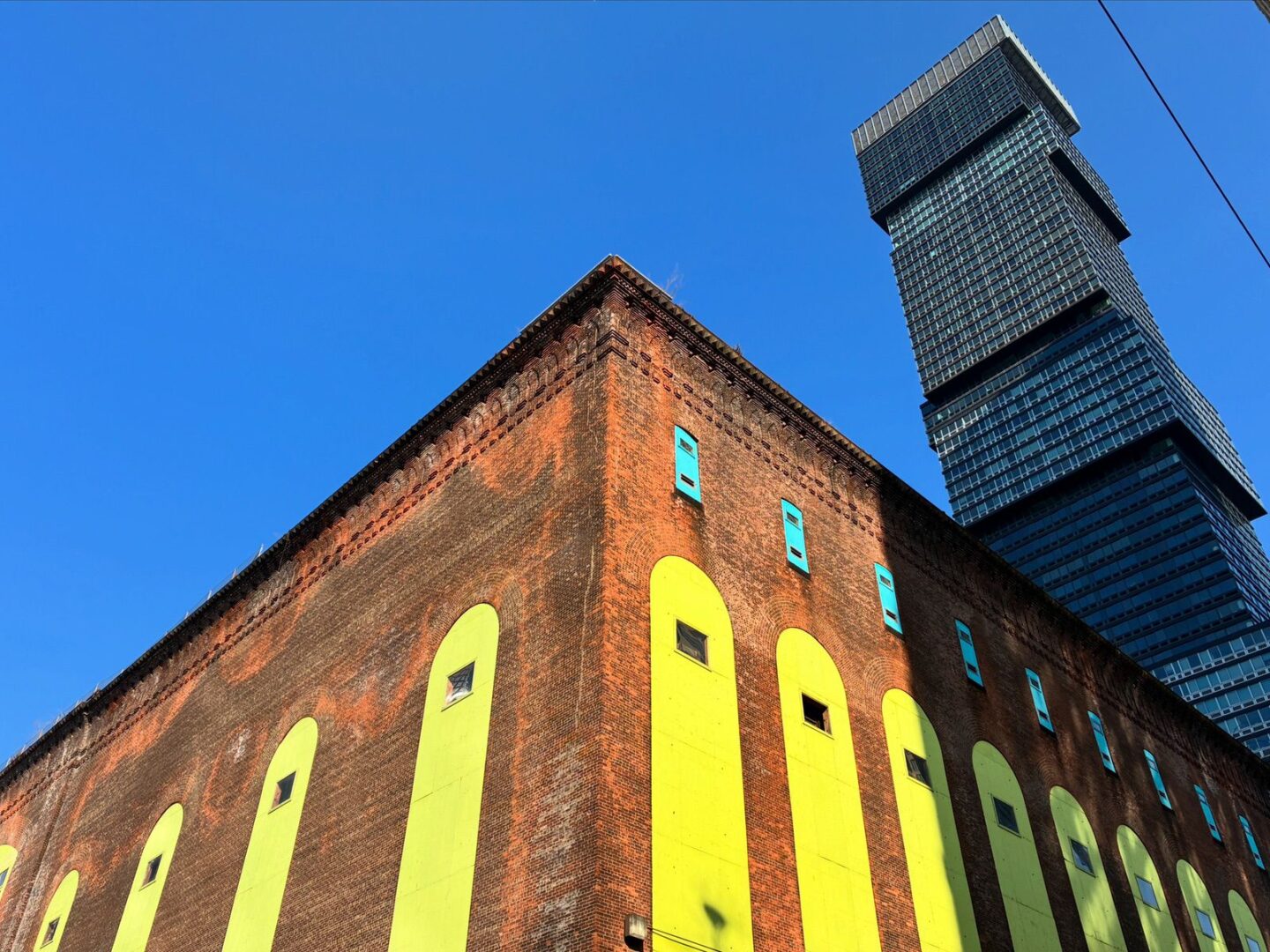 The H&M Powerhouse in downtown Jersey City. Photo by Darren Tobia.
Standing in front of the Hudson & Manhattan Railroad Powerhouse, built in 1908 to power what would later become the PATH trains, Gomez holds a binder with tour-related materials. Among the pages is a photocopied image of him posing near the building in 1999.
“I had hair back then,” he joked.
Saving the powerhouse is what started Gomez’s career in preservation. A school teacher by day, he brought about the formation of the Jersey City Landmarks Conservancy in 1999. The conservancy had a victory early on authoring the nomination that landed the building on the National Register in 2001 and prevented its demolition. But the advocacy since then has been an “uphill battle,” largely because Port Authority is still leasing it until the December deadline.
Today, the building is surrounded by skyscrapers, such as the 69-story 200 Greene Street. Others are proposed, such as the one at 100 Bay Street, which could reach 90 stories. The city doesn’t need another skyscraper on the site of the powerhouse, Gomez said, although a different times in the last that has been pitched as a way to save the building.
“It has to be first and foremost a cultural space for the neighborhood,” he said. “There also has to be open space.”
The need for a cultural space here is important when you learn about what happened at 111 First Street, the historic Lorillard Tobacco Company warehouse that was once home to an artist’s enclave, helping build the neighborhood’s reputation as an arts district. In 2007, a Manhattan developer demolished it for a skyscraper that was never even built. The neighborhood was supposed to be protected as a historic district, but the owners fought that and won. In the end, all the city gained from that fight was an abandoned lot in front of the powerhouse. Though plans to build a 90-story skyscraper on the site finally reemerged this year.
The historic district was never established, but the fight with the owners of 111 First Street awakened local residents to fight for better development.
”It was a lesson learned,” Kathryn Moore of the Powerhouse Arts District Neighborhood Association, who attended the tour. “We realized that we couldn‘t just let the process happen naturally. We had to stay on top of it.”
With the help of the neighborhood association’s oversight, the Powerhouse Arts District neighborhood has seen a number of adaptive reuse projects at places like the former Manichewitz Factory at 151 Bay Street — the future home of the New Jersey Symphony — and Modera Lofts. It has given preservationists hope that something similar could happen at the powerhouse.
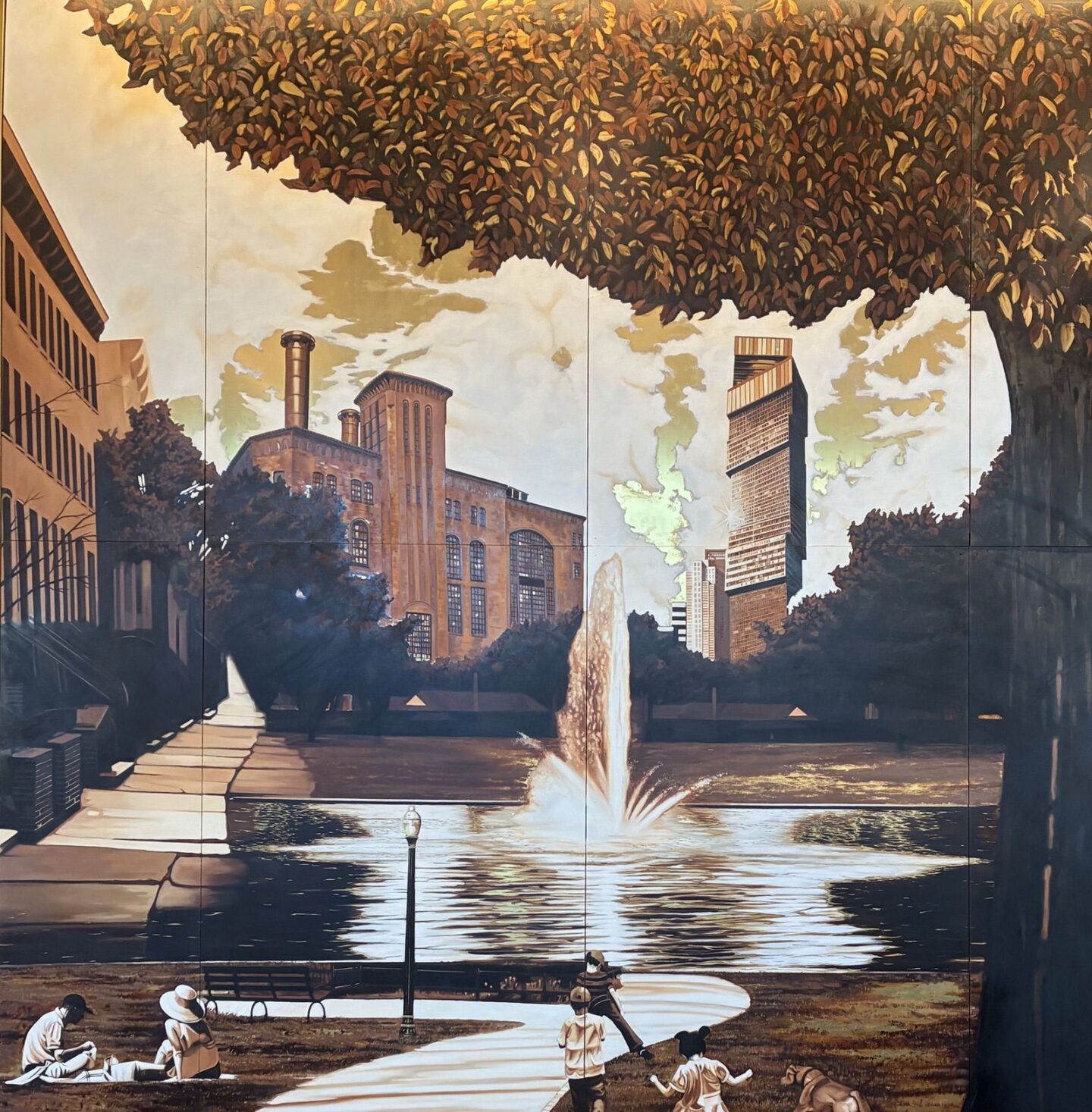 A mural of the powerhouse inside the building at 25 Christopher Columbus Drive. Photo by Darren Tobia.
Meanwhile, the neighborhood continues to thrive through its association with the powerhouse. The tour points out murals of the building that grace the walls of luxury buildings. One of the Powerhouse Arts District’s newest apartment buildings, Gomes pointed out, is even named The Oakman after the powerhouse’s architect, John Oakman. But the namesake building that gave the neighborhood its sense of identity and cachet remains roofless and boarded up with plywood.
“The Powerhouse Arts District has risen around that building,” Gomez said. “Ironically, it’s the one that’s rotting there, and we hope to change that.”
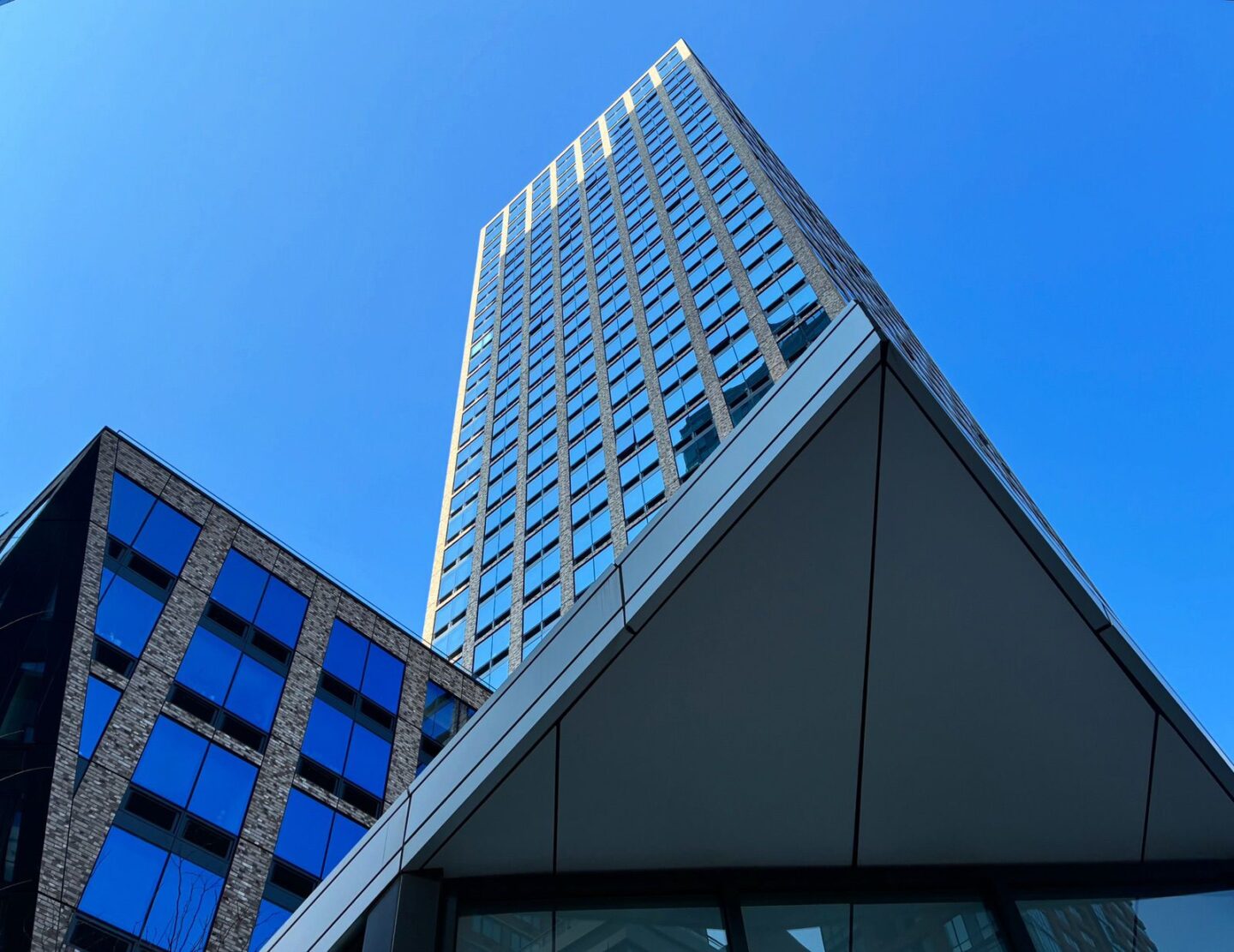 One of the many skyscrapers that have sprouted up around the historic powerhouse. Photo by Darren Tobia.
The broader theme of the two-hour tour, visitors will discover, is about urban renewal and the ongoing fight to right the wrongs of misguided urban planning. This is a subject that is near and dear to Gomez. Growing up on First Street, he witnessed urban renewal happening at his doorstep. In 1975, his father, Kenny Gomez, fought against the bulldozing of brownstones on Marin Boulevard. “I remember listening to this at the kitchen table,” he said. “It was my first experience with preservation.”
As the tour group stood along Greene Street, the powerhouse appeared swallowed up by modernity. It is the only structure visible from this angle that hints at the neighborhood’s illustrious industrial past. With its towers, arched windows, and ornate masonry, Gomez would argue it is the most beautiful building in sight.
“You’re not going to see a building like this anywhere in the metro area,” he said. “You’ll see other power stations in New York — but not like this.”