
KINGSTON, N.Y. — Implementing the state’s aggressive climate laws could cost the average Upstate household more than $4,100 annually, according to the New York State Energy Research and Development Authority.
In a memo detailing the projected costs associated with the Climate Leadership and Community Protection Act, the authority said Upstate New Yorkers who own two cars and heat their homes with fuel oil will be the hardest hit under the act, which sets carbon emissions targets to be reached by 2030.
Among its mandates are a 40% reduction from 1990 levels in greenhouse gas emissions and 70% renewable energy generation by 2030.
According to the memo, implementing the plan as currently required would cause gas prices to increase by as much as $2.23 a gallon or more on top of the current prices at the time. The cost for heating and cooking gas could hit $16.96 per MMbtu, which is the standard measure for gas. Other fuels would see comparable increases, the memo stated.
“Upstate oil and natural gas households would see costs in excess of $4,000 a year … Only a portion of these costs could be offset by current policy design.”
Additionally, the memo stated, small and medium businesses could see increases of as much as 46%, depending on the utility and size of the facility. Costs for operating a delivery truck, it said, would increase by over 60%.
The Climate Leadership and Community Protection Act was enacted in 2019 under Gov. Andrew Cuomo.
Although it provides for allowances that would help offset the anticipated cost increases, the memo said households across the state would still see higher costs.
“Even households switching to newer, more efficient fossil fuel equipment could expect to see substantial costs, with net savings emerging only among the lowest income households and those that have largely eliminated all fossil fuel use,” the memo states.
The memo generated a flurry of statements from special industry groups on both sides of the issue, with pro-business groups including the National Federation of Independent Business, New York State Farm Bureau and Upstate United lauding the authority’s findings, saying it validated their concerns.
“NYSERDA’s analysis shows that a small business could see costs rise by nearly $7,000 per year by 2031 if the (climate law) continues to move forward,” the National Federation of Independent Businesses stated in a release. “This should alarm everyone – Main Street simply cannot absorb this dramatic increase, and the … mandates must be revisited and amended. Continuing down the current road is the opposite of affordability. With utility bills already rising to unsustainable levels, small businesses, residents, and the state’s economy cannot pay even more.”
Assemblyman Chris Tague, who is running for the 51st Senate seat that covers parts of Ulster County and is currently held by state Sen. Peter Oberacker, said the memo proves the climate law is a “reckless, downstate-imposed experiment that’s driving up energy bills, threatening jobs and making life unaffordable for the people who actually power this state.”
“I’ve been saying it for years, the CLCPA’s aggressive green mandates are imposing an unbearable financial burden on upstate New Yorkers. NYSERDA’s own internal memo confirms what we’ve all felt in our wallets,” he said in a release.
State Sen. Michelle Hinchey, D-Saugerties, did not respond to a request for comment.
Other groups, including Public Power NY, blasted the memo, with Public Power saying it “comes in the context of Governor (Kathy) Hochul’s long-standing position that following the state’s climate law is not worth the cost.”
Hochul is expected to push for changes to the plan during upcoming budget negotiations, as she unsuccessfully did in 2023. According to media reports, state budget director Blake Washington called the measure “well-intentioned,” but said circumstances had changed since it was first enacted.
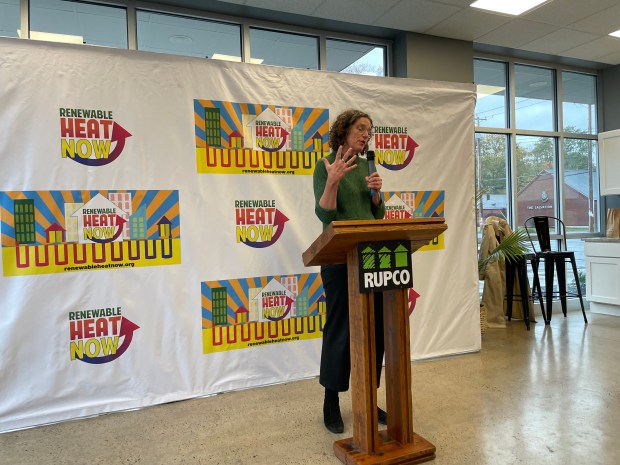 Elected officials, including Assemblymember Sarahana Shrestha, D-Esopus, Ulster County Executive Jen Metzger, pictured here, joined advocacy groups New Yorkers for Clean Park and For The Many, calling on Gov. Kathy Hochul to repeal the 100-Foot-Rule, which forces utility ratepayers to pay for new natural gas hookups, at an event at Energy Square in Midtown Kingston on Thursday, Oct. 30, 2025. (Brian Hubert, Daily Freeman)
Assemblymember Sarahana Shrestra called the memo “a misleading ruse” meant to give Hochul ammunition to weaken the law. The memo, she said, is “purposefully obtuse on the actual costs of climate change: the costly impacts on our food system, our roads and bridges, our healthcare system, and much more.”
Ulster County Executive Jen Metzger, who as state senator was largely responsible for the adoption of the Climate Leadership and Community Protection Act, said the memo is not an analysis of the costs and benefits of achieving the goals laid out in the climate law, but rather “appears to have been requested by the Governor’s office on the costs of implementing a cap and invest program.”
She said NYSERDA failed to consider savings to residents from energy efficiency improvements and from replacing costly propane and oil systems with energy-efficient heat pumps in its calculations or the larger, society-wide costs of more severe climate change or the avoided costs to the healthcare system by reducing pollutants that are harmful to both the climate and our health, causing asthma, heart disease, cancer, and other chronic diseases.