
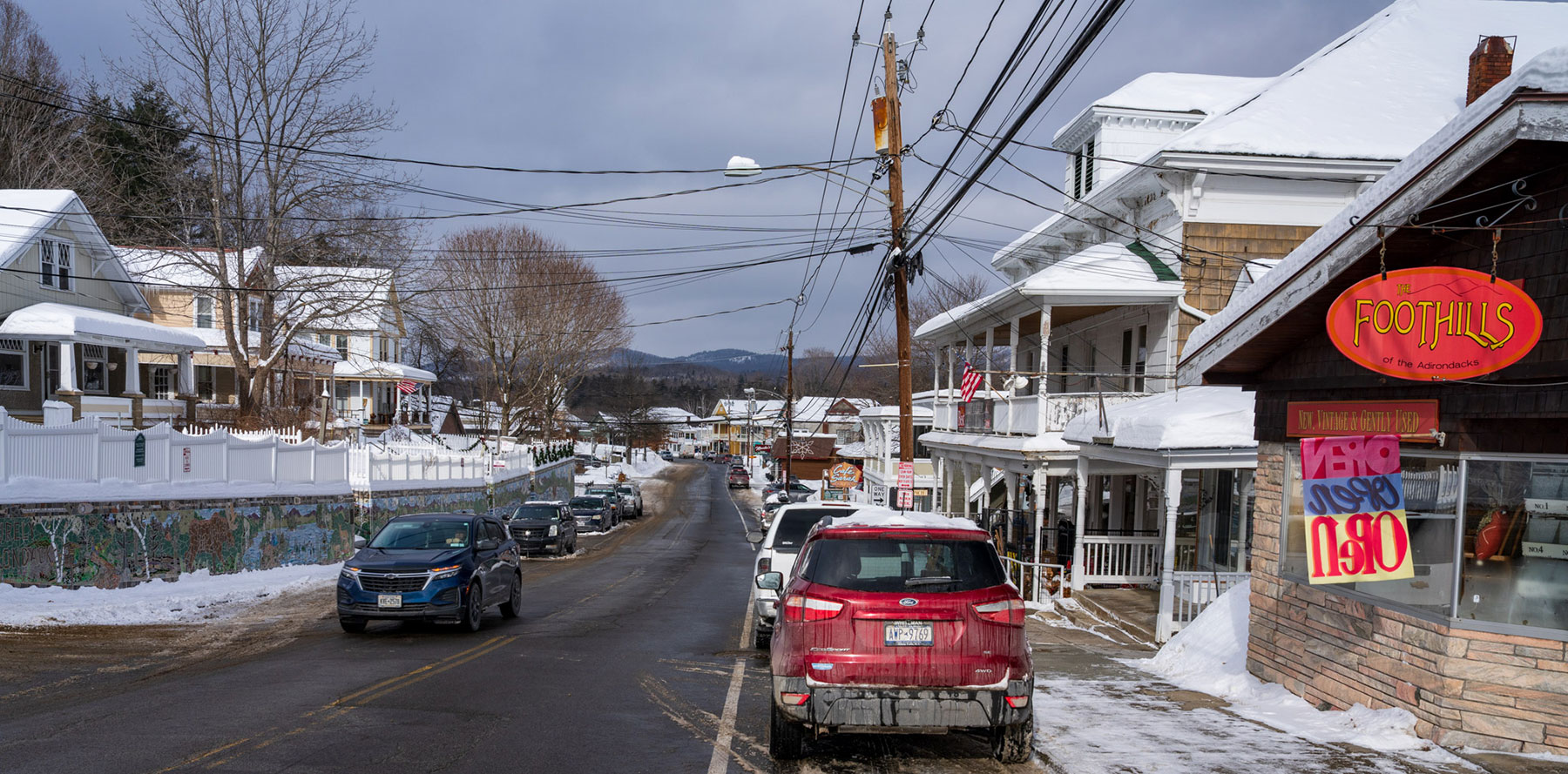
Among David Cronheim’s favored artworks is a stylized overview of North Creek from the 1930s, when hundreds of people from the Albany area shrugged off the scourge of the Great Depression and boarded excursion “snow trains” in Schenectady that dropped them off a few hundred yards from the foot of Gore Mountain.
The sketch is brimming with joy and energy, as skiers sling their boards over their shoulders and make their way through the streets of town to waiting trucks that promised they could “drive up and slide down.” Maybe it’s art, maybe it’s shameless promotion, but what stands out to Cronheim, a commercial real estate attorney from New Jersey, is that there’s no delineation between streets and slopes. North Creek, the largest hamlet in the town of Johnsburg, presents as a classic European ski town, where visitors in colorful sweaters and rosy cheeks merrily eat, drink and shop.
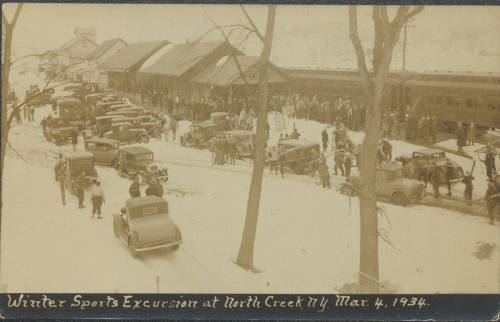 North Creek Depot lined with trains and cars as people prepare to head to the ski slopes from the Winter Sports Excursion Train. This postcard is part of the Adirondack Research Library of the Kelly Adirondack Center at Union College, and was provided by Protect the Adirondacks.
The snow trains didn’t survive the war, and, in time, neither did Gore Mountain’s relationship with the town. Decisions that make sense at the time can be fatal to golden geese.
The heritage gap
Gore’s central lodge moved a couple of miles up the road, no longer within walking distance of the commercial district. In the 1960s, a broad new Route 28 didn’t just bypass North Creek, it bisected it, with its businesses on one side of the high-speed thoroughfare, and Gore Mountain on the other. Finally, a highway department sand pit grew into a high-bermed moonscape that cut off sight lines between the Ski Bowl and the town.
These moves, however well-intentioned,“disconnected the town from its heritage,” Cronheim said. “It feels like an inheritance we never got.”
Today, locals say only 1 or 2% of the 250,000 people who recreate at Gore Mountain each year find their way into the town. If that increased to 10%, the benefit would be exponential.
Now, a cluster of Johnsburg partisans are aiming to get that heritage, and those skiers, back. Their success matters not just for North Creek and for Johnsburg, but for the entire Adirondacks, where many hamlets face similar trouble parlaying world-class natural assets into anything resembling an economic pulse.
 Mindy Preuninger, Johnsburg board member and chair of the Johnsburg Economic Development and Marketing Committee, at the top of Main Street in North Creek. Photo by Eric Teed
Mindy Preuninger, Johnsburg board member and chair of the Johnsburg Economic Development and Marketing Committee spearheading the initiative, said the holistic vision for North Creek dates back nearly a century. At that time, people with a deep and abiding love for the town were inspired by the 1932 Lake Placid Olympics, and began brushing out ski trails of their own.

From food desert to deli destination: The rise of Wylde & Young in Johnsburg
David Webb traded glamping for good sandwiches—and in doing so, brought an abandoned building back to life
“It was a really unique community at that point,” Preuninger said. “I think we need to build on that, because sometimes we forget our history, and what a grassroots effort looks like, and how it brings the community together when everyone was participating.”
If there is optimism that North Creek can at last blossom into a vibrant community it is well founded, or at least well-funded. In January, the state opened an 18,000-square-foot lodge called The Station at the historic Ski Bowl on the edge of town, part of a $40 million initiative that also includes a speedy chair lift that connects the Ski Bowl with the main trail network.
The infrastructure anchor
This spring, the town will begin connecting homes and businesses to a $10 million public sewer project, and in anticipation of that — and perhaps most telling of the hamlet’s potential — private investors are putting up their own money to renovate and reimagine downtown North Creek with hotel space, food and beverage opportunities, shopping, outdoor fire pits and such.
The optimism is palpable, but not unbridled. At a November economic development forum, a shopkeeper said she’s seen millions of dollars in grants and investments come to town before. Today, she looks around and wonders where all that money went.
Preuninger understands. “I’ve seen it over 35 years, people will say ‘yeah, yeah, yeah, go, go, go, but then they pull back,” she said. “The fast starts always seem to come to a halt.”
What’s different this time can’t be measured in statistics or bought with grant money. It is a core of people with a vision for North Creek, all pulling in the same direction.
 Jake Gaechter, chef and owner of Izzy’s Market and Deli in North Creek. Photo by Eric Teed
“I hope that it can all come together,” said Jake Gaechter, who came to town to ski, stayed as a chef and is now owner of Izzy’s Market and Deli. “We have people saying that this promise of a big booming ski town was made 25 years ago, so when’s it going to happen?”
Gaechter believes it’s starting to happen now. “We get a lot of the families, the mothers, the kids, the babies, that don’t ski,” he said. “And a lot of the skier crowd here likes to ski from opening until maybe 11; they’ll ski in the morning, and then they’re done, and they’ll come have lunch in town.”
Others come too, including 41,000 people who ride one of Revolution Rail’s four railbiking routes in Warren County, and another 10,000 rafters and tubers on the Hudson River. The railroad and the Hudson are also an integral part of the town; its historical bellcow is Teddy Roosevelt’s dash from the flanks of Mount Marcy to the North Creek train station to assume the presidency following the assassination of William McKinley.
But what was true 150 years ago, when the station was a jumping off point for city vacationers heading to lake country, is true today — the trick has never been getting people to come to North Creek, the trick has been getting them to stay.
Anna Bowers, a Johnsburg board member and chair of the comprehensive plan committee, said conquering the physical barrier that is Route 28 is key to making that happen. “The goal is to have multiple safe and very clear points of access for pedestrians, and cyclists and skiers, so that they can go from the Ski Bowl and get to this side of the town safely,” she said.
Ideally there might be a traffic circle, or some other traffic-calming obstacle — although the state Department of Transportation would have to sign off. Mainly there needs to be an overall reduction in speed. “It’s hard to see what’s happening at the town or what’s happening at the Ski Bowl at 55 miles an hour,” Bowers said.
Once skiers cross the highway there’s a lot to see, including the Tannery Pond Center for the Arts, Riverfront Park and the North Creek Depot Museum. Tannery Pond, said Executive Director Candice Murray, is an outlet for artists and also a window into the beauty and creativity of the Adirondacks.
“It’s photography, it’s painting, theater and music,” Murray said. “That’s just another piece to that puzzle that we don’t always think about. It’s the extra cultural experience that you can enjoy, even if you’re not a skier, hiker or biker. It’s a great anchor for the downtown.”
Tannery Pond, built in 2002, also serves as something of a community center for locals and visitors alike, with educational programming from documentary movies about skiing to discussion of threats to rural health care. Bill McKibben has spoken on solar energy, and Melanie Sawyer on woodland foraging.
A private-investment wave
Private investment would round out the picture, and developers believe they have spotted a market inefficiency that is making North Creek property a bargain.
 David Cronheim, a commercial real estate attorney from New Jersey, is planning to build a craft distillery, with a European style ice garden and winter market in North Creek. Photo by Eric Teed
“From an economic standpoint, there’s a tremendous mismatch between the quality of the skiing and the pricing of the real estate,” said. Cronheim. “If you look, there is not a ski town in America — and I mean this after doing a great deal of research — that has the property values that North Creek has in such close proximity to skiing, any skiing, much less great skiing.”
Cronheim is partnering with a premium distiller in New Jersey to build a craft distillery, as well as a European style ice garden and winter market where visitors can sip warm beverages, play a form of curling and relax around a fire pit.
The goal is to come up with something that celebrates winter in North Creek in a way that pays homage to its history, but also brings in some of these wonderful alpine traditions from around the world of skiing.
DAVID Cronheim, commercial real estate attorney
Another goal of investors is to transform Gore Mountain from a day-skiing venue to an overnight destination.
It was a couple months into the COVID pandemic when Keir Weimer’s Weekender hotel group bought its first North Creek property, the 19-room Alpine Lodge “against the better advice of nearly everybody,” he said. The lodge opened its doors after a complete renovation, and for a time it looked like nearly everybody was right.
“It was super quiet for the first few months, and I thought, ‘oh no, did I make a mistake here?” Weimer said. But as COVID receded, business picked up to the point that the Alpine is among the leaders in Weimer’s Adirondack portfolio.
“We leaned into this independent boutique approach to hospitality that was very much focused on connecting our guests to great adventures in the outdoors, wilderness and clean air environments,” he said. “At that time you could see some cool things happening in North Creek and feel the energy might be changing. But a lot of my peers were still on the fence about whether or not it is a good area to invest in for a number of reasons.”
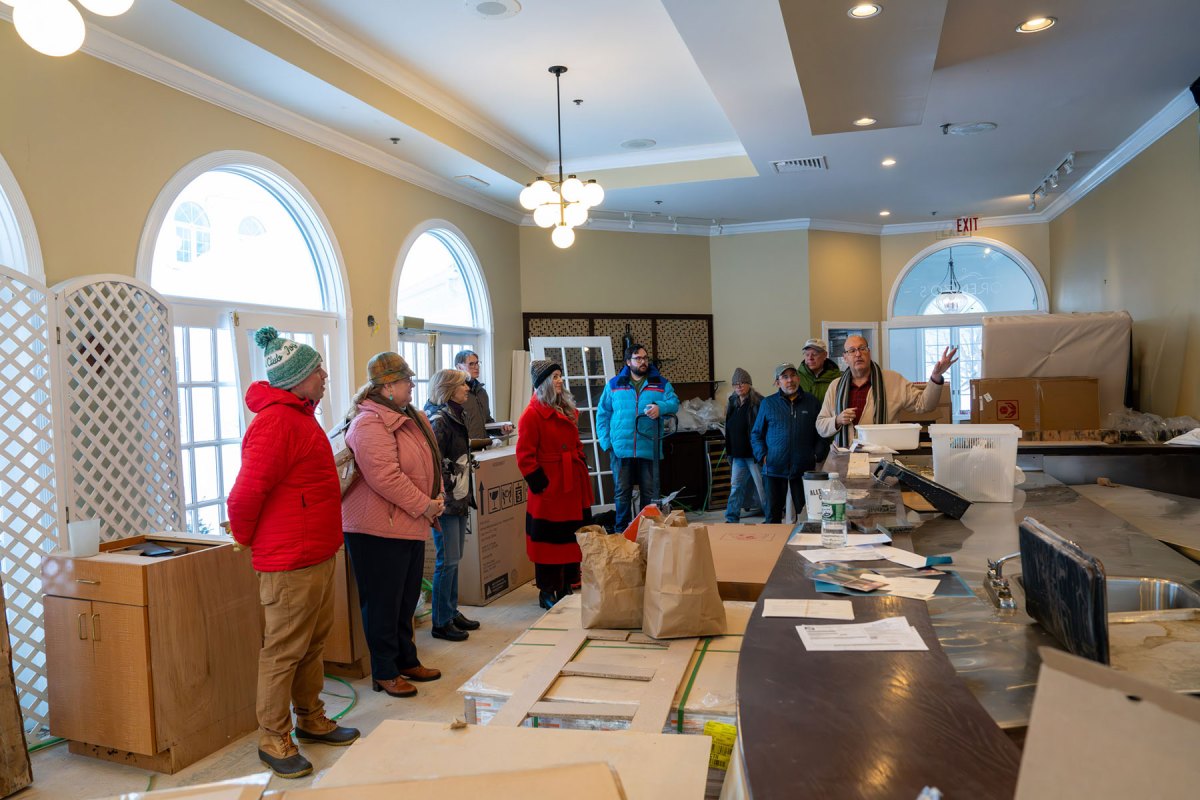 Jason Gerard (right), general manager of Weekender Hotels, giving a tour of the former Copperfield Inn, then becoming the Phoenix Inn, in downtown North Creek. Photo by Eric Teed
Those reasons will sound familiar to most any Adirondack hamlet: unreliable cell service, weak wifi and no public sewer. “There was a very significant lack of just basic infrastructure at a municipal level that we would have had in other markets,” Weimer said.
Turning a page
In late 2024, Weimer bought and began a complete renovation on the one building in town that might be most representative of North Creek’s economic fits and starts. Known as the Copperfield Inn, then the Phoenix Inn, before giving up the ghost altogether.
On the eve of its soft opening in February, Weekender area general manager Jason Gerard led a tour of the property, developed with financial assistance of the Warren County Local Development Corporation and the Warren County Industrial Development Authority.
Among other challenges, which again will sound familiar to many Adirondack towns, is building in enough upscale swank to impress city visitors, while also making it affordable and comfortable — and open — for locals in the off seasons.
To that end, the reimagined hotel includes a health club, private dining room and restaurant with a show-kitchen where guests can watch their meals being prepared — but also a cozy tavern room that is little changed from its days at a local hangout.
“We’re bringing the property out of 1992, which is where it was kind of stuck,” Gerard said.
A long-awaited sewer project
Town leaders believe these developments will fire the imaginations of others, the ultimate catalyst being the wastewater project. “People talk about things. People say, well, I’d love to open a brew pub, but you can’t do that without a sewer,” said Johnsburg economic development board member Mark Cartwright. ”So it’s limiting. People have ideas, people want to do things, but you can’t do them without that sewer.”
Jim Siplon, president of the Warren County Economic Development Corporation, said it’s gratifying that North Creek will have a public sewer system, but what will be sobering to other Adirondack communities is how hard it was to get it.
“It was a confederation of literally every possible source of funding, and it took an army of people to figure out how to piece this together,” Siplon said. “Every day, we fought a battle to make sure that this project did not start to unwind. And that’s not realistic for every community to be able to do it.”
The Public Investment
$40 Million: Total initiative for the Ski Bowl expansion, including the new lodge.
$10 Million: Cost of the municipal sewer project
250,000+: Annual visitors to Gore Mountain; the town’s goal is to increase the local “capture rate” from 1% to 10%.
Silpon believes it should not be this hard, particularly when, for once, economic development and environmental interests both agree that growth should occur in hamlets.
“There are several things that we agree on that need to be done,” he said. “One is that we need to be able to fully develop the hamlet, essentially repopulate the hamlet. But you cannot do it unless you have infrastructure, because in towns like North Creek, you are held hostage by the fact that you can’t even add a bathroom.”
Compounding the problem, much vacant space in the hamlet couldn’t be built upon, because that’s where the septic system’s leachfield was.
Because of public sewer, Siplon said there is $40 million worth of investment already underway or in the planning process. By contrast, when the state awarded a $10 million Downtown Revitalization Initiative grant, it took a decade to realize that much growth.
“How amazing that we were able to see roughly the same level of investment in less than a calendar year here,” he said. “It tells you just how much pent up opportunity there is in these communities. And I think we need to do this again and again and again.”