
New York has been falling behind on its legally-mandated climate goals. And now Gov. Kathy Hochul is indicating she’s again moving to revise the law.
The governor is now pointing to the costs that could be in store for New Yorkers, if the law — which requires the state to drive down planet-warming emissions and shift away from fossil fuels — doesn’t change.
New York City households running on natural gas could face $2,300 in additional annual costs by 2031, according to a brief memo the New York State Energy Research and Development Authority (NYSERDA) released Thursday.
The memo’s release, with that eye-popping number for escalating household bills, followed comments made last week by the governor’s budget director suggesting the law would need to be changed to protect New Yorkers from “thousands of dollars in new costs.” The memo, quickly seized upon by business groups who claim the law is expensive and impractical, was Hochul’s attempt to set the stage for negotiations towards revising the climate law.
But others, including some environmental advocates, questioned the memo’s “misleading” conclusions.
They took issue with the $2,300 headline number as the report itself notes that would decline to $1,548 with some measure of affordability rebates, or down to $864 if New York City households begin running more efficient boilers.
The memo also notes that households could save $804 a year by switching from fossil fuels to electric and making their homes more energy efficient.
The memo did not include the underlying analysis or data and incorporates assumptions about a program that doesn’t yet exist.
The mandates of the climate law have become harder to achieve since New York’s legislature passed it in 2019. The pandemic gave rise to supply chain constraints and inflation, which drove up the costs of clean energy development. President Donald Trump’s hostility towards renewable energy, notably offshore wind, further stymied the state’s progress.
The memo called deploying clean energy “infeasible” at the pace required to achieve the climate law’s targets, and said it would be “difficult to envision” how the state could quickly spend the $28 billion in revenue a program could generate.
The law requires New York State to source 70% of its electricity from renewables like solar and wind by 2030, and to reduce greenhouse gas emissions 40% below 1990 levels by 2030 (and 85% by 2050). New York is behind on both counts.
“For us to meet the goals on the timeframe that was set by the legislature, there’s going to be enormous costs to families,” Hochul said Monday after an unrelated press conference.
Hochul has long been sensitive to anything that could hit New Yorkers’ wallets, including measures that could help the state reach the climate law’s targets. She has embraced an “all of the above” energy strategy that includes fossil fuels for longer than the law foresaw.
Meanwhile, environmental advocates and others say the memo’s cost projections are misleading, and point out that a prolonged reliance on fossil fuels like gas and oil — which, when burned, emit greenhouse gases — drive energy prices up.
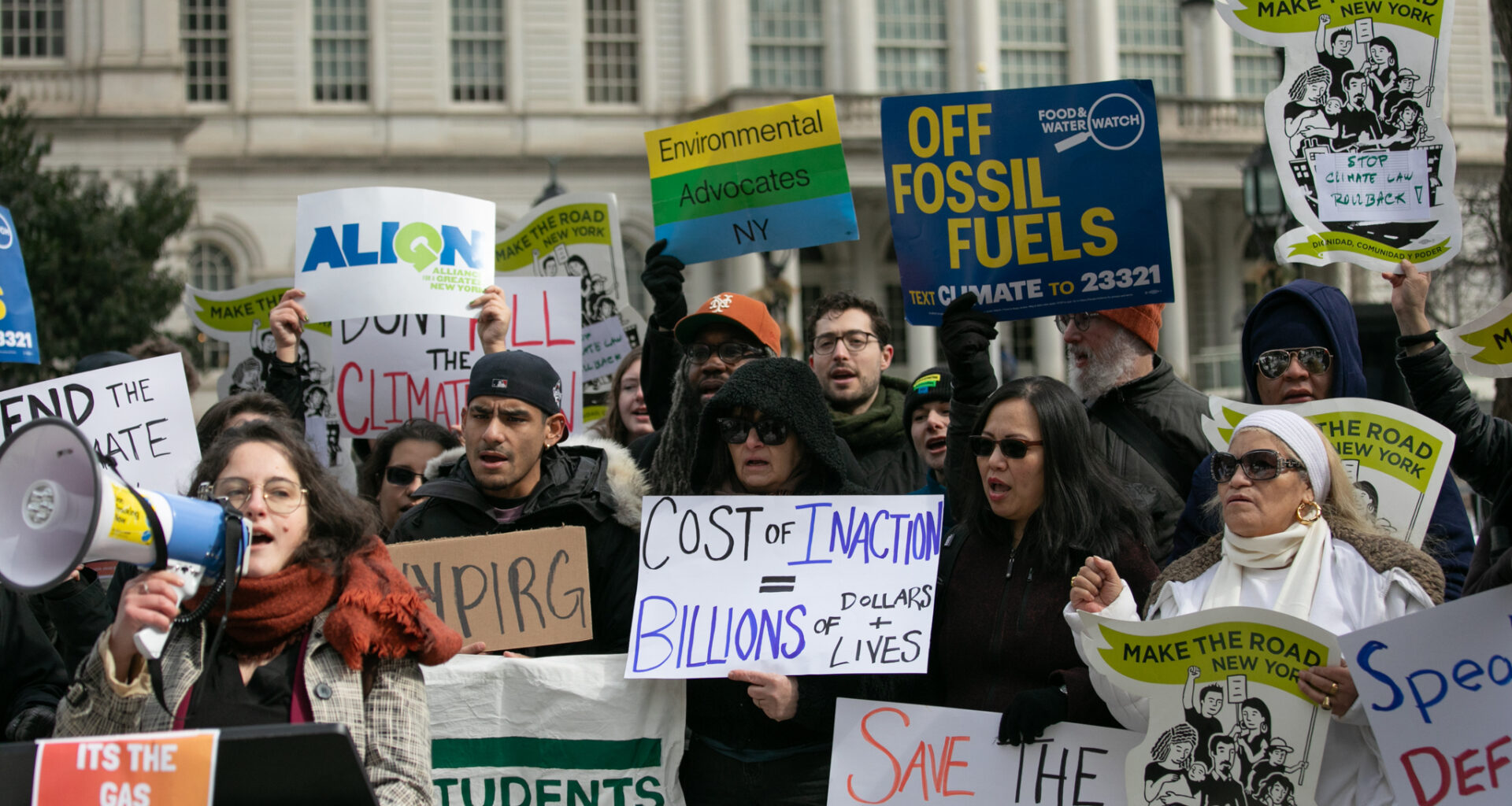
“It’s not the climate law, it’s the gas!” a group of environmental advocates chanted at a rally in City Hall Park on Monday.
Cap and Invent?
The climate law specifies the state must come up with regulations to drive down greenhouse gas emissions. The memo references a cap-and-invest program, which would raise money for climate-related projects by charging some entities that emit a significant amount of gas for the emissions they spew, with a declining cap to drive down carbon over time.
The program could also include rebates to low-income utility customers to offset any hike in bills that might come as a result.
Hochul herself proposed the cap-and-invest program in 2023. Two years later she largely abandoned the idea and her administration blew past a deadline in the climate law mandating the creation of regulations to slash emissions.
That means the cap-and-invest program does not yet exist, despite its inclusion in the cost memo. The state has full control of designing a cap-and-invest program — or other regulations — to drive down emissions and consider household costs.
Michael Gerrard, director of the Sabin Center for Climate Change Law at Columbia University, pointed out that the estimates are based on several assumptions about the structure of a cap-and-invest program and the state’s future energy mix.
“The devil is in the unseen details. Trying to seriously critique this [memo] is like shadow boxing,” Gerrard wrote in an email.
Charles Komanoff, an economist and policy analyst whose work has focused on transportation and carbon pricing, called the memo “misleading.” He said a cap-and-invest program would increase fossil fuel prices — akin to congestion pricing imposing a toll on drivers — but should use that revenue to benefit New Yorkers.
“It would be as if we charged all those motorists to drive into the Manhattan congestion zone — which is a good thing because there are so many externalities associated with that — but then did nothing with the revenues and flushed them down the drain,” Komanoff said, rather than having the congestion pricing revenue go back into the MTA to upgrade the transit system.
Vanessa Fajans-Turner, executive director of Environmental Advocates New York, said the memo was “misleading” and a “scare tactic.”
The memo showed a cap-and-invest program “devoid of all the guardrails and cost protections, no price ceilings, no consumer protections or other kinds of material cost controls,” she said. “If you say that everybody’s going to drive a car, but everybody has to drive a top-end Rolls-Royce, that’s the scenario that they have priced out.”
Sounding an Alarm?
Environmental advocates have pushed New York State to create and implement the climate law’s emission-cutting regulations — but to do so in a way that considers costs to New Yorkers.
Some green groups a year ago sued the state Department of Environmental Conservation to release regulations to bring down carbon emissions, as required by the climate law.
In October, a state court judge ruled New York was violating the climate law and directed it to release the regulations. The state is appealing that ruling.
“The lawsuit doesn’t call for cap-and-invest,” said Caroline Chen, New York Lawyers for the Public Interest’s director of environmental justice and a co-counsel in the case. “The lawsuit called for regulations that work, and the law requires affordability to be part of the consideration. The DEC has the power to design a program that works.”
Hochul has not publicly proposed any concrete changes to the climate law, though she has been open about seeking to change it — and she would need buy-in from state lawmakers to do so. She recently began conversations with lawmakers to do just that, POLITICO reported.
“What I’m trying to do is just sound the alarm right now. I want people to know, what is the impact of the continuation of this law,” Hochul told reporters Monday. “If people understood the effects of this, I think the legislature would be very willing to have these conversations about how to make adjustments.”
During budget negotiations in 2023, Hochul unsuccessfully attempted to change the formula used to count emissions in New York to bring it inline with 48 other states. The change would’ve brought the state closer to the climate law’s emissions goals, meaning action to cut emissions wouldn’t have to be as drastic or quick. Other changes could potentially reduce costs related to the law, according to NYSERDA.
Spokespeople for Senate Majority Leader Andrea Stewart-Cousins and Assembly Speaker Carl Heastie did not reply to requests for comment, though Stewart-Cousins mentioned last week said lawmakers aren’t in conversation about changing the law.
Sen. Liz Krueger, who chairs the powerful Senate Finance Committee, said rolling back the climate law won’t bring prices down.
“What I’ve told the governor is that I and many of my colleagues are eager to work with her to actually deliver on the promise of CLCPA, but we have no interest in surrendering when we’ve hardly even begun to fight,” she said in a statement.
Related