
This is your first of three free stories this month. Become a free or sustaining member to read unlimited articles, webinars and ebooks.
In August, as Grace Young walked down Doyers Street in Manhattan’s Chinatown, she was “stunned” to see that Ting’s Gift Shop, a charming gift shop that operated there for nearly 70 years, had disappeared.
“In its place, yet another bubble tea chain — probably the tenth to open in Chinatown this year,” Young, a Chinese American food anthropologist and celebrated cookbook author, wrote on Instagram afterward. “At this rate, will Chinatown become Bubble Tea Town?”
Boba, the sugary tapioca tea beverage originally from Taiwan, has been popular in American Chinatowns for well over a decade. But in the last two years its presence in Manhattan’s Chinatown has proliferated dramatically.
Today, there are more than 30 standalone boba shops in the neighborhood’s two-mile radius, each an average of 230 feet from the next — less than the length of a typical city block.
At least 15 of these appeared between now and the beginning of 2024, more than the number that began operations in the 10-year period between 2013 and 2023. They’ve supplanted a variety of businesses: houseware shops, Chinese dry goods stores, pharmacies, salons.
This boom is unfolding amid widespread small-business closures and a residential population that has become less working-class and less Asian. And while most of the new boba shops are a part of multinational chains based in Asia, mostly staffed and often frequented by Asian Americans, few have connected the trend to commercial gentrification or how this “bobafication” is reshaping Chinatown’s streets, economy and rhythms of life.
Young’s question has real implications, and it sheds light on how ethnicity and food can camouflage gentrification taking place in immigrant enclaves. As a citywide affordability crisis deepens, the bubble tea boom reflects a broader struggle over who the neighborhood’s future is being built for.
A legacy business becomes a boba shop
Run by three generations of Ting women, Ting’s Gift Shop sold handmade porcelain, silk garments and whimsical toys behind a rustic red storefront with a lived-in history of its own.
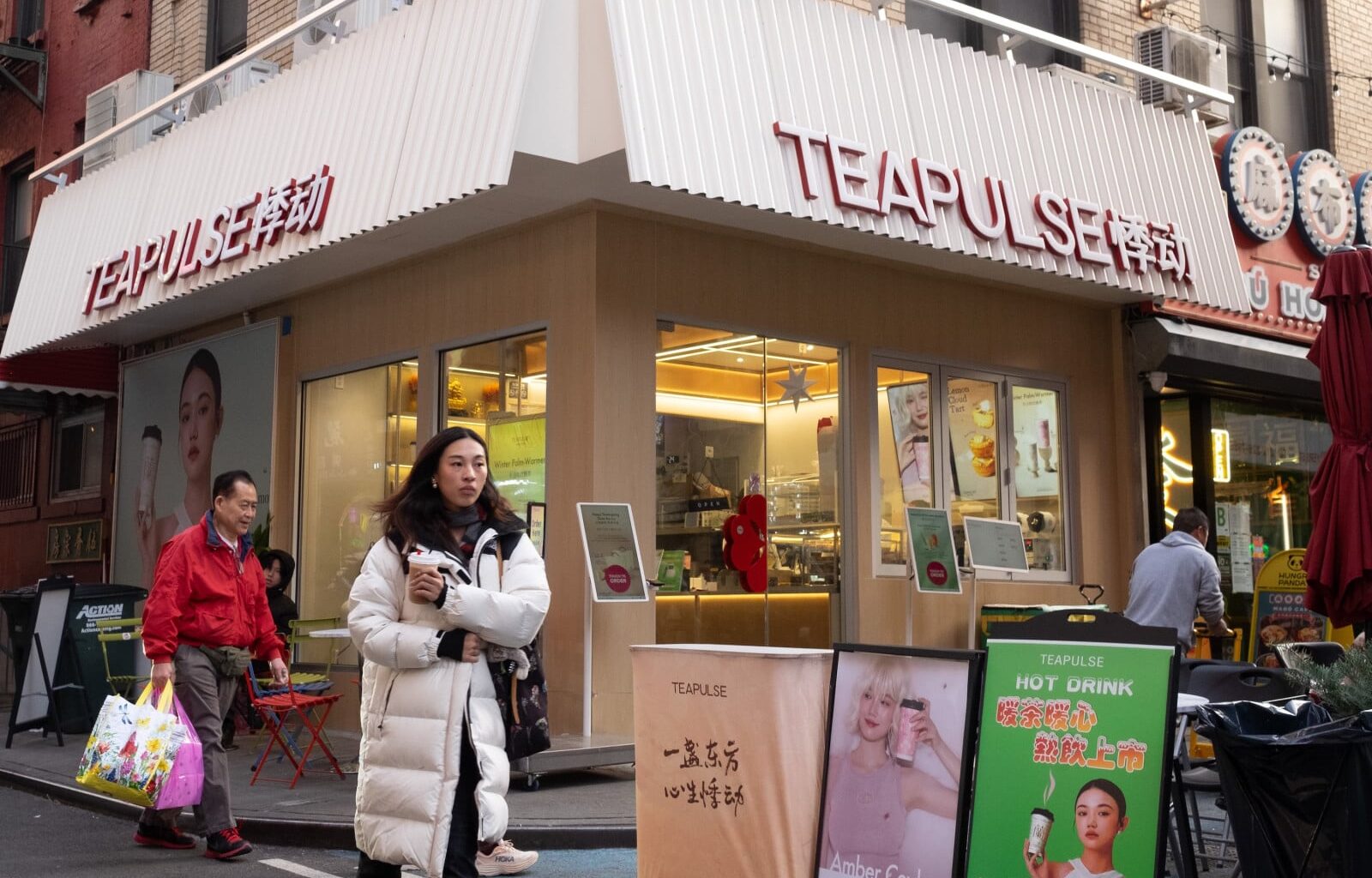
Any physical trace of that today is gone. This past summer, the Tings retired, and 18 Doyers Street became the newest TEAPULSE, a Shanghai-based boba chain with over 3,000 locations. Questions of Ting’s economic viability played a major role in the decision to shutter, especially in the aftermath of the Covid-19 pandemic, which kept the shop closed for six months.
Read more: Can Chinatown’s Unique Food Ecosystem Last Another Generation?
It’s a common narrative among Chinatown small businesses that closed in the years following the pandemic.
Many were accustomed to operating on razor-thin economic margins, and struggled to catch up once business resumed, especially amid record levels of inflation and the city’s rising rents. Largely run by immigrants — whose businesses often didn’t even have a website — many also couldn’t lean on digital marketing to draw in customers, unlike the boba chains that have succeeded them.
In contrast to Ting’s lived-in charm and emphasis on cultural history, TEAPULSE is sleek and modern. Customers queue behind stanchions and order drinks, which cost as much as $9, on kiosk screens. Limited-edition items and eye-catching promotions are advertised throughout. Under its awning, a billboard of a model holding a cup of boba reads, “Free Phone Pouch with Any 2 Drinks.”
“Legacy shops tell the story of immigration and our history. Boba shops carry nothing.”
Behind the counter, a teenaged employee assembles ingredients and places a branded cup in a machine. A few seconds of automation later, the drink is ready to be Instagrammed and consumed.
If Ting’s had encouraged quiet contemplation and an appreciation for Chinese history and crafts, TEAPULSE does the opposite. Like most new boba shops, there’s little seating, so customers seldom linger.
“Legacy shops tell the story of immigration and our history,” says Young, who’s received the Julia Child Award and James Beard Foundation Award. “Boba shops carry nothing.”