

Tianna Daniels was eight months pregnant when she moved into a Staten Island family shelter last March. She had just been fired from her job as chief engineer at a Pennsylvania hotel — on the same day her doctor submitted documents to her employer for her maternity leave, she said.
“I weighed out every option — pros and cons — and I said, ‘Yea, I’m gonna go to New York and see what resources I can find,’” Daniels recalled. “I said, ‘This is where I was born, I got to go back.’”
Her son, whom she calls Papa, is now nearly 10 months old. He is taking his first steps and starting to potty-train — and is always by Daniels’ side as she participates in various trainings to widen her job prospects.
He watches Daniel Tiger’s Neighborhood sometimes during his mother’s online Occupational Safety and Health Administration classes, and sat alongside her as she trained to become an addiction recovery coach. He’s even tagged along on her job interviews in Manhattan, Brooklyn and Queens.
“I haven’t had an hour from him since ever… I’ll pull up anywhere with this kid. This kid is always with me,” Daniels said. “I need child care.”
But the 31-year-old mother sees no other option than to care for her baby on her own. The drop-in daycare center inside her shelter, for one, is still slowly moving through the city’s permitting process despite being furnished two years ago. Meanwhile, she can neither bypass the long waitlist for a child-care voucher from the Administration for Children’s Services (ACS) nor qualify for one from the Human Resources Administration (HRA), which would require her to work.
But without child care, Daniels can’t work.
“The Catch-22 is so ridiculous,” she said. “How am I supposed to get out of the shelter?”
For homeless parents, the lack of access to affordable, convenient child care is often a main barrier to transitioning into stable housing, according to a new report by WIN, New York City’s largest family shelter provider. Without it, parents struggle to work, find permanent housing, or attend crucial public benefits appointments.
Nearly 15,000 New Yorkers under the age of five live in shelters. WIN surveyed 96 parents, including Daniels, across its 16 shelters citywide and found just 31% can access ACS or HRA child-care vouchers.
More than half the surveyed parents said they rely on themselves for most of their child care, with 60% of them citing a lack of other child care options as the reason.
The Department of Education offers some free and low-cost child care, which are competitive in some high-demand areas but chronically underfilled in others. The open spots often require long travel for families, and many parents simply do not know about them: Two-thirds of parents surveyed by WIN said they knew little or very little about available child care programs and resources.
“Programs meant to offer free or reduced cost child care to low-income families were not reaching parents in shelter,” the report writes, adding how traditional daycare hours — from 8 a.m. to 5 p.m. — make it difficult for parents to hold shift- or gig-based jobs.
Mayor Zohran Mamdani and Gov. Kathy Hochul, meanwhile, have made universal child care a core tenet of their agendas. In January, they announced $1.2 billion in state funding to expand 3-K seats in areas with unmet demands and to launch child care for 2,000 2-year-olds this fall and another 10,000 next fall.
But Emmy Liss, executive director of the Mayor’s Office of Child Care and Early Childhood Education, said at a City Council hearing on child care Monday that the administration does not currently anticipate being able to move families off child care voucher waitlists. State dollars, she added, would go toward covering the cost of existing vouchers.
Employment remains the most straightforward path out of shelters for families, according to Katie Masi, who oversees workforce development at WIN. But parents often forgo work or job training to take care of their children, she said.
“Most recently I had a client who wanted to participate in a training program to get into the maintenance field, and so they found a training program that would give them the skills and the tools to connect them with employment,” Masi recalled. “But they ended up having to drop out because they would have to pay out of pocket $70 a week for child care, and they couldn’t get the program approved by the city as a training program so they couldn’t get a voucher.”
She added: “The biggest obstacle for our families for employment is not motivation — it is access to reliable child care that matches what they need.”
‘I Was Really Doing Everything’
Kellice Bobbitt knows what it’s like to lose a job over the lack of consistent child care.
The native New Yorker lived in Colorado for five years before returning to the city last April. There, she worked nights at FedEx while her daughters’ father worked days. They’d hand off their toddler before each shift, making it hard for Bobbitt to be on time.
“I ended up getting fired because some nights I was going in a little bit late,” said Bobbitt, 24, who is now separated from the father of her two-and-a-half-year-old daughter.
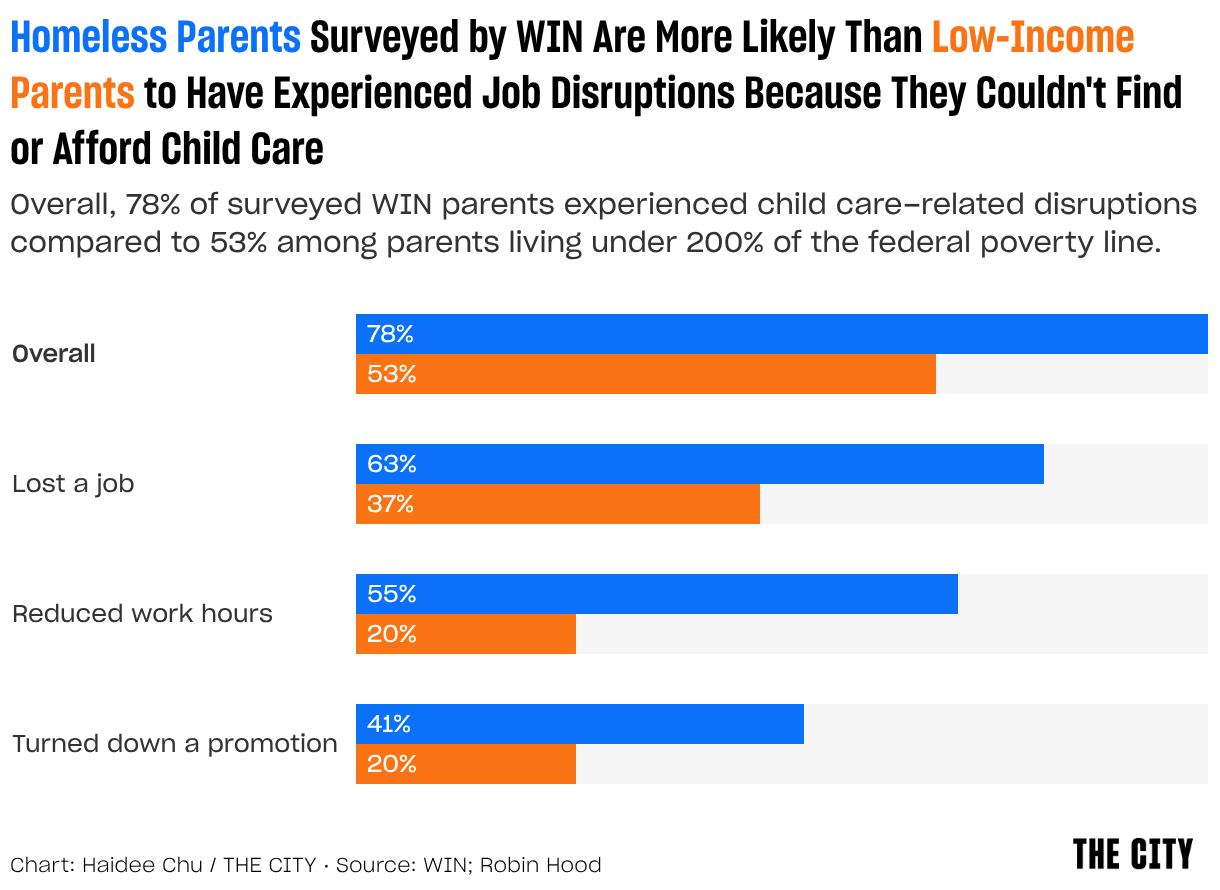
Bobbitt’s case is not an anomaly. Among the parents surveyed by WIN, 78% reported job disruptions because they could not find or afford child care — with 55% saying they’d cut their own hours and 68% saying they have, like Bobbitt, lost jobs.
Those are far higher rates compared to mothers living below 200% of the poverty line, according to a 2024 Robin Hood study referenced by the WIN report.
The WIN report concludes: “Parents in shelter are more likely to have experienced child care related work disruptions than their low-income peers, suggesting that the lack of child care is itself a root cause of family homelessness.”
Bobbitt, for one, said she started looking for jobs in the city even before she moved back — but struggled to land a job for months between a dearth of both job opportunities and reliable child care.
“I was really doing everything,” Bobbitt said. “I have to work around my family’s schedule with when they can watch the baby and when I can go out, and that was pretty hard.”
It took her until November — four months after moving into a WIN shelter, and two months after her daughter became eligible for in-house daycare — for her to land a job working at Sweetgreen, she said. With child care covered by WIN from 8 a.m. to 5 p.m., Bobbit said she’s now working shifts from 10 a.m. to 3:30 p.m. about three days a week.
Other parents need child care to carve out time to attend appointments. Ilana, a 27-year-old mother who asked only to be identified by her first name, said she had been living in a car when she realized she was pregnant with her third child.
Since entering a WIN shelter in September, she said, she has relied on the in-house daycare to look after her two-and-a-half-year-old, Jade, whenever she needs to attend appointments with her doctor or at HRA.
She had been nervous about sending Jade to daycare, she said, since she has never done so with her older daughter, who now lives with her father.
“But as my pregnancy progressed, it started becoming very hard to get to appointments on time and to do what I had to do to get housing — seeing that I had to get myself and my daughter ready and a lot of my appointments are early in the morning,” said Ilana, who hopes to enroll Jade in the city’s pre-K program next year.
“Being able to access free child care here in the building has tremendously changed our lives,” Ilana said. “I don’t really have any friends — let alone friends with kids her age — so she’s really not around children her age, and I feel like part of her growth is to get used to being around other kids her age and learning how to communicate and make friends.”
With child care in place, Ilana plans to pursue her GED after giving birth and to find a more stable job than the babysitting work she’s done intermittently in the past.
“I hope to be able to provide a life for them where they don’t end up going down the path I went on growing up or as a teen. I hope for them to just be educated,” Ilana said. “I know kids make mistakes, but I just hope that they learn compassion and stay on the track of success in life rather than, you know, failing or ending up like mom.”
’I’d Be Just Fine’
Daniels, for her part, is juggling caring for Papa with continuing her professional training and job search. She’s also grieving the fact that she’s lost custody of her three older daughters to their fathers and her estranged mother.
“When I go to HRA, they always tell me, I cannot get a child care voucher unless I have an ACS case — which I don’t want, which I’m scared of,” Daniels said. “But if I had the daycare downstairs I would be just fine … I’ll be working on my mental and getting other stuff done, like taking classes and working on getting the housing situation better.”
On a recent afternoon, she showed off photos of her daughters on her fridge and kitchen cupboards — as well as boxes of clothes ready for her daughters if they’re reunited one day.
“Now that I’m so focused on Papa, all I think about is all the children,” Daniels said.
Bobbitt, meanwhile, has found a supportive housing rental apartment in Harlem for her and her daughter through the Department of Homeless Services — and has been packing up to prepare for a move in the next few days.
She anticipates paying a quarter of her monthly income toward rent, but still isn’t certain how she’ll access child care after leaving the WIN shelter and its in-house daycare.
She recently began applying for an HRA child care voucher, she said, but pushed back the process between finding an apartment and moving.
So far, she said, she’s found two daycares in the neighborhood that would each cost about $3,000 a month — an insurmountable sum on her Sweetgreen salary without a voucher.
She’s also applied for a 3-K seat for the fall. But with months to go until then, she’s considering offering her grandmother a portion of her paycheck in exchange for child care while cutting back her hours to care for her daughter.
“I just want her to feel comfortable in the environment she’s at,” Bobbitt said. “I just want her to be happy.”
Related