
The finish line is in sight, and the New York Knicks have 20 games to shake their inconsistent label and find stable ground before the NBA postseason starts in a little over a month.
There have been reasons for optimism as of late, most notably the defense that has been one of the league’s best over the last month. The team is healthy outside of Miles McBride, and coach Mike Brown is getting legitimately meaningful minutes from the back end of his rotation.
Will all of that continue? Who knows. However, New York appears to have found a few things to build on as it prepares for the playoffs.
To prepare you for the next stage, I’m answering reader questions about the Knicks, with most centered around the postseason and how New York will approach its last 20 games of the regular season.
Let’s get into it. (Questions have been edited for clarity.)
Once the playoffs roll around, do you expect Mike Brown to shorten the rotation? Who is most likely to see their minutes cut? — Geoffrey R.
As of late, Brown has been consistently using a nine-man rotation. The Jeremy Sochan experiment failed a few days into it, and rookie Mohamed Diawara snatched yet another opportunity to play meaningful minutes for New York and further his development.
It’s still a tad too early to say for certain, but I’m expecting Brown to use an eight- or nine-man rotation in the postseason. That tends to be the standard for most coaches. Brown played nine players real minutes during his last playoff stint as the head coach of the Sacramento Kings back in 2023.
If McBride can return from his sports hernia injury by then, I’d expect him to push Diawara out. If he’s not able to return by the first round (or at all), and as more games pass, I do believe that he will start the playoffs with Diawara in the rotation.
The second-round rookie brings good size, has shown the ability to hit open shots and makes some advanced reads as a passer at times. Diawara’s staying in the postseason rotation will depend on how he looks in the high-pressure moments. With Knicks governor James Dolan expecting the team to make the NBA Finals, I’m not sure Brown will let Diawara play through mistakes.
The Knicks aren’t in the business of playing someone who might look overwhelmed. And I’m not saying that Diawara will for certain be overmatched. He’s been nothing but cool, calm and collected during the second half of the regular season, but the playoffs are a different beast.
Can Brown keep getting Diawara 10 minutes a game to keep progressing? His size and ceiling seem to warrant it in my opinion. — Anonymous U
Diawara averaged 14 minutes per game in February, and I’m not sure why that would change. As you said, he’s shown flashes and contributed to winning basketball. Furthermore, McBride is unlikely to be ready to return by the end of the regular season. Brown has been pretty comfortable lately with his nine-man rotation, which includes Diawara.
There’s a world, I guess, where Brown gives Sochan another opportunity to prove he’s rotation worthy to close the regular season. Sochan arrived in New York and did not perform well, so Brown may give Sochan another crack at things now that his world has slowed down. Still, I don’t see it — even if, for the playoffs, Sochan’s defense could be valuable. Even then, while Sochan might be a better defender than Diawara right now, Diawara can hold his own defensively at times and make open 3s. Sochan is the worst non-big man shooter on the roster.
If teams are going to sag off one or the other regardless of when the Knicks have the ball, might as well play the guy who has shown to make teams pay more often than not as of late, and that’s Diawara.
Would the Knicks be better off starting Shamet or McBride as the point-of-attack defender? Seems Bridges is at his best in the free safety role. — Jevon R
This question is one of the oldest debates amongst diehard Knicks fans: Should Josh Hart come off the bench for more shooting/point-of-attack defense?
It’s a fair question.
New York’s starters have been good but not great since being put together last season. This year, the five-man lineup of Jalen Brunson-Hart-Bridges-OG Anunoby-Karl-Anthony Towns has played (before Tuesday’s game against Toronto) 301 minutes together and carries a net rating of plus-5.6 this season. Is that bad? No. Is it good enough for a lineup with those names and a top-heavy roster? No.
Teams sag off Hart and dare him to shoot while guarding him with their center. It has and can muck up the Knicks’ offense if his jumper isn’t falling, or he’s not attacking the space. I understand why people want to go into a five-out system so that rival teams are forced to defend Towns with their center, which usually doesn’t go well for them.
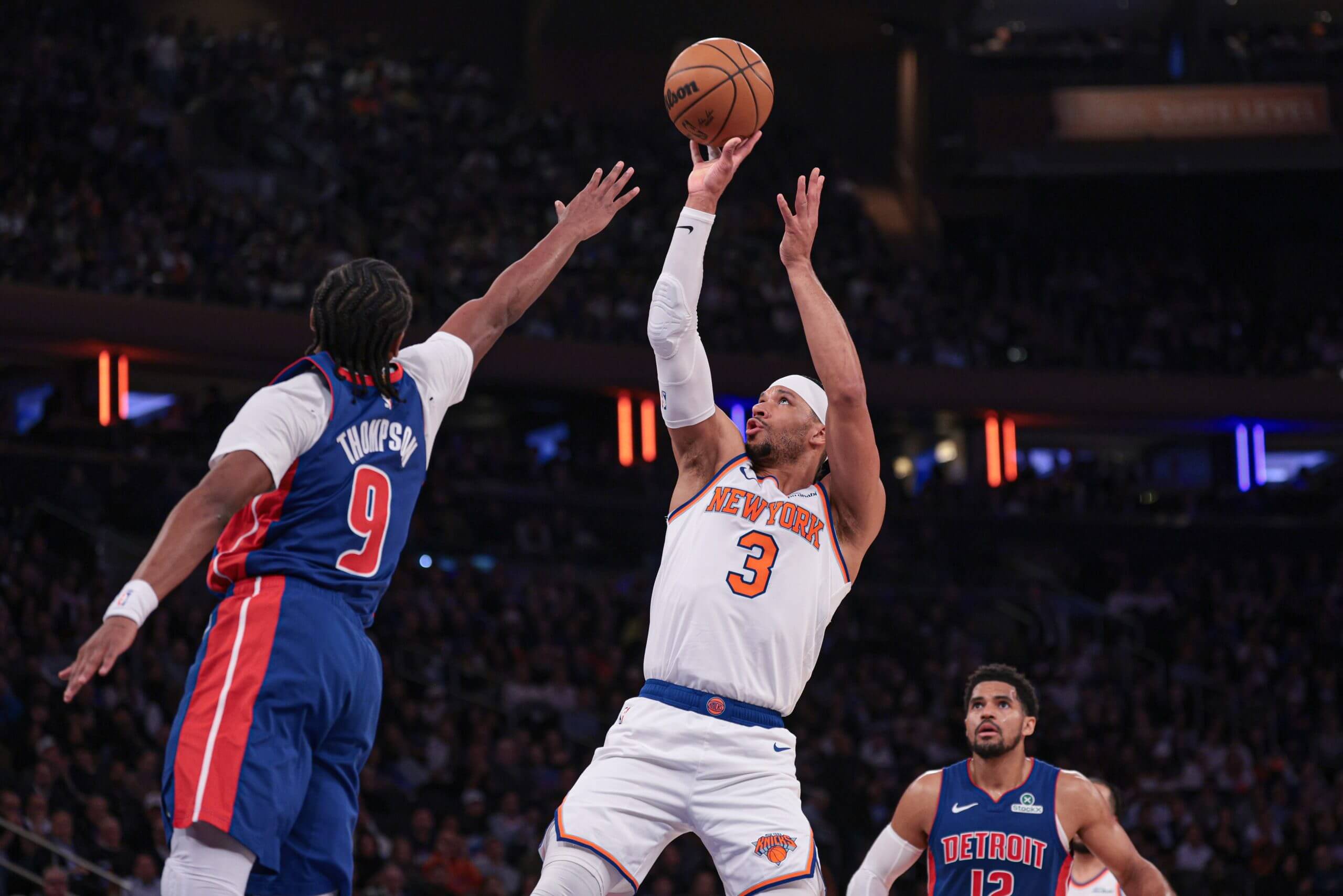
Josh Hart puts up a midrange jumper over the outstretched arm of Detroit’s Ausar Thompson. (Vincent Carchietta / Imagn Images)
What I will say is that while Hart might not be respected as a shooter, and it can complicate New York’s offense, no one in that group gets the slow-paced team to try and play fast as Hart does, and no one in that group looks for Towns as Hart does. Hart is also a great rebounder for his size. Bridges and Anunoby aren’t consistently good enough on the glass to make Hart’s absence less damaging in that department.
If you take out Hart and replace him in the starting lineup with Shamet, yes, you add five-out spacing and allow Bridges to play off the ball as a defender more. However, that means Shamet will have to guard better players more often than he does right now, and that could change how he’s viewed on that side of the ball.
For reference, a lineup featuring Hart replaced by Shamet and alongside the other four starters has played just 72 minutes together this season. In those limited minutes, that group has a minus-2.2 net rating. Enter McBride in the starting lineup in place of Hart, and that five-man unit has played 86 minutes together and, essentially, has a neutral net rating.
The alternatives to benching Hart haven’t played a ton of time together, but maybe for good reason? Brown may have viewed the alternatives together more behind the scenes, and that is why we don’t see it in public.
As per (Monday’s) Mikal Bridges article, and most times Bridges is in the conversation, the draft compensation is mentioned. I know there are five first-round picks. However, it is rarely placed in context — what years, what protections, what likely range. I think it’s unfair to have always be discussed as if they gave away five lottery picks. — Shadyhollow1
I hear what you’re saying, Shady. However, I think it’s important to realize that the picks are also currency, on top of being hope for a franchise and its fans.
Whether or not you agree, there is a world where, instead of trading four unprotected first-round picks and a protected first for Bridges, the Knicks could be just as good now if they traded only two first-round picks for, let’s say, Dillon Brooks (I’m using him as an example to get this thing moving a little bit). When trading for Bridges, New York knew it would have to extend him to justify the trade, which weakens flexibility. Ultimately, Bridges is asked to be a role player on this current Knicks team. Furthermore, New York’s roster isn’t perfect, but it now doesn’t have the assets to add a player who can dribble, shoot and defend, while also having several high-salary players that make it tough to match money in deals.
Trading flexibility and assets for Bridges makes it so that this specific group has to win the title. It doesn’t leave much wiggle room without a major overhaul of the roster.
Yes, on the surface, the bulk of the four unprotected first-round picks that the Knicks sent Brooklyn as part of the Bridges trade will likely be in the late 20s for the next few years. With that said, any team that realistically trades for Giannis Antetokounmpo is also going to be trading picks in the 20s because Antetokounmpo is going to make his new team better. There aren’t a ton of teams in the NBA that could offer five first-round picks, no matter where they are, like the Knicks could have before trading for Bridges. In this scenario, Milwaukee would be able to show its fans, “Hey! We got five firsts, and our franchise player didn’t walk for free!” Then a team like the Bucks trading its franchise face could have its own high picks and some more bites at the apple with New York’s picks to build a future core, potentially.
It’s all about optionality and flexibility, which the Knicks punted away on a player who is, essentially, a (really good) role player.