
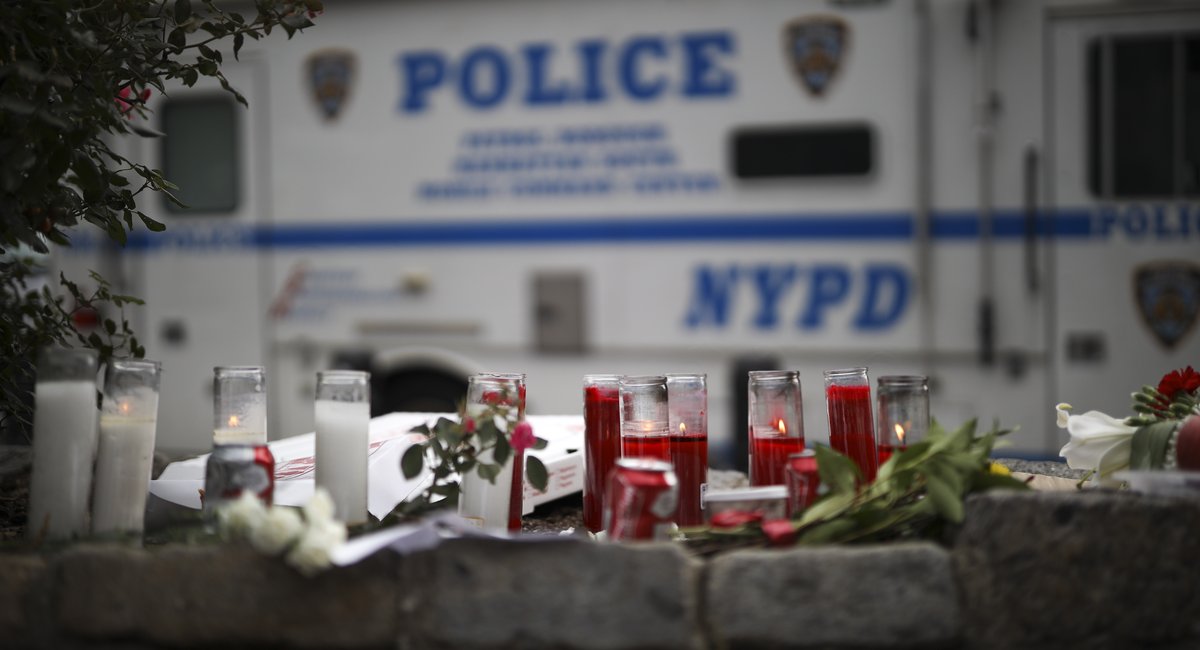
Mark Soyka remembers feeling unsettled when he heard homeless people had been attacked while they were sleeping in Chinatown in 2019. At the time, he said, he had been staying on nearby Mulberry Street.
“I was safe, by the grace of God, because I was living in a basement. So I had protection at night from the cold and the madness,” he said. “Before I was there, I was just sleeping in the street around where them guys got killed.”
The man accused of those killings, who was also homeless, was convicted of murder and assault last month. Prosecutors said Randy Santos traveled from the Bronx to the neighborhood surrounding the Bowery, known for its large homeless population, and used a heavy metal bar to bash the heads of five men as they slept on the street. Florencio Moran, Nazario Vásquez Villegas, Anthony Manson and Chuen Kok died from their injuries.
One man survived, along with another person whom Santos beat with a stick in Chelsea days earlier, prosecutors said.
Santos’ conviction offers some closure in a case that took nearly seven years to go to trial. But the dangers facing homeless New Yorkers remain.
One high-profile act of violence after another has plagued the city’s homeless community in recent years.
In 2022, a homeless man stabbed three other homeless people in Manhattan. In 2023, Daniel Penny choked Jordan Neely on the subway while Neely complained that he was hungry and thirsty.
The next year, Sebastian Zapeta allegedly set Debrina Kawam on fire while she slept on an F train, then watched as she burned to death. This week, a group allegedly set a homeless man on fire while he slept on the floor of Penn Station, according to police.
The NYPD does not track crimes against homeless New Yorkers as a separate category, according to a spokesperson.
“Word gets around and people express fear,” said Philip Yanos, a psychology professor at John Jay College of Criminal Justice who also treats patients that sleep on the street. “It does increase the sense of, ‘We’re not safe in the community.’”
Beyond crime, it’s been a particularly perilous winter for New Yorkers without stable housing, as heavy snow and frigid temperatures have gripped the region.
At least 15 people died from exposure during the recent cold snaps, according to the mayor’s office. City officials have not specified how many of those people lived on the street, but at least some were homeless.
After facing criticism for the deaths, the city ramped up its response to the cold, including by opening new warming centers and encouraging New Yorkers to call 311 for people in need of help. Mayor Zohran Mamdani also revived homeless encampment sweeps, reneging on past promises to ditch the practice used regularly during the previous administration.
The mayor said the Department of Homeless Services would lead the sweeps, rather than the NYPD, and that his main goal is to help homeless New Yorkers find housing and other resources.
“Our administration will meet those homeless New Yorkers every single day, and we will meet them looking to connect them with shelter, looking to connect them with services, looking to connect them with a city that wants them to be sheltered and indoors and warm and safe,” Mamdani said at a February press conference.
About 4,500 New Yorkers are estimated to be sleeping on the streets or in the subway each night, according to the 2025 HOPE count, which tracks the number of unsheltered people in the city on a given night. Some say they feel safer outside than in a shelter. But sleeping outside comes with its own unique set of dangers.
“They don’t need to be on the streets. They don’t need to be unsafe,” said Gary Jenkins, interim CEO of Urban Pathways.
The nonprofit provides housing, mental health care and other resources for homeless New Yorkers, including Soyka.
“We really focus on creating an environment where our clients feel safe — where they can come in and know that they have a roof over their head, and they get the services that they need and deserve,” he said.
‘It could have been me’
Days after Santos’ conviction, the Chinatown neighborhood where he carried out his attacks was bustling. Kids frolicked in the snow at Sara D. Roosevelt Park. Groups of chatting people crowded around the benches and players packed the handball court.
Several homeless people also ambled around. Some were bundled in blankets and jackets, or asking for money at the Grand Street stop.
Anthony Clarkson said he’s been staying in this area for about 10 years.
“ I like it around here. Usually nothing really happens,” he said. “But two or two or three things happened, and it makes you think about coming around here and being safe. You have to look around sometimes.”
Clarkson said he knew the men Santos killed and was staying nearby that night.
“It could have been me,” he said.
Clarkson said the men were vulnerable when they died.
“ You don’t have a lock on the door,” he said. “So when you don’t have a lock on the door, anything can happen.”
Santos’ defense attorneys argued at trial that he should not be held criminally responsible for his actions. They said he has schizophrenia and that he heard a voice commanding him to kill 40 people, or else he would be killed.
“This is a tragedy in every direction — for the victims and their families, for a man who unraveled without adequate care, and for a system that allowed warning signs to go unanswered until it was too late,” defense attorneys Arnold Levine and Marnie Zien said in a statement.
Soyka, the Urban Pathways client, said he’s had his own scary experiences in his years without stable housing.
He stopped staying in shelters after someone was killed, he said. Then, he started sleeping in the street on a cardboard box.
“I tried the train, but I got robbed on the train, like an idiot,” he said. “They took my jacket and my phone and everything.”
For a while, he got permission to sleep in the basement of a building where he was working, Soyka said. Now, he said, he has a single occupancy room that locks with a key.