
Attempt to Push Boundaries on Congressional Lines Before Mid-Term Elections is Blocked
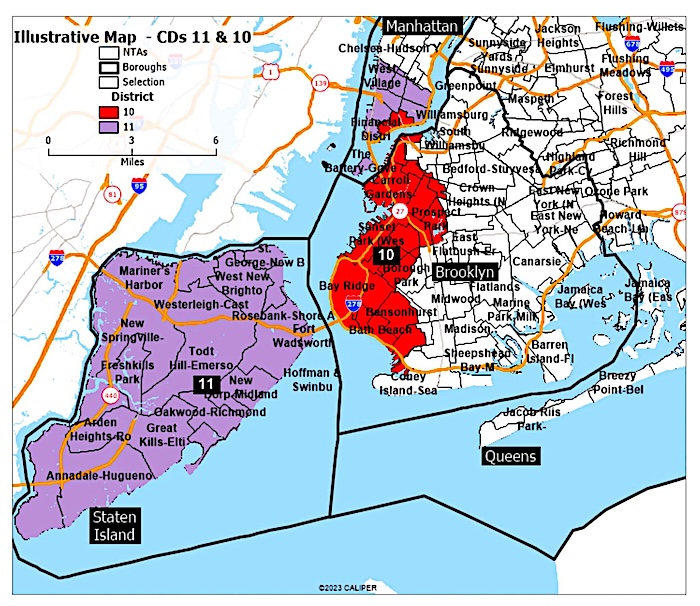
On Monday evening, the U.S. Supreme Court halted (at least for the time being) a lawsuit that had earlier resulted in a judicially ordered redrawing of Congressional lines that include Lower Manhattan. The prior ruling, from the New York State Supreme Court, would have joined all of Staten Island to most of Lower Manhattan below 14th Street into a new 11th Congressional district, while grafting much of Chinatown and the Lower East Side onto a large swath of Brooklyn (Williamsburg to Bensonhurst) that would have become the new 10th district.
The current lines group Manhattan south of 14th Street with a smaller slice of Brooklyn (between Dumbo and Sunset Park) for the 10th district, while the 11th district encompasses all of Staten Island with a reduced portion of South Brooklyn (between Bay Ridge and Gravesend). These boundaries leave a large Black and Hispanic population on Staten Island’s North Shore, which leans Democratic, isolated among the majority white population in the rest of the borough and South Brooklyn that tends to vote Republican.
The litigation, initiated last October by two residents of Staten Island and two who live in Manhattan, alleged that the current lines have the effect of disenfranchising these Black and Hispanic voters. Citing the State Constitution (which mandates that “districts shall be drawn so that, based on the totality of the circumstances, racial or minority language groups do not have less opportunity to participate in the political process than other members of the electorate and to elect representatives of their choice”), the suit argued that gathering them in a single Congressional district that brought together minority voters on the North Shore of Staten Island with those on Manhattan’s East River waterfront between the Brooklyn Bridge and 14th Street would give them more influence in deciding elections. The plaintiffs asked the Court to order the State legislature “to adopt a valid congressional redistricting plan in which Staten Island is paired with voters in Lower Manhattan to create a minority influence district in [District 11] that complies with traditional redistricting criteria.”
On January 21, the New York State Supreme Court agreed, with Justice Jeffrey Pearlman finding, “fundamental to this claim is the extent of racially polarized voting in [District 11].” The opinion continued, “here, racially polarized voting has been clearly demonstrated,” noting, “across federal, state, and city elections from 2017 to 2024, Black voters in [District 11] voted together an average 90.5 percent of the time, while Latino voters voted together 87.7 percent of the time. Asian voters voted for the Black and Latino preferred candidates 58.93 percent of the time, displaying less cohesion than Black or Latino voters but still demonstrating a consistent preference. White voters, meanwhile, voted against the candidates preferred by Black and Latino 73.7 percent of the time. Across the 20 most recent elections in [District 11], the Black- and Latino-preferred candidates won merely five races.”
Justice Pearlman concluded, “based on the facts presented by the expert witness reports and on the record, it is clear to the Court that the current district lines of [District 11] are a contributing factor in the lack of representation for minority voters.” He ordered that a new commission be empaneled immediately to redraw the lines in a more equitable manner.
Nicole Malliotakis, the incumbent member of Congress in District 11 and the only Republican member of New York City’s Congressional delegation (who would likely have faced a difficult reelection campaign if the proposed new lines were implemented), promptly filed a federal “emergency appeal,” asking the U.S. Supreme Court to nullify Justice Pearlman’s order, saying, “this is a frivolous attempt by Washington Democrats to steal this congressional seat from the people and we are very confident that we will prevail at the end of the day.”
On March 2, the U.S. Supreme Court granted Ms. Malliotakis’s request without explaining why (which is customary in cases of expedited review), other than conservative Justice Samuel Alito’s finding that Justice Pearlman’s order “blatantly discriminates on the basis of race.” The U.S. Supreme Court’s three liberal justices, Sonia Sotomayor, Elena Kagan, and Ketanji Brown Jackson, dissented from this ruling, writing, “the Court’s unexplained order can be summarized in just seven [words]: ‘Rules for thee, but not for me.’” They continued, “time and again, this Court has said that federal courts should not interfere with state-court litigation. Time and again, this Court has said that federal courts should not meddle with state election laws ahead of an election. Today, the Court says: except for this one.”
The U.S. Supreme Court’s ruling is a temporary “stay,” rather than a permanently binding decision, but it effectively ends the quest to redraw Congressional district lines in advance of the mid-term elections later this year. It does not, however, derail the original lawsuit that sought this outcome.