
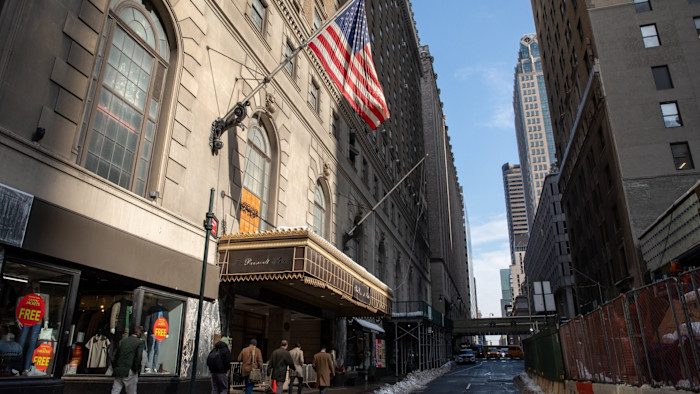
JPMorgan Chase’s aspirations to expand its Manhattan real estate empire have hit a roadblock at the Roosevelt Hotel, which the government of Pakistan wants to knock down and replace with a high-rise development.
The bank led by Jamie Dimon has for more than a year had designs on buying the Roosevelt, which neighbours JPMorgan’s new 60-storey Park Avenue skyscraper and two other buildings it also owns, according to people familiar with the matter.
“JPM was aggressively chasing the Roosevelt hotel,” one of the people said.
However, talks fizzled because of the Pakistani government’s preference to redevelop the site and retain an ownership stake as well as the loss of its real estate adviser.
The century-old hotel has fallen into disrepair and needs major renovations or rebuilding after it was leased by New York City for use as a migrant processing centre. The Pakistani government, which has held the Roosevelt since the 1970s, has publicly expressed a desire to pursue a joint venture with a developer.
 JPMorgan’s new headquarters at 270 Park Avenue
  The nearby Roosevelt Hotel © Olga Ginzburg/FT
For JPMorgan, acquiring the Roosevelt would be another addition to its growing campus in New York, where it has more than 17,500 employees.
America’s largest bank, which last year made more than $1bn a week in profits, spent billions of dollars rebuilding its new headquarters at 270 Park Avenue, which opened last year.
It is also renovating an existing office building at 383 Madison Avenue and is considering adding hotel rooms for employees at the 520,000 square feet 250 Park Avenue building it acquired in 2024, the FT has previously reported.
Right next door to JPMorgan’s burgeoning property portfolio is the Roosevelt Hotel.

On a private tour of the skyscraper at 270 Park Avenue for wealthy clients in late 2024, Gary Cohn, a former top executive at Goldman Sachs and senior official in the first Trump administration, asked JPMorgan’s head of global real estate David Arena whether the bank would want to buy the Roosevelt.
Arena said JPMorgan would love to buy the hotel but the sale process was complicated, said people familiar with the matter.
Pakistan, however, has closed the door to a sale.
JPMorgan declined to comment.
The Pakistani government initially hired JLL to advise on the hotel’s future but the property group withdrew from the role.
JLL cited “heightened interest in the Roosevelt Hotel from many of its own clients . . . [that] put them in a compromising position”, according to Pakistan’s privatisation commission.
Muhammad Ali, chair of the commission, said many “global organisations and banks are interested” in the Roosevelt but the plan was to pursue a joint venture to build a high-rise where the current building stands.
“We are not engaged in discussions with any entity about sale of Roosevelt property and discussions on the joint venture will begin in March after appointment of our new financial adviser,” Ali told the FT.
 Muhammad Ali, chair of Pakistan’s privatisation commission. Islamabad declined to comment on any talks with potential bidders for the Roosevelt © Salahuddin/Reuters
Islamabad envisions a multibillion-dollar redevelopment that brings in an investor to inject cash into the joint venture, which would also raise new debt.
Khurram Schehzad, an adviser to the finance ministry and member of the board of the privatisation commission, said the government of Pakistan has “no plans to sell it outright” and that this was a “cabinet decision”.
Pakistan’s government declined to comment on any talks with potential bidders for the Roosevelt.
The hotel has become a burden to its owners since New York City’s $220mn contract to house and process migrants ended earlier than expected last year. Supporters of US President Donald Trump and members of his administration had sharply criticised its use as a shelter.
 Lobby corner of the Roosevelt Hotel in 1924
  The Roosevelt Hotel’s main dining room in 1924 © The Print Collector/Getty Images
The hotel was leased to state-owned Pakistan International Airlines (PIA) in 1979, which later bought it outright. But it gradually fell out of favour and pandemic-related losses finally forced its closure in 2020.
Cash-strapped Pakistan had tried to sell the property in 2003.
Its desire to redevelop the property is partly driven by hope of making a profit to pay down more than Rs600bn ($2.2bn) in liabilities that it absorbed on the government balance sheet in recent years during attempts to privatise the debt-laden airline.
A 75 per cent share in PIA was sold off in December, but Islamabad retains control of the 1,000-room hotel and other assets formerly held by the flag carrier.
The Roosevelt has also become involved in Pakistan’s diplomatic efforts. Early last month, the Pakistani government announced a “strategic economic initiative” with the US General Services Administration to collaborate on maintaining and renovating the site. The finance ministry said the deal was “negotiated and stewarded” by US special envoy Steve Witkoff, who appeared at the formal signing.
 An asylum seeker shows his documents to US Army soldiers at the entrance of the Roosevelt Hotel in September 2023 © Selcuk Acar/Anadolu Agency via Getty Images
The ministry said: “Given the Roosevelt Hotel’s prime Manhattan location and the complexity of New York zoning and municipal processes, institutional co-ordination aims to reduce execution risk, enhance regulatory clarity and maximise transaction value.”
The Roosevelt’s prime location — it sits a two-minute walk from Grand Central station, an area that has become an increasingly popular choice for luxury office developments — means any attempt to sell or renovate it will probably be met with a great deal of interest.
The biggest US real estate players including CBRE, Cushman & Wakefield and JLL, as well as banks including Citibank and Morgan Stanley, all bid to act as advisers last year, said a person familiar with the matter.
Cushman, Citibank and Morgan Stanley declined to comment. JLL and CBRE did not respond to requests for comment.