
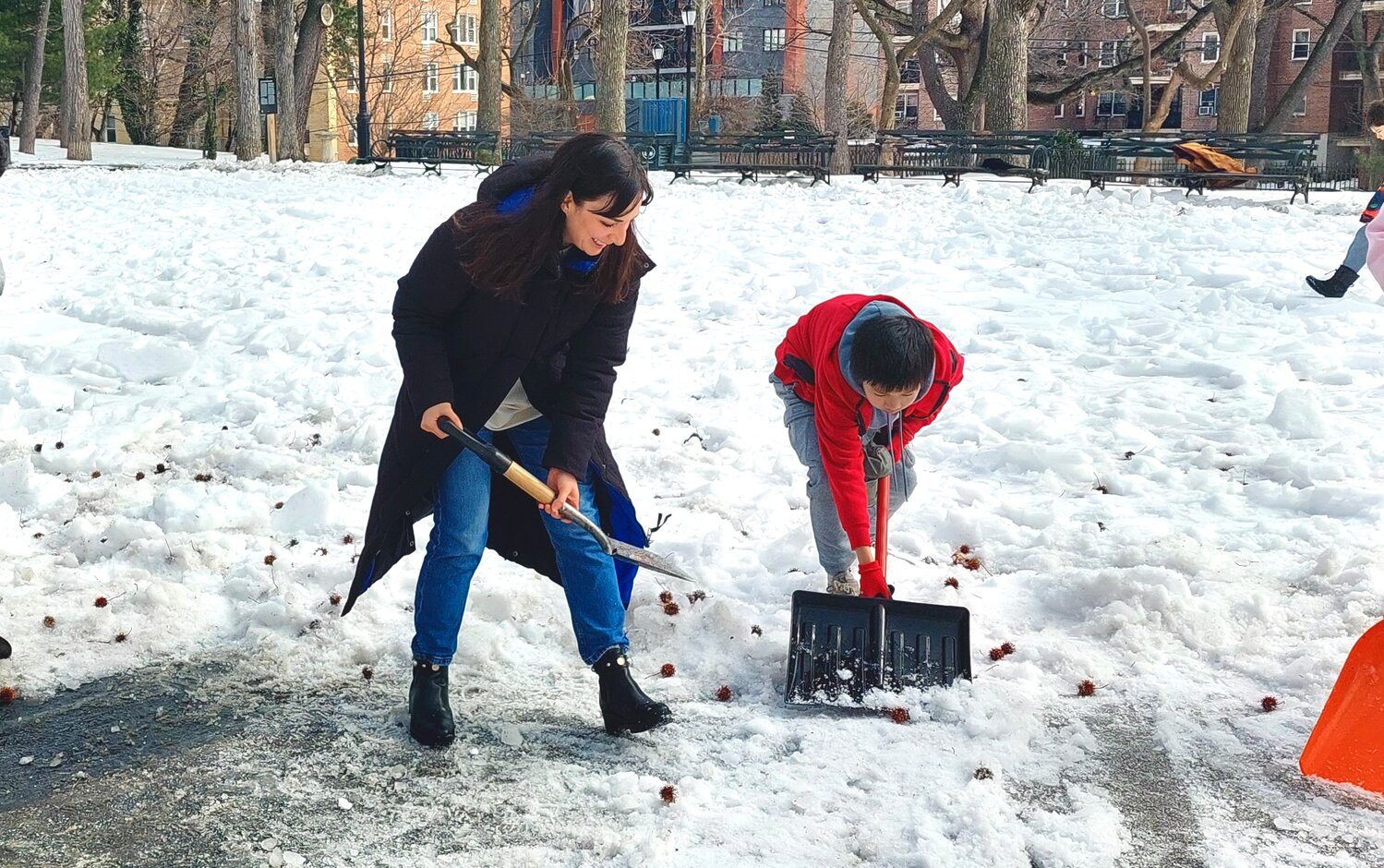
As New York City’s Department of Parks and Recreation battled two recent snowstorms, crews were spread thin, working long hours to clear snow and ice in and around green spaces.
For park staff and volunteers, navigating bare-bones resources has become routine, part of a decades-long cycle of scrambling to maintain and steward parkland within one of the city’s historically most understaffed and underfunded agencies.
On Sunday, Jan. 25, and Feb. 22, employees at Van Cortlandt Park slept overnight in trailers and on-site Parks Department buildings so they could report for Monday-morning shifts during active snowfall.
Crews in the northwest Bronx and across the five boroughs worked 12-hour shifts beginning at 6 a.m. for several days during and after the storms. But Christina Taylor, deputy director of the Van Cortlandt Park Alliance, said parks employees rarely get the credit she believes they’re due.
“They just work so hard and they’re so dedicated, but it’s underappreciated by the general public,” she said. “I don’t think they realize how much they’re doing with so little.”
In a statement, a parks spokesperson said workers prioritize heavily used areas first, not just those inside the green spaces the department maintains.
“They focus on park perimeters, commuter hubs, and other high-traffic areas before moving on to interior pathways,” the spokesman said. “Many locations we clear, due to size constraints or materials, need to be shoveled by hand.”
Perimeters include sidewalks, crosswalks, bike lanes and bus stops surrounding parkland. In the 1,146-acre Van Cortlandt Park, the third-largest in the city, staff must clean miles of sidewalks and interior parkland with a total workforce of roughly 30.
During the first storm, Taylor said, the park did not have a snowplow on site because it lent its only one to the city’s department of sanitation under an interagency agreement, though it was back in Van Cortlandt possession for the most recent blizzard.
Budget constraints remain a central concern heading into next year’s funding cycle. Mayor Zohran Mamdani campaigned on allocating 1 percent of the city’s budget to parks, yet his February preliminary budget proposes about $654 million for the of parks depatment out of a $127 billion budget — roughly 0.5 percent. It also includes a $33.7 million reduction, largely affecting maintenance and operations.
“I used to say that parks are like the ugly stepsister of city agencies, but I think I want to change it to parks are like Cinderella — parks are beautiful but they’re not respected among city agencies,” Taylor said. “Parks are considered essential, but the staff is not treated or paid like essential workers. It’s frustrating.”
According to the Citizens Budget Commission, a nonpartisan watchdog group, when it comes to park’s operational budget, its share of the total city budget dropped by more than a third since 1970, when it stood at about 0.9 percent. Despite repeated promises from successive mayors and city council speakers, the share has remained largely flat in recent years.
Debra Travis, chair of the Community Board 8 Parks and Recreation Committee, said the numbers translate directly to what residents see on the ground.
“When you look at half a percent of the city’s budget going to an agency responsible for thousands of parks and millions of users, it’s not surprising crews are stretched thin,” Travis said. “We keep expanding expectations — more programming, more maintenance, more safety responsibilities — without expanding the budget to match.”
Jodie Colón, founder of Stewards of Henry Hudson Park and Friends of Spuyten Duyvil, said volunteers have grown accustomed to stepping in when city resources fall short. After the January storm, 31 volunteers turned out for her city-approved Valentine’s Day cleanup to chip away several inches of ice around Henry Hudson Park’s plaza. They returned ahead of the February snowfall to prevent lingering ice from refreezing.
Colón described the pattern as cyclical, a year-round effort to which she’s dedicated decades, leading unpaid neighborhood environmental stewards to care for parts of the parks staff cannot cover.
“If it’s not snow in the winter, then it’s weeds in the spring, watering plants in the summer, removing leaves in the fall,” Colón said. “If there’s not enough park staff, we fill in where they can’t. Volunteers have been standing in the gap for decades, and it’s ultimately frustrating.”
Volunteer hours citywide dipped in fiscal year 2025, according to city data, falling to 38,845 from 39,186 the year before.
Yet parks was among the only agencies to expand volunteer-led programming through initiatives such as Partnerships for Parks, increasing engagement among New Yorkers. Friends of Jerome Park, led by Travis, logged 4,000 hours alone last year. Colón’s racked up even more.
As the fiscal year 2027 budget cycle approaches, the question is whether the city will close the gap between expectations and investment. Without sustained funding at the level promised by Mamdani and those who led the city before him, the pattern of overworked crews and aging equipment shows no sign of slowing down.
“New York City mayors, city council, commissioners, including our current mayor, say parks are essential,” Colón said. “But they’re not putting their money where their mouth is. People love living in this neighborhood, and if they have the time and the capacity, they will volunteer, but parks shouldn’t be so poorly funded that volunteers have to do what used to be the department’s responsibility.”
Keywords
NYC Parks Department funding,
Van Cortlandt Park snow cleanup,
NYC parks staffing shortage,
Bronx park maintenance workers,
NYC parks budget funding debate,
New York City park volunteers